

On this page
When you press a curved lens against a flat piece of glass, a beautiful target-like pattern of rings appears around the point of contact. This optical phenomenon has been studied for over three centuries. It played a pivotal role in one of physics' greatest debates: whether light is made of particles or waves.
Who first observed Newton's rings?
Despite the name, Isaac Newton was not the first person to describe these rings. The English scientist Robert Hooke first documented the phenomenon in his 1665 book *Micrographia* (Britannica). Hooke observed the colourful patterns in thin flakes of mica and between plates of glass, and correctly suggested that light must be a wave to create them.
A year later, during the Great Plague of 1666, Isaac Newton began his own study of the rings. He eventually published his findings in his 1704 book *Opticks*. Newton was a brilliant experimentalist, and he used a plano-convex lens resting on a flat glass plate to make exact measurements of the ring radii as the air gap widened. However, Newton was fiercely committed to a corpuscular (particle) theory of light. To explain the periodic rings without admitting light was a wave, he invented a convoluted theory of "fits of easy reflection and transmission" (Wikipedia).
How did Thomas Young explain Newton's rings?
The mystery was finally solved in 1801 by the English polymath Thomas Young. Using Newton's own meticulous data, Young calculated the exact wavelengths of different colours of light and explained the rings through interference (Wikipedia).
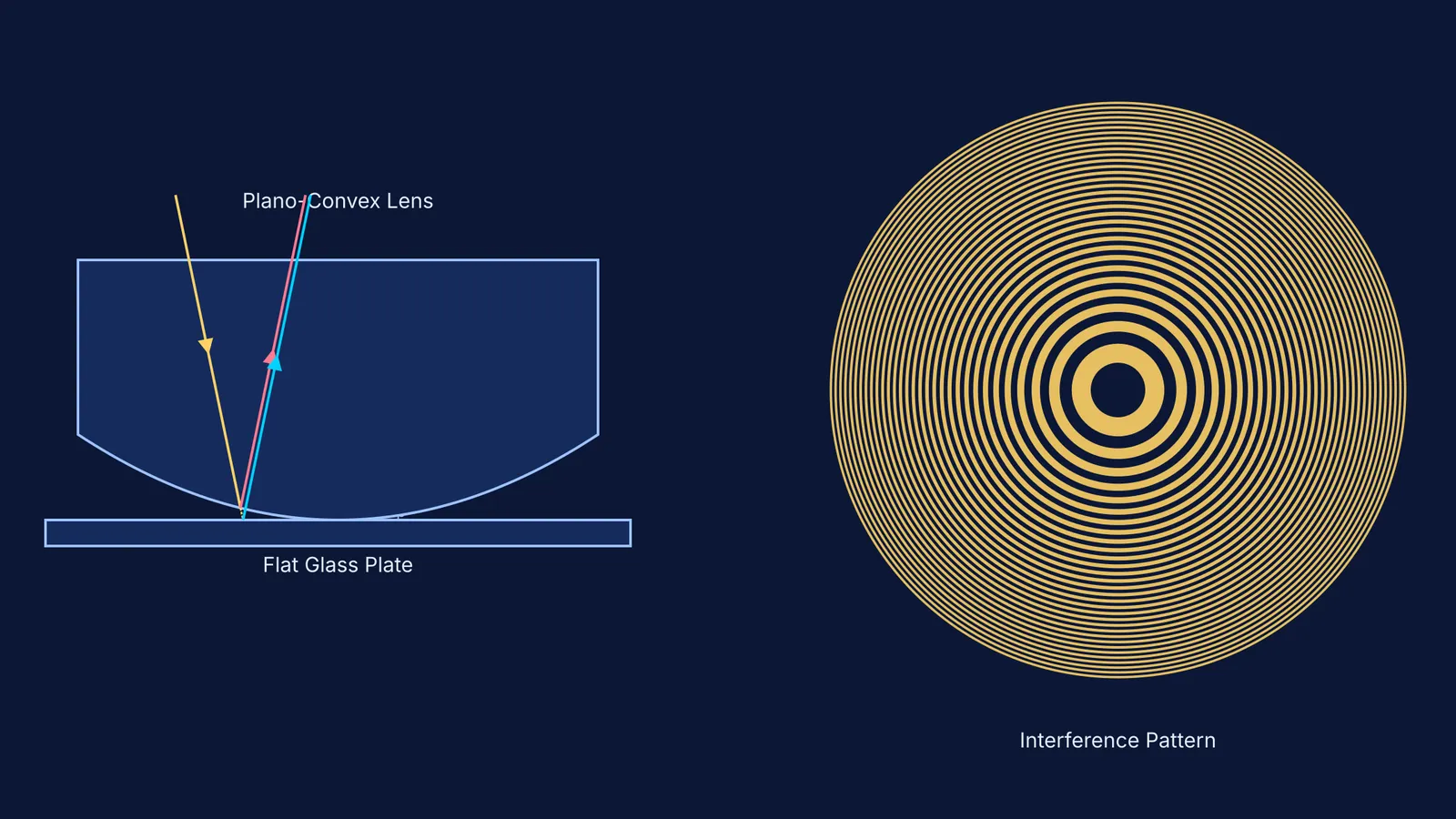
Young realised that light travels through the top lens, enters the air gap, and reflects off both the top of the air gap (the bottom of the lens) and the bottom of the air gap (the flat glass plate). When these two reflected waves meet, they overlap. If a wave crest meets a wave crest, they undergo constructive interference and create a bright ring. If a crest meets a trough, they cancel each other out, creating a dark ring. This breakthrough is closely tied to Thomas Young and the experiment that showed light is a wave.
Young also solved the puzzle of the central dark spot. At the exact point where the lens touches the glass, the path difference is zero, so one might expect a bright spot. However, Young deduced that when a light wave reflects off a denser medium (the bottom glass plate), it undergoes a 180° phase shift (Wikipedia). This flips the wave upside down, turning what should be constructive interference into destructive interference. If you find this shift confusing, our guide on Phase difference vs path difference: converting with 2π/λ breaks the maths down further.
What is the explanation of the Newton's rings experiment?
Today, the Newton's rings experiment is a classic laboratory exercise. It is typically performed using a monochromatic light source, such as a sodium lamp, to produce a clear pattern of yellow and black rings.
The air gap between the curved lens and the flat plate acts as a thin wedge that grows thicker as you move outward. For a dark ring to form, the total path difference must be an integer multiple of the wavelength (mλ). Because the geometry of the spherical lens dictates the thickness of the air film, the radius r of the m-th dark ring is given by the formula r = √(mλR), where λ is the wavelength and R is the radius of curvature of the lens (Science Facts).
For a bright ring, the extra half-wavelength from the phase shift means the path difference must equal an odd multiple of half-wavelengths. This causes the spacing between the rings to shrink as you move further from the centre, resulting in rings that get tighter and tighter until they blur together. This is a common theme in interference, much like the fringe spacing explored in Young's double-slit experiment: fringe width problems and traps.
Optical interference problems can be difficult to picture from equations alone. If you are struggling to visualise how light waves overlap, the Fermi Simulation Lab allows you to change the lens curvature and wavelength to watch the rings expand and contract in real time. When you are ready to tackle the numerical problems, the Fermi Problem Library will walk you step-by-step through calculating ring radii, helping you build a solid strategy for your next physics exam.


