

On this page
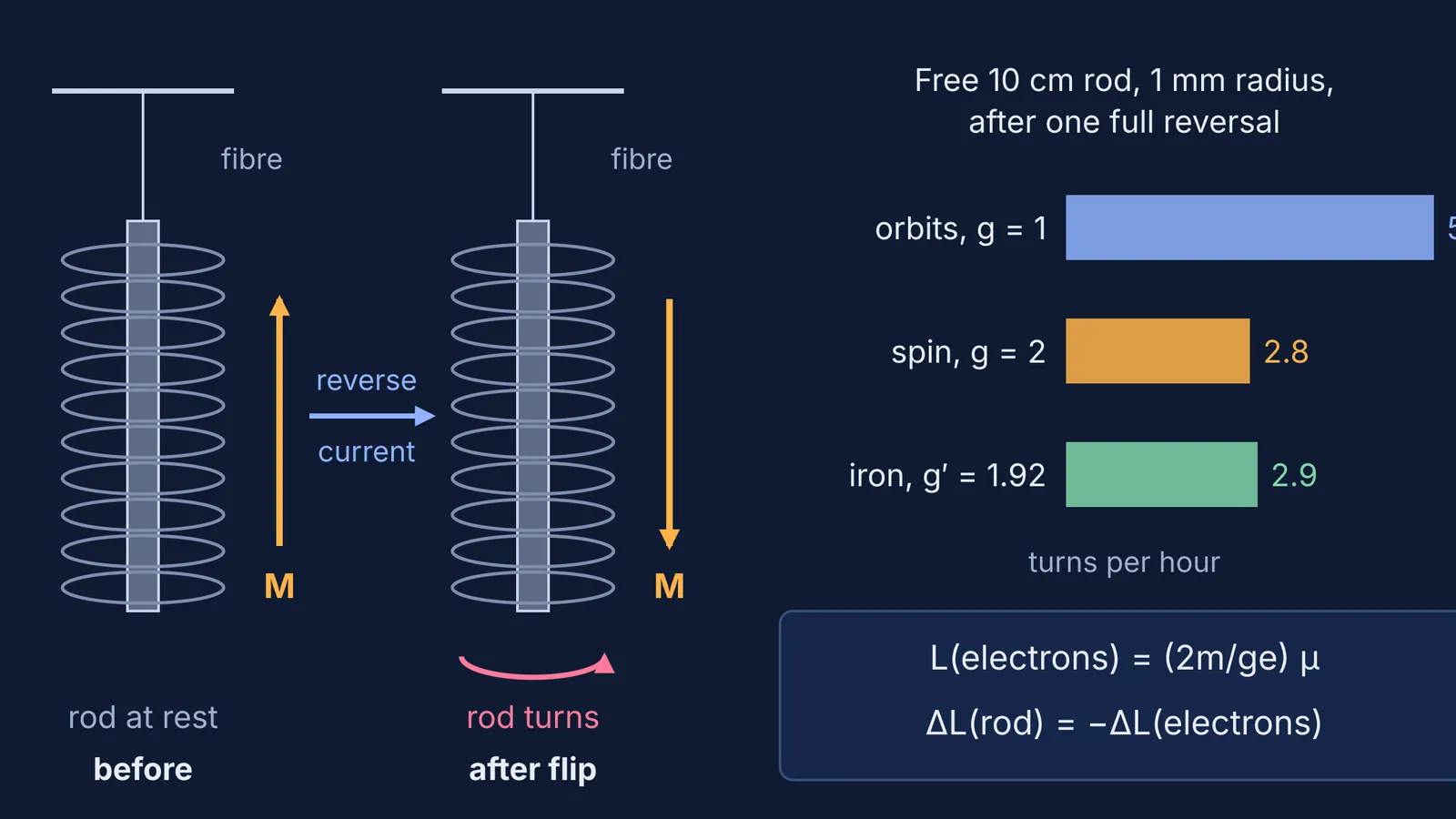
Hang a thin iron rod on a fine fibre inside a coil, then reverse the current so the rod's magnetisation flips end for end. The rod twists. Nothing outside has pushed it round, because the coil's field runs along the rod's axis. Albert Einstein and Wander de Haas measured this twist in 1915, and it is now called the Einstein–de Haas effect. It shows that a magnet's magnetism comes from electrons that carry angular momentum, and it is a clean test of conservation of angular momentum.
Why does a magnetic moment come with angular momentum?
A charge moving round a loop is a current, and a current loop has a magnetic moment. For an electron in an orbit, the moment and the orbital angular momentum are tied by μ = (e/2m)L. That result is derived in the magnetic moment of an orbiting electron, so it is not repeated here. For the electron's spin the moment per unit angular momentum is about twice as large, μ ≈ 2(e/2m)S, a factor explained in how Uhlenbeck and Goudsmit proposed electron spin.
One factor g covers both cases:
L(electrons) = (2m/ge)μ, with g = 1 for orbits and g ≈ 2 for spin.
The electron's charge is negative, so its angular momentum points opposite to its moment.
A magnetised rod has a total moment μ = MV, where M is the magnetisation and V the volume. So its electrons hold a total angular momentum (2m/ge)MV along the axis. You never see it, because it stays fixed while the magnetisation stays fixed.
Why does the rod turn when its magnetisation flips?
Take the rod and its electrons as one system and look at angular momentum about the rod's axis.
The coil's field is parallel to the axis. The torque on a magnetic moment is μ × B, which is zero when μ lies along B, so the field gives no turning effect about the axis.
With no outside torque about the axis, the total angular momentum about it stays fixed.
Reversing M reverses the electrons' angular momentum. The electrons' change is ΔL = 2 × (2m/ge)μ.
The crystal lattice must take an equal and opposite change, so the rod as a whole starts to rotate.
The rod gets its spin only while the magnetisation is changing. After the flip a free rod would keep turning at that rate but a rod that is simply magnetised and left alone never starts turning. The reverse effect also exists: spin an iron rod fast and it becomes slightly magnetised. That is the Barnett effect.
How fast does a 10 cm iron rod turn? A worked example
Take an iron rod of radius 1.00 mm and length 10.0 cm, magnetised to saturation along its length, then fully reversed. Use density 7,874 kg/m³ and saturation magnetisation about 1.71 × 10⁶ A/m. That figure comes from a NASA measurement of 217.5 emu/g at 299 K for polycrystalline iron (Behrendt and Hegland, 1972), multiplied by the density.
Volume. V = πr²L = π × (1.00 × 10⁻³)² × 0.100 = 3.14 × 10⁻⁷ m³.
Mass. m(rod) = ρV = 7,874 × 3.14 × 10⁻⁷ = 2.47 × 10⁻³ kg, about 2.5 g.
Moment of inertia about the axis. I = ½m(rod)r² = 0.5 × 2.47 × 10⁻³ × (1.00 × 10⁻³)² = 1.24 × 10⁻⁹ kg m².
Magnetic moment. μ = MV = 1.71 × 10⁶ × 3.14 × 10⁻⁷ = 0.537 A m².
Electron angular momentum for spin (g = 2). L = (m/e)μ = (9.109 × 10⁻³¹ / 1.602 × 10⁻¹⁹) × 0.537 = 3.05 × 10⁻¹² kg m²/s. Units: (kg/C) × (C/s) × m² = kg m²/s.
Change on reversal. ΔL = 2L = 6.11 × 10⁻¹² kg m²/s, handed to the lattice.
Angular velocity. ω = ΔL/I = 6.11 × 10⁻¹² / 1.24 × 10⁻⁹ = 4.94 × 10⁻³ rad/s.
Turns per hour. 4.94 × 10⁻³ × 3,600 / 2π = 2.8 turns per hour, or about 0.28° every second.
If iron's magnetism came from orbits (g = 1), the rate would double to 9.88 × 10⁻³ rad/s, or 5.7 turns per hour. With the measured value for iron, g′ ≈ 1.92 (next section), it is 5.15 × 10⁻³ rad/s, about 2.9 turns per hour.
Put the steps together and the length cancels: ω = 8mM/(geρr²). Only the radius matters, and a thinner rod turns faster, because I falls as r⁴ while μ falls only as r².
Why was the twist so hard to measure?
A rod hanging on a fibre is a torsional pendulum, so one reversal does not make it spin for an hour. It gives the rod a single angular kick, and the rod swings with amplitude θ = ω/ω₀, where ω₀ is the pendulum's natural angular frequency. As an illustrative round value, take a fibre that gives a 10 s period: ω₀ = 0.628 rad/s, so θ = 4.94 × 10⁻³ / 0.628 = 7.9 × 10⁻³ rad, about 0.45°.
Einstein and de Haas got round this by reversing the current over and over at the rod's own torsional frequency. Each reversal adds a kick in step with the swing, so the amplitude builds up, just as a swing goes higher when you push it at the right moment. They read the swing from a light beam reflected off a mirror on the rod. Most later experiments used the same resonance method, as the historian V. Ya. Frenkel describes in his history of the effect in Soviet Physics Uspekhi (1979).
What did Einstein and de Haas find, and were they right?
They expected Ampère's molecular currents, electrons going round in orbits, and so g = 1. Their 1915 result agreed with that. Later measurements by Stewart, Beck, Barnett and others found a ratio of angular momentum to moment only half as big. That means g is close to 2, which Frenkel's account records (Frenkel, 1979). The mismatch was called the gyromagnetic anomaly. It made sense only after electron spin was proposed in 1925: in iron, the magnetism comes mainly from spin, not orbits.
Careful later work pinned the value down. G. G. Scott's magnetomechanical measurements gave g′ = 1.919 ± 0.002 for iron (Scott, J. Phys. Soc. Japan, 1962). It is a little below 2 because a small orbital share of the moment survives in the crystal.
If conservation of angular momentum in a system with hidden parts still feels slippery, the Concept Library covers angular momentum and magnetic moments concept by concept. For the quantum side of an electron's angular momentum, see orbital angular momentum and the √(l(l+1)) formula.
Quick checklist
Each electron's magnetic moment comes with angular momentum: L = (2m/ge)μ.
g = 1 for orbits, g ≈ 2 for spin; iron measures about 1.92.
Flip M and the electrons' angular momentum reverses; the lattice turns the other way.
A 1 mm radius iron rod gets about 4.9 × 10⁻³ rad/s from one full reversal, about 2.8 turns an hour for g = 2.
ω = 8mM/(geρr²): length cancels, a thinner rod turns faster.
The rod is kicked only while M changes; a steady magnet does not start rotating.
The 1915 result matched g = 1 and was later shown to be wrong; spin explains g ≈ 2.


