

On this page
In atomic physics, understanding how electrons move around the nucleus requires moving past the simple solar system model. The modern quantum mechanical model replaces fixed circular orbits with probability clouds, known as orbitals. To describe these orbitals accurately, we use quantum numbers. The azimuthal quantum number, denoted by l, determines the three-dimensional shape of the orbital and its angular momentum.
What is the orbital angular momentum formula?
The magnitude of the orbital angular momentum (L) of an electron is calculated using the formula:
L = √(l(l+1)) h/2π
Here, h is Planck's constant (6.626 × 10⁻³⁴ J·s), and the term h/2π is often simplified as ℏ (pronounced "h-bar"). The value l is an integer ranging from 0 up to n - 1, where n is the principal quantum number. According to HyperPhysics, this mathematical form of √(l(l+1)) is a fundamental characteristic of quantum mechanics, governing not just orbital motion but also intrinsic spin.
How do you calculate momentum for s, p, and d electrons?
Each type of subshell corresponds to a specific value of l. You can use the formula to find the exact angular momentum magnitude for any electron. Here is the framework for calculating the values:
s electrons (l = 0):
L = √(0(0+1)) ℏ = 0 An electron in an s orbital has exactly zero orbital angular momentum.
p electrons (l = 1):
L = √(1(1+1)) ℏ = √2 ℏ ≈ 1.41 ℏ
d electrons (l = 2):
L = √(2(2+1)) ℏ = √6 ℏ ≈ 2.45 ℏ
If you sometimes forget which l value matches which letter, a quick review of how many subshells and orbitals are in each shell can keep the sequence clear.
How is this different from Bohr's angular momentum?
In 1913, Niels Bohr proposed that electrons move in rigid circular paths. As detailed by HyperPhysics, he theorised that angular momentum was quantised according to the principal quantum number (n):
L = n(h/2π) = nℏ
This model successfully predicted the energy levels of the hydrogen atom because it matched the standing wave condition for an electron's de Broglie wavelength. However, Bohr's model had a major flaw regarding the ground state.
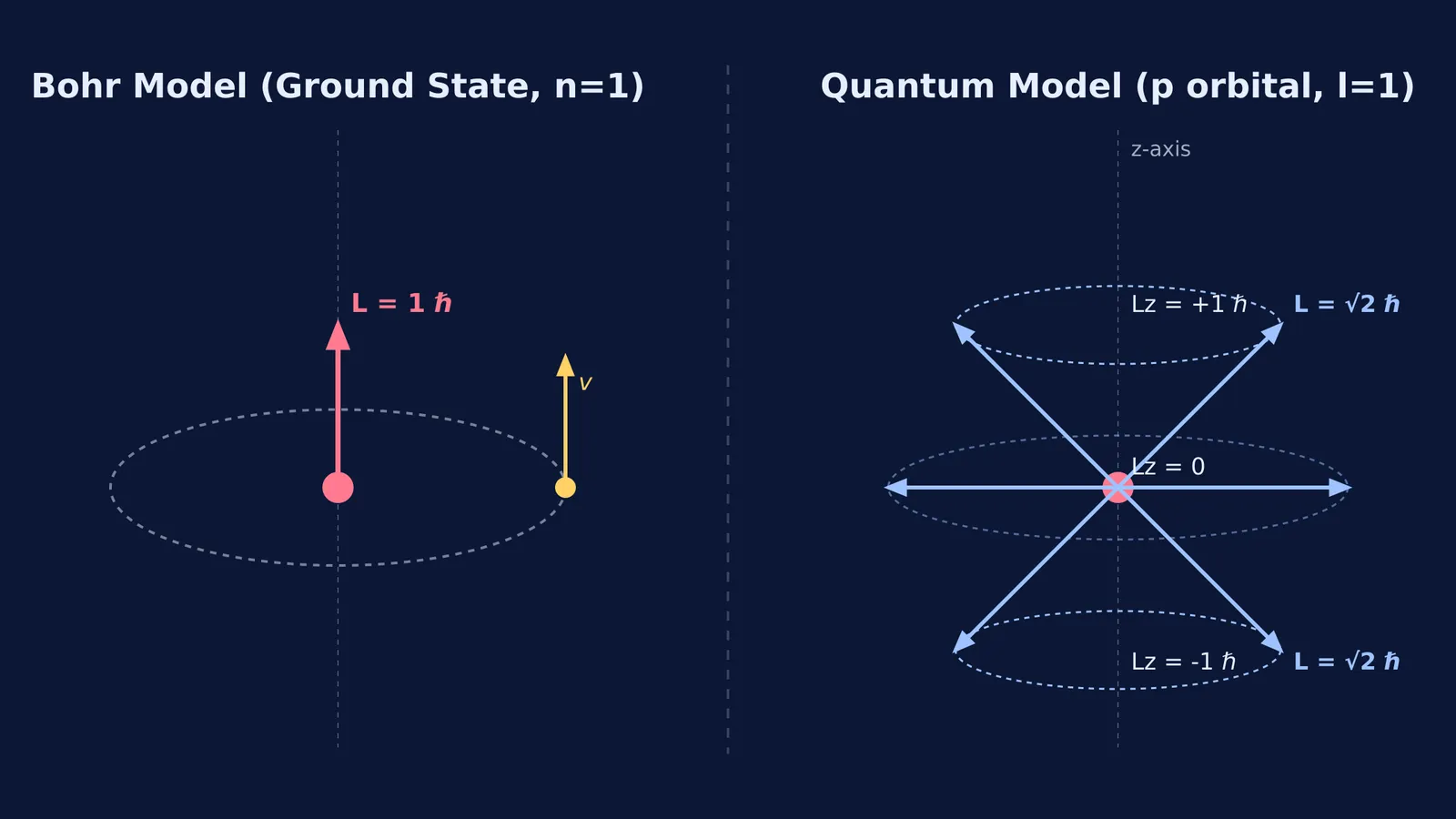
For the ground state of hydrogen (n = 1), Bohr's formula gives an angular momentum of exactly 1ℏ. We now know this is incorrect. The ground state of hydrogen is a 1s orbital. Using the modern quantum formula, the 1s electron has l = 0, meaning its orbital angular momentum is actually zero.
This shift from circular orbits to spherical probability clouds is a core idea in physical chemistry. For more context on how energy behaves in these states, exploring why 2s and 2p have the same energy in hydrogen can help clear up common exam confusion.
What happens to the direction of angular momentum?
The formula L = √(l(l+1)) ℏ only tells you the total magnitude, or the "length" of the angular momentum vector. But in quantum mechanics, the direction of this momentum is also restricted. This phenomenon is known as space quantization.
The component of the angular momentum along a specific axis (usually called the z-axis) is defined by another quantum number: the magnetic quantum number, m_l. The value of the z-component is given by the simpler equation:
Lz = m_l ℏ
Because m_l can take integer values from -l to +l, the angular momentum vector can only point at certain specific angles relative to the z-axis. For example, for a p electron where l = 1, the total magnitude is √2 ℏ. However, the projection along the z-axis can only be +1ℏ, 0, or -1ℏ. This creates a distinct set of cones when mapped out in three-dimensional space, visually proving that the electron cannot simply spin at any arbitrary angle.
How does this help your physics revision?
Transitioning from classical orbits to quantum mechanics is one of the steepest learning curves in Class 11 and 12 physics. If you are struggling to picture why l dictates the orbital shape while n dictates the energy, the Fermi Concept Library lays out every quantum number with its own lesson. When you need to calculate these values in a tricky exam question, the Fermi Problem Library provides a step-by-step solver that explains the reasoning behind the formula rather than just printing an answer.
By remembering that L = √(l(l+1)) ℏ, you avoid the trap of treating electrons as tiny planets, ensuring you apply the correct quantum rules to your chemistry and physics problems.


