

On this page
A life jacket labelled 100 N cannot hold up a whole person, and it does not need to. In water, your body is held up almost entirely by the water it pushes aside. What is left for the jacket is a few kilograms: mainly your head, which has to stay above the surface so you can breathe. Here is that job worked out with Archimedes' principle and Boyle's law.
What does a 100 N rating on a life jacket mean?
The number is a force, not a mass. It is the net upward push the jacket gives when it is fully under water: the weight of water its foam or gas displaces, minus the jacket's own weight.
The international standard for personal flotation devices, ISO 12402, has four performance levels: 50, 100, 150 and 275. Each level number is a buoyancy in newtons. The scope of ISO 12402-5, for example, covers buoyancy aids "with a buoyancy of not less than 50 N". The UK sailing body RYA describes each level's use: level 50 close to shore for confident swimmers, level 100 for sheltered water with quick rescue, level 150 for coastal and offshore use, and level 275 for extreme offshore conditions or heavy clothing. A level 50 aid "will not turn an unconscious person face up"; level 150 is designed to.
To turn a force into the mass it can support, divide by g:
50 N ÷ 9.81 m/s² = 5.1 kgf
100 N ÷ 9.81 m/s² = 10.2 kgf
150 N ÷ 9.81 m/s² = 15.3 kgf
275 N ÷ 9.81 m/s² = 28.0 kgf
A 75 kg adult is far heavier than 10 kg. The next section shows why 100 N is still enough.
How much does a person weigh in water?
Very little. The human body is only slightly denser than water, and its exact density depends on fat, muscle, bone and how much air is in the lungs. How density is measured, and how it gives body fat, is covered in weighing a person under water to find body fat, so here we just use a number.
Take, as a round illustrative value, a 75 kg person with an average density of 1,010 kg/m³ in fresh water (1,000 kg/m³).
Volume of the body: V = m/ρ = 75 ÷ 1,010 = 0.0743 m³, or 74.3 L.
Buoyancy: the weight of 74.3 L of water, which is 74.3 kgf.
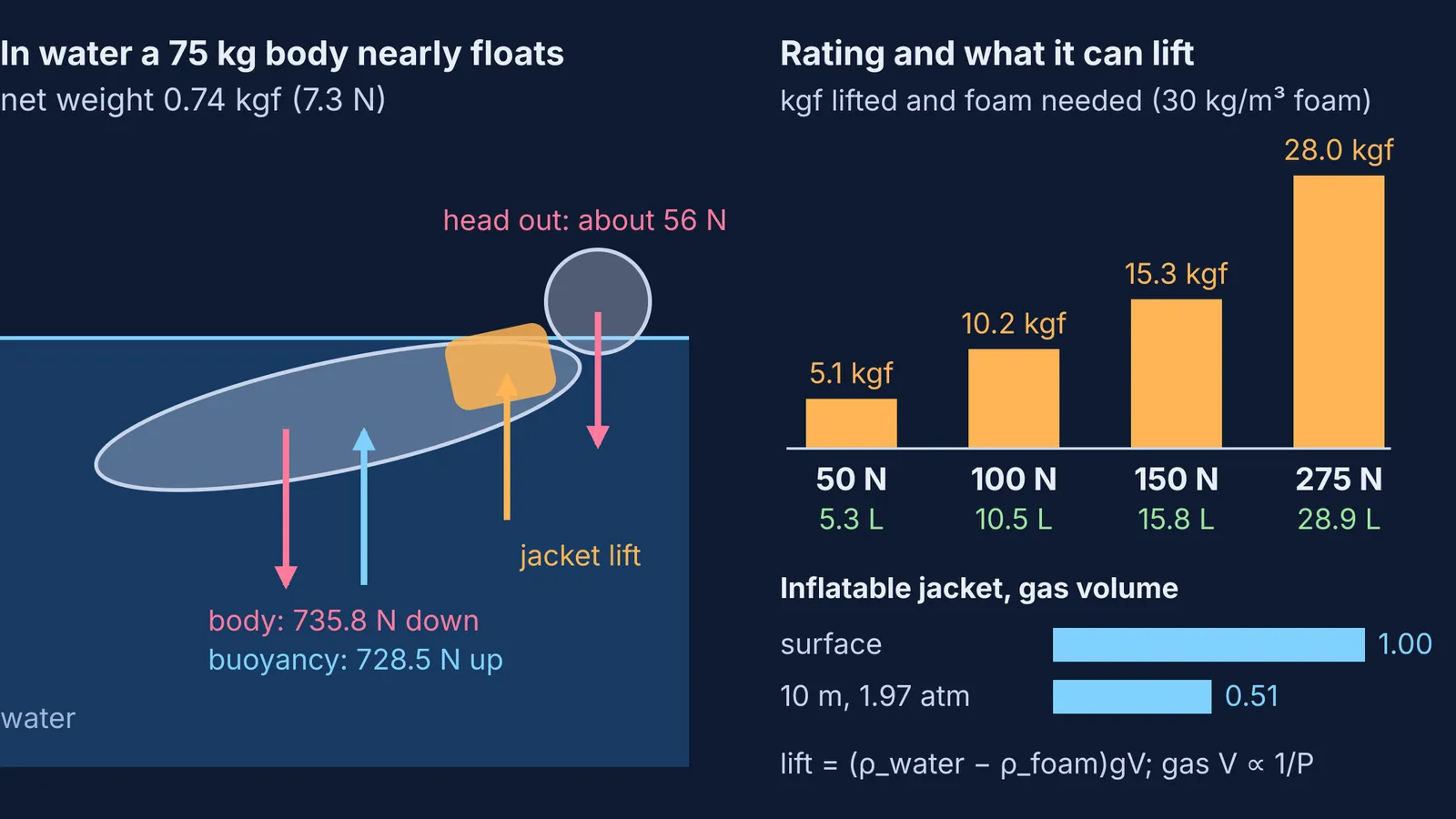
Net weight in water: 75 − 74.3 = 0.74 kgf, about 7.3 N.
Fully under water, this person needs less than 1 kgf of help. One extra litre of air in the lungs adds 1 kgf of lift (9.8 N), enough to turn "sinks slowly" into "floats".
If the body almost floats, what is the jacket for?
Breathing. A body that just floats shows only a few centimetres above the surface, and that part may not be the mouth. Any part held out of the water stops displacing water and loses its buoyancy, but keeps all of its weight.
This is the key idea: what a life jacket really lifts is the weight of whatever must stay above the surface, not the weight of the person.
How much lift does it take to hold your head out?
Worked example
Use the same 75 kg person, density 1,010 kg/m³. Take the head as 5 kg, again a round illustrative value, with the same density as the body.
Volume of the head: 5 ÷ 1,010 = 0.00495 m³, or 4.95 L.
Volume still under water when the whole head is out: 74.3 − 4.95 = 69.3 L.
Buoyancy of the part under water: 69.3 kgf.
Lift the jacket must give: 75 − 69.3 = 5.7 kgf.
In newtons: 5.7 × 9.81 = 56 N.
Lifting the entire head clear takes about 56 N. You only need the mouth and nose clear, so the real need is smaller. The US Coast Guard puts it at 7 to 12 pounds, or 31 to 53 N, for most adults.
This explains the spacing of the levels. A 50 N aid is near the minimum, so the wearer must help by swimming. A 150 N jacket has about three times the need, and the extra lift helps roll an unconscious person face up and raise the face above waves.
How much foam does each rating need?
Foam works because it is much less dense than water. Its net lift is the buoyancy of its volume minus its own weight:
lift = (ρ_water − ρ_foam) g V
Take closed-cell foam of density 30 kg/m³ (illustrative; real foams differ) in fresh water. Then V = lift ÷ [(1,000 − 30) × 9.81]:
50 N needs 5.3 L of foam
100 N needs 10.5 L
150 N needs 15.8 L
275 N would need 28.9 L if it were all foam
About 29 L of foam would be very bulky, which is why high-rated jackets are usually inflatable. In sea water (1,025 kg/m³) the same lift needs about 2.5% less foam. How deep a floating body settles is worked out in the fraction of a floating body under water.
Why does an inflatable jacket lose lift at depth?
Foam keeps its volume and lift at depth. An inflatable jacket holds gas, which obeys Boyle's law: PV is constant at constant temperature.
At 10 m in fresh water the pressure is P = P₀ + ρgh = 101,325 + 1,000 × 9.81 × 10 = 199,425 Pa, about 1.97 atm. The gas shrinks to P₀/P = 0.51 of its surface volume, so a 150 N bladder gives only about 76 N while it is held at that depth. In sea water the factor is 0.50. The same squeeze acts on the gas in a fish, which is why the swim bladder has to adjust with depth.
For more Archimedes and Boyle's law questions with full working, the Fermi Problem Library has a step-by-step solver that explains the reasoning at each stage.
What should you actually do near water?
Take safety rules from the authorities that write them. The US Coast Guard stresses choosing an approved jacket you will actually wear, checking the label for user weight and chest size, and trying it on in the water to make sure your airway is clear. The World Health Organization's drowning fact sheet lists teaching school-age children basic swimming, water safety and safe rescue skills, and enforcing safe boating and ferry rules, among the ways to prevent drowning. So wear an approved life jacket and learn to swim.
Quick checklist
A jacket's rating is a force in newtons; divide by 9.81 to get kgf (100 N is about 10.2 kgf).
A person in water weighs well under 1 kgf; the body's own buoyancy does most of the work.
The jacket's job is to replace the buoyancy lost by the head held above the surface, roughly 30 to 55 N.
Foam lift = (ρ_water − ρ_foam)gV; it hardly changes with depth.
Gas lift falls as 1/P: at 10 m it is about half.
Sea water gives slightly more lift per litre than fresh water.


