On this page
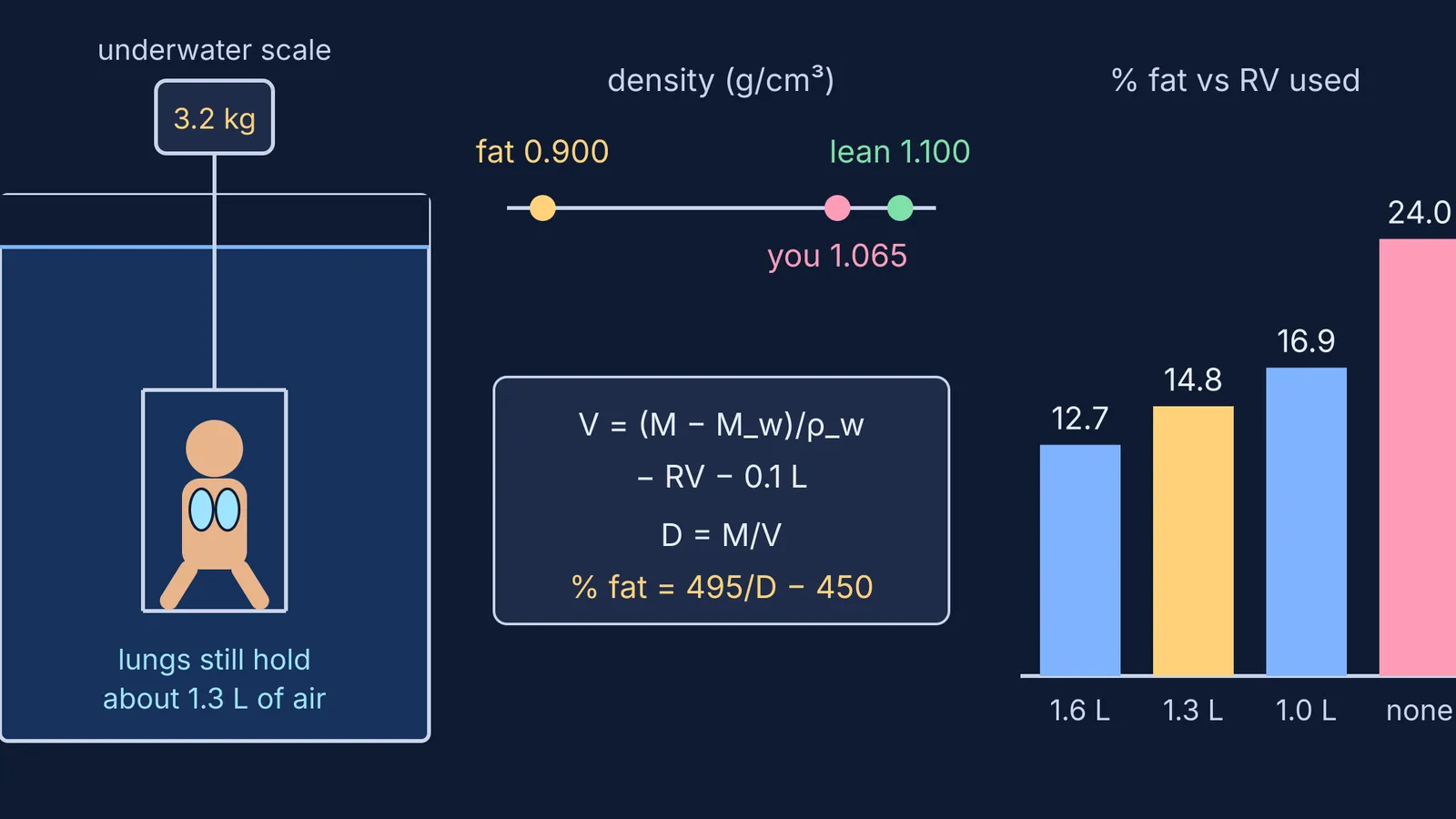
Sit on a chair hanging from a scale, breathe out as hard as you can and sink under the water. A 70 kg person might read only 3.2 kg. That small number, plus Archimedes' principle and two densities, gives one of the older lab estimates of body fat. The physics is simple. The hard part is something most textbook problems ignore: the air you cannot breathe out.
How does weighing someone underwater measure their volume?
Underwater, the scale reads your weight minus the buoyant force. The buoyant force equals the weight of water you push aside. Why an object weighs less in water is covered in loss of weight in water and Archimedes' principle, so here we use the result directly.
If M is your mass in air and M_w is the scale reading under water, the mass of water displaced is M − M_w. Divide by the density of the water, ρ_w, and you get the volume displaced:
V_displaced = (M − M_w)/ρ_w
That is not yet the volume of your body tissue. Some of what displaced the water was air: air still in your lungs, and a little gas in your gut. Air has almost no mass, so it adds volume without adding weight. You have to take it away:
V_body = (M − M_w)/ρ_w − RV − V_gut
Here RV is the residual volume, the air left in the lungs after a full breath out. Labs often allow a fixed 0.1 L for gut gas. Then body density is simply D = M/V_body.
This is the same idea as a hydrometer reading density from how deep it floats (why a hydrometer's scale is upside down), but turned around: the body sinks, and the scale measures how much it fails to weigh.
Why does body density tell you the fat fraction?
The method splits the body into two parts. Fat is less dense than water. Everything else (muscle, bone, water and organs, called fat-free mass) is denser. In William Siri's two-component model, fat is taken as 0.900 g/cm³ and fat-free mass as 1.100 g/cm³ at body temperature, as described in a review of body composition reference methods by Heymsfield and colleagues in Obesity Reviews.
Volumes add, so for a fat fraction f (by mass):
1/D = f/0.900 + (1 − f)/1.100
Solve for f and you get f = 4.95/D − 4.50, or as a percentage:
% fat = 495/D − 450
This is the Siri equation. The same review lists it in mass form as M_F = 4.950 V_B − 4.500 M_B, and gives a later version with fat at 0.9007 g/cm³ that changes the constants to 4.971 and 4.519. Check the two limits: D = 0.900 gives 100% fat and D = 1.100 gives 0%. Anything in between is a weighted mix.
How do you calculate body fat from an underwater weight? (worked example)
Illustrative numbers: M = 70.0 kg, underwater reading M_w = 3.2 kg, water at 32 °C (density about 0.99505 kg/L), residual volume 1.3 L, gut gas 0.1 L.
Mass of water displaced. 70.0 − 3.2 = 66.8 kg.
Volume displaced. 66.8/0.99505 = 67.13 L.
Remove the air. 67.13 − 1.3 − 0.1 = 65.73 L. This is the tissue volume.
Body density. D = 70.0/65.73 = 1.0649 kg/L, the same as 1.0649 g/cm³.
Siri equation. 495/1.0649 − 450 = 14.8%.
Fat mass. 0.148 × 70.0 = 10.4 kg, leaving about 59.6 kg of fat-free mass.
Check the units: kg divided by kg/L gives L, and kg divided by L gives kg/L, which equals g/cm³. Check the sense: 1.065 lies between 0.900 and 1.100, closer to the lean end, so a small fat fraction is right.
Now change one thing at a time:
Water density taken as exactly 1 instead of 0.99505: 12.5%. Water at body-comfortable temperatures is less dense than 1 kg/L, and ignoring that moves the answer by about 2 points.
Underwater reading 3.3 kg instead of 3.2 kg: 14.1%. A 0.1 kg change moves the answer about 0.7 points.
Residual volume 1.0 L: 16.9%. Residual volume 1.6 L: 12.7%.
Residual volume left out entirely: 24.0%.
Why is residual lung volume the weak link?
Look at the sensitivity. 0.1 kg on the scale and 0.1 L of lung air each move the answer by about 0.7 points, because 0.1 L of water weighs about 0.1 kg. The difference is how well each is known. A scale reading can be repeated and averaged, but residual volume varies from person to person and is often estimated rather than measured.
A 2021 study by Cicone, Nickerson and Esco in Clinical Physiology and Functional Imaging measured residual volume under water in 175 adults and fitted RV = −3.419 + 0.026 × height (cm) + 0.019 × age (years), in litres, with a standard error of 0.26 L. For an 18-year-old who is 170 cm tall that gives 1.34 L, close to the 1.3 L used above. But an error of 0.26 L alone shifts the fat estimate by about 1.8 points. The same study found older prediction equations, made from lung measurements on land, agreed less well with the underwater values.
So the scale is not the problem. The lungs are.
Is underwater weighing still used, and how accurate is it?
For decades, Siri's model with underwater weighing was treated as a reference method, according to the Heymsfield review. Today most labs use dual-energy X-ray absorptiometry (DXA) or air-displacement chambers, which are easier for the person being tested. Air displacement uses the same idea, finding volume and then density, but with air pressure instead of water.
Every result from these methods is an estimate, not a direct measurement of fat. The two-part model assumes fixed densities for fat and fat-free mass. Real fat-free mass varies in its water, bone and protein content with age, sex, ethnicity and training, so the true constants differ between groups. That is why other equations exist, and why a single number such as 14.8% should be read with an uncertainty of a few points. The electrical method in how a body-fat scale estimates fat from resistance makes even more assumptions, which is why it is checked against density methods.
If you want to try more buoyancy and density problems with the reasoning shown at each step, the Fermi Problem Library has a step-by-step solver that explains the reasoning.
Quick checklist
Underwater reading = weight − buoyant force, so displaced volume = (M − M_w)/ρ_w.
Use the real water density at the tank temperature, not 1 kg/L.
Subtract residual lung volume and gut gas before finding density.
Two-part model: 1/D = f/0.900 + (1 − f)/1.100 gives % fat = 495/D − 450.
Check D lies between 0.900 and 1.100 g/cm³.
0.1 kg on the scale or 0.1 L of lung air each shift the answer about 0.7 points.
The result is an estimate from an assumed model, not a direct measurement.