

On this page
Step on a body-fat scale barefoot and it shows your weight and, a second later, a fat percentage. The weight comes from a strain gauge. The fat number comes from something quite different: a tiny alternating current sent up one leg and down the other. The scale measures how hard your body resists that current and then estimates fat from a formula. Working through the physics shows why the number moves when you drink a glass of water, even though your fat has not changed.
This is a physics explainer, not health advice. A body-fat reading is an estimate, not a measurement of fat, and any decision about your health should be made with a doctor.
How does a body-fat scale measure anything about fat?
A normal digital scale only measures force, using a load cell, as explained in how a digital weighing scale measures weight. A body-fat scale adds metal pads under your feet. Two pads pass a small alternating current into your body, and the other two measure the voltage across it. The ratio gives an impedance.
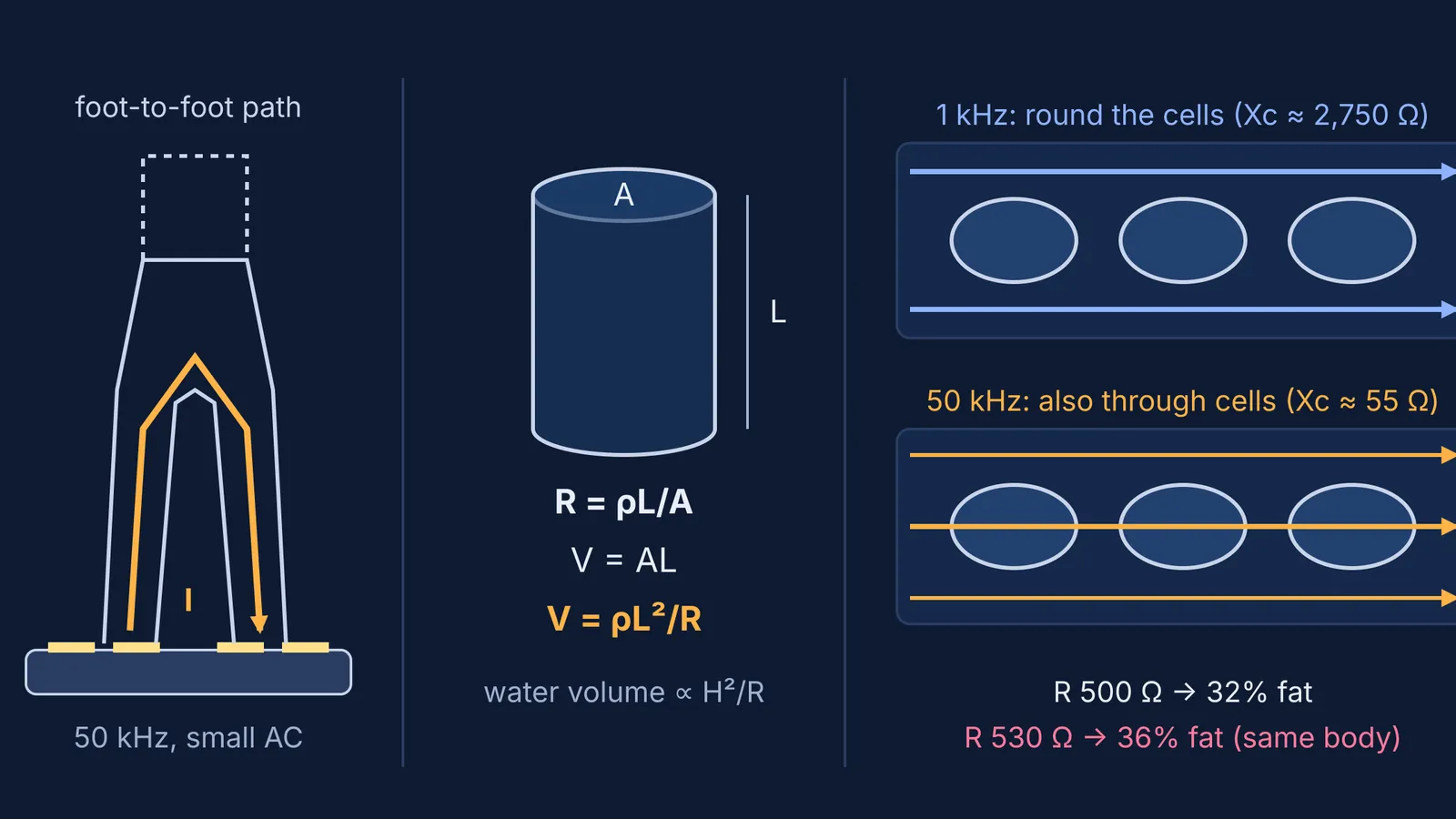
The key fact is that body water conducts and fat barely does. The water in and around your cells carries dissolved salts, so ions move freely. Fat tissue holds little water. So the current mostly travels through water-rich lean tissue: muscle, blood and organs. A foot-to-foot scale sends current up one leg and down the other, so the reading mostly reflects the legs and lower body.
The scale does not see fat. It measures resistance and reactance, then infers fat from an equation fitted to a reference group of people.
Why does the formula use height squared divided by resistance?
Treat the conducting part of the body as a uniform cylinder of salty water with resistivity ρ, length L and cross-section area A. From current electricity:
R = ρL/A
Volume V = AL, so A = V/L
Substitute: R = ρL²/V, which gives V = ρL²/R
So the volume of conducting water is proportional to L²/R. Since L is hard to measure for a real body, height H is used instead, and body-composition equations use the index H²/R. The review by Khalil, Mohktar and Ibrahim (Sensors, 2014) gives this same relation, V = ρL²/R, as the basis of most prediction methods.
A body is not a cylinder, so real equations add terms for weight, age and sex, with constants found by comparing against reference methods. That is why two brands can give different fat readings for the same person.
Why does the scale use 50 kHz alternating current?
Cell membranes are thin insulating layers between two conducting fluids, which makes each membrane a capacitor. The same idea is worked for nerve cells in the nerve membrane as a capacitor.
A capacitor's reactance is Xc = 1/(2πfC). It is large at low frequency and small at high frequency, as in impedance and phase angle of an RC series AC circuit. Khalil and colleagues describe the result directly: at low frequencies the current passes through the fluid outside the cells only, because of the membranes' capacitance, while at high frequencies it passes through all the body water, inside and outside the cells. Single-frequency analysis at 50 kHz is the common standard they describe.
An illustrative number shows the size of the effect. Suppose the cell route behaves like a capacitor of 58 nF:
At 50 kHz: Xc = 1/(2π × 50,000 × 58 × 10⁻⁹) ≈ 55 Ω, small enough that current also crosses the cells.
At 1 kHz: Xc is 50 times larger, about 2,750 Ω, so the current goes round the cells instead.
The capacitance also shifts the current slightly out of step with the voltage. The angle between them, the phase angle, is tan⁻¹(Xc/R). Ward and Brantlov (2023) note that phase angle is usually taken at 50 kHz and that membranes act as imperfect capacitors.
Worked example: one person, two fat readings
All the numbers here are illustrative, including the equation, which is simplified to show the method. Real devices use their own fitted equations.
A person 170 cm tall weighing 70 kg reads R = 500 Ω and Xc = 55 Ω at 50 kHz.
Phase angle: tan⁻¹(55/500) = 6.3°.
Index: H²/R = 170² ÷ 500 = 28,900 ÷ 500 = 57.8 cm²/Ω.
Total body water, using an illustrative equation TBW = 0.6 × H²/R litres: 0.6 × 57.8 = 34.7 L.
Lean mass. Khalil and colleagues give body water as about 73% of lean mass in normally hydrated people. Taking 1 L of body water as about 1 kg: lean mass = 34.7 ÷ 0.73 = 47.5 kg.
Fat mass = 70 − 47.5 = 22.5 kg, which is 22.5 ÷ 70 = 32% of body weight.
Now the same person steps on after a morning without drinking, and R reads 530 Ω, 6% higher (an illustrative change):
H²/R = 28,900 ÷ 530 = 54.5 cm²/Ω.
TBW = 0.6 × 54.5 = 32.7 L.
Lean mass = 32.7 ÷ 0.73 = 44.8 kg.
Fat = 70 − 44.8 = 25.2 kg, or 36%.
No fat changed, but the reading jumped 4 percentage points because the water changed. In the other direction, Khalil and colleagues report that food and drink can lower impedance by 4–15 Ω for 2–4 hours after a meal. A 15 Ω drop, to 485 Ω, would move this person's estimate from 32% to 30%.
How accurate is a body-fat scale reading?
The physics explains the main limits:
Hydration. The method assumes lean tissue has a fixed water fraction. Khalil and colleagues state that single-frequency analysis is not valid when hydration is significantly altered.
Path. A foot-to-foot current samples mainly the legs, so the rest of the body is estimated.
Equation. The constants come from a reference group. A person unlike that group gets a less reliable estimate.
For a consistent trend, the same conditions each time (same time of day, same scale) reduce the scatter, but the number stays an estimate.
If you want to practise the R = ρL/A and RC reactance steps used here, the Fermi Problem Library has a step-by-step solver that explains the reasoning.
Quick checklist
Body water conducts; fat barely does.
R = ρL/A and V = AL give V = ρL²/R, so water volume ∝ H²/R.
Cell membranes are capacitors: Xc = 1/(2πfC) is large at low f, small at 50 kHz.
Low frequency: current around cells. High frequency: through cells too.
Phase angle = tan⁻¹(Xc/R).
Fat = weight − lean mass, and lean mass is inferred from water, so a change in water changes the fat reading.
The reading is an estimate from a fitted equation, not a direct measurement.


