

On this page
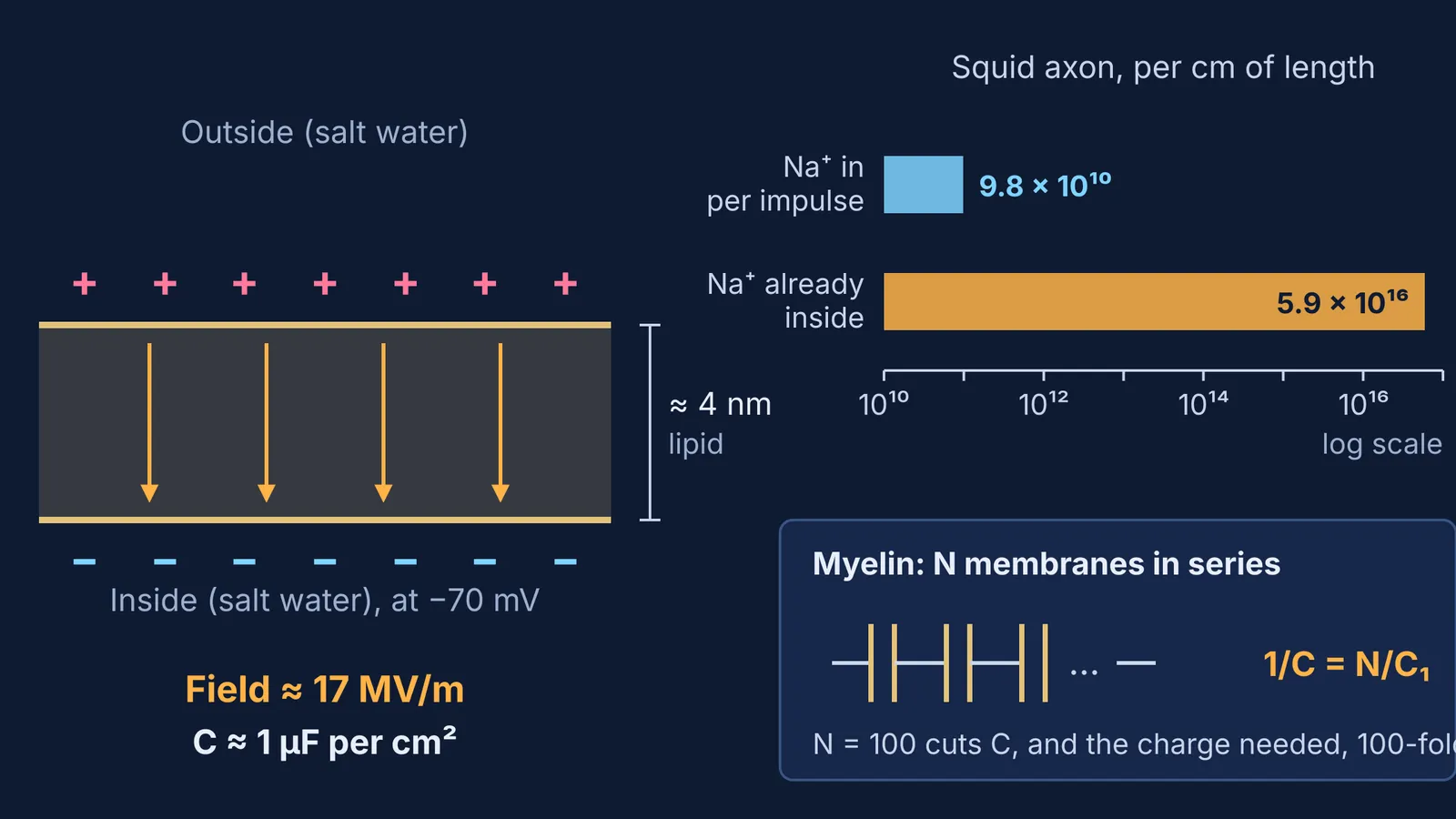
Every nerve cell is wrapped in a membrane only a few nanometres thick, with salt water on both sides. Salt water conducts and the oily middle of the membrane does not. That is a conductor, an insulator and another conductor: a parallel-plate capacitor. Treating it that way explains three things with Class 12 electrostatics: why the membrane holds about 1 µF on every square centimetre, why the field across it is far stronger than the field that makes air spark, and why one nerve impulse moves almost none of the ions inside the cell.
This is a physics explainer. It uses round textbook values and makes no medical claims.
Why is a cell membrane a capacitor?
A capacitor is two conducting regions separated by an insulator. In a membrane:
The plates are the thin layers of ions in the water just outside and just inside the membrane.
The dielectric is the hydrocarbon core of the lipid bilayer, which ions cannot easily cross.
The charge is a small excess of positive ions on the outside face and an equal excess of negative charge on the inside face.
At rest, the inside of a nerve cell is negative compared with the outside. Neuroscience Online, an open textbook from UTHealth Houston, notes that the resting potential ranges from about −40 mV to −80 mV depending on the type of nerve cell. This post uses −70 mV, a value inside that range. Where that voltage comes from, the Nernst potential and the ion currents, is covered in how Hodgkin and Huxley explained the nerve impulse. Here we only need the voltage.
How much capacitance does a membrane have per square centimetre?
For a parallel-plate capacitor with a dielectric, C = Kε₀A/d, so the capacitance per unit area is C/A = Kε₀/d. The same formula is worked for slabs in capacitance with a dielectric slab.
Both K and d are approximate for a membrane. A 2012 Biophysical Journal paper by Heimburg gives a thickness of 3.92 nm for a fluid lipid bilayer and takes the dielectric constant as about 2 to 4. Use round values K = 4 and d = 4 nm.
Write the formula: C/A = Kε₀/d.
Substitute: C/A = 4 × 8.854 × 10⁻¹² / (4 × 10⁻⁹) = 8.85 × 10⁻³ F/m².
Convert: 1 m² = 10⁴ cm², so C/A = 8.85 × 10⁻⁷ F/cm² = 0.89 µF/cm².
Compare with measurement: Gentet, Stuart and Clements (Biophysical Journal, 2000) measured 0.9 µF/cm² directly on three kinds of neurons. The usual round figure is 1 µF/cm².
The agreement is a check, not a proof. K and d are not known precisely, so treat the measured 1 µF/cm² as the real number and the 4 nm, K = 4 model as the reason it is so large. A capacitance this big comes from a gap this small.
How strong is the electric field across a nerve membrane?
Inside a parallel-plate capacitor the field is uniform and E = V/d.
Substitute: E = 0.070 V / (4 × 10⁻⁹ m) = 1.75 × 10⁷ V/m.
In MV/m: about 17 MV/m.
Compare with air: dry air breaks down at about 3 MV/m, the figure used in the maximum charge a sphere can hold in air. The membrane field is about 6 times larger.
Air breaks down by an avalanche: free electrons speed up between collisions and knock more electrons out of gas molecules. The membrane's oily core is a condensed insulator only a few molecules wide, with no gas for that avalanche to grow in. The large field is simply what a small voltage across a very small distance gives.
How many ions does one nerve impulse move?
In an impulse (an action potential), the inside of the membrane swings from its resting value to slightly positive and back. Take a round swing of ΔV = 100 mV. The charge that must cross to make that swing is ΔQ = CΔV.
Charge per cm²: ΔQ = 1 × 10⁻⁶ F/cm² × 0.100 V = 1.0 × 10⁻⁷ C/cm².
Ions per cm²: each Na⁺ carries e = 1.602 × 10⁻¹⁹ C, so ΔQ/e = 6.2 × 10¹¹ ions/cm².
Squid giant axon, 1 cm long: take a diameter of 0.5 mm. Surface area = πdL = π × 0.05 cm × 1 cm = 0.157 cm². Ions in = 6.24 × 10¹¹ × 0.157 = 9.8 × 10¹⁰.
Na⁺ already inside: volume = π(0.025 cm)² × 1 cm = 1.96 × 10⁻³ cm³ = 1.96 × 10⁻⁶ L. Moore and Adelman (Journal of General Physiology, 1961) measured about 38 mM of Na⁺ in fresh squid axons, rising to 50 mM after an hour. Using 50 mM: 0.050 × 1.96 × 10⁻⁶ × 6.022 × 10²³ = 5.9 × 10¹⁶ ions.
Fraction: 9.8 × 10¹⁰ / 5.9 × 10¹⁶ = 1.7 × 10⁻⁶, about 2 parts per million. With 38 mM it is about 2.2 parts per million.
This is the minimum charge for the voltage swing. In a real impulse some K⁺ flows out while Na⁺ flows in, so somewhat more Na⁺ enters. It is still a tiny fraction of what is there.
Now a thin axon, 1 µm across, with an illustrative round value of 10 mM Na⁺ inside. The area per cm falls in proportion to the diameter, but the volume falls with the square of the diameter. Ions in = 1.96 × 10⁸ and ions inside = 4.7 × 10¹⁰, a fraction of about 0.4%. Still small, but 2,500 times larger than in the squid axon. The general result is fraction ∝ (surface area)/(volume) ∝ 1/diameter.
If you want to practise problems that mix capacitors, fields and charge like this, the Fermi Problem Library has a step-by-step solver that explains the reasoning.
Why does myelin lower the capacitance?
Myelin is many layers of membrane wrapped round an axon. Each layer is a capacitor, and they are connected one after another across the sheath, so they are in series. For N equal capacitors in series, 1/C = N/C₁, so C = C₁/N.
The number of layers varies a lot. A 2022 review in Frontiers in Neuroscience notes that the number of myelin lamellae is normally below 50 and in some cases more than 100. As a round illustration, take N = 100. Then C falls from 1 µF/cm² to about 0.01 µF/cm², and the charge needed to change the voltage of a wrapped stretch by 100 mV falls by the same factor of 100. Less charge to move means the voltage change can spread further along the axon before it fades. That is the physics behind faster conduction in myelinated fibres.
Quick checklist
Membrane = parallel-plate capacitor: ion layers are the plates, the lipid core is the dielectric.
C/A = Kε₀/d. K ≈ 4 and d ≈ 4 nm give 0.89 µF/cm². Measured: about 0.9 to 1 µF/cm².
E = V/d = 0.070/(4 × 10⁻⁹) ≈ 17 MV/m, about 6 times the breakdown field of air.
ΔQ = CΔV = 10⁻⁷ C/cm² for 100 mV, which is 6.2 × 10¹¹ ions/cm².
In a 0.5 mm squid axon, one impulse moves about 2 parts per million of the Na⁺ inside.
The fraction moved grows as 1/diameter in thinner axons.
N capacitors in series: C = C₁/N, which is how myelin cuts the charge needed.


