

On this page
When you place an insulator between the plates of a capacitor, you change how well it stores charge. For a parallel plate capacitor, introducing a dielectric slab of thickness t increases its overall capacitance.
The exact effect depends on two things: how thick the slab is compared to the air gap, and the material's dielectric constant, K.
What happens inside the capacitor?
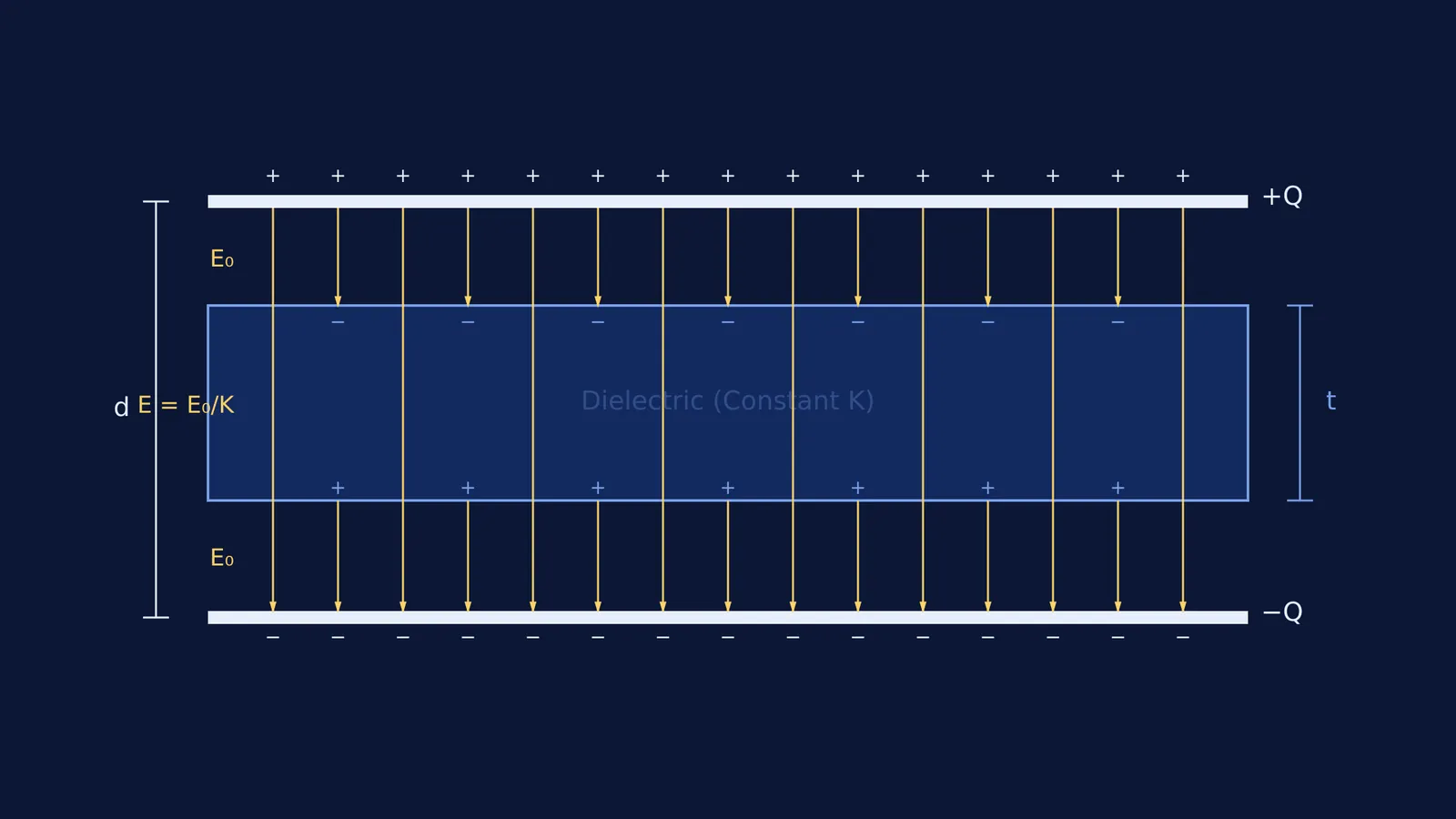
A dielectric is a non-conducting material, meaning it has no free charge carriers. When you place a dielectric slab inside the external electric field (E₀) of a charged capacitor, its molecules align themselves with the field. This alignment, called polarization, creates an induced internal electric field that points in the opposite direction.
Because the internal field opposes the external one, the net electric field inside the slab drops to E = E₀ / K, where K is the dielectric constant (or relative permittivity) of the material [[1]](https://phys.libretexts.org/Bookshelves/University_Physics/University_Physics_(OpenStax)/University_Physics_II_-_Thermodynamics_Electricity_and_Magnetism_(OpenStax)/08%3A_Capacitance/8.05%3A_Capacitor_with_a_Dielectric). A weaker electric field means the potential difference (V) between the plates also decreases. Since capacitance is charge divided by potential difference (C = Q/V), a smaller V for the same charge Q results in a larger capacitance.
If you find it hard to picture how polarization changes the electric field, Fermi's AI tutor can work out what you already know and teach through it, drawing the figure and checking your understanding as it goes.
What is the capacitance formula for a slab of thickness t?
Consider a parallel plate capacitor with plate area A and a separation distance d. The capacitance in a vacuum is C₀ = ε₀A / d, where ε₀ is the permittivity of free space [[1]](https://phys.libretexts.org/Bookshelves/University_Physics/University_Physics_(OpenStax)/University_Physics_II_-_Thermodynamics_Electricity_and_Magnetism_(OpenStax)/08%3A_Capacitance/8.05%3A_Capacitor_with_a_Dielectric).
If you insert a dielectric slab of thickness t (where t < d), the gap is now split into two regions: an air gap of total thickness d − t, and a dielectric region of thickness t.
To find the new capacitance, we calculate the total potential difference (V) across the plates. This is the sum of the potential drop across the air gaps and the potential drop across the dielectric slab.
In the air gaps, the electric field remains E₀, and the total distance is d − t. The potential drop is E₀(d − t). Inside the slab, the field is E₀/K, and the distance is t. The potential drop there is E₀(t/K).
Adding them together gives:
V = E₀(d − t + t/K)
Since the initial field E₀ is equal to Q / (ε₀A), we can substitute this into the equation. Rearranging it for C = Q/V yields the final formula:
C = ε₀A / (d − t + t/K)
This formula tells us that the effective distance between the plates has shrunk from d to d − t + t/K. Because K is always greater than 1, the denominator is smaller than d, meaning the new capacitance C is strictly greater than C₀.
If you are working through electrostatics problems and keep confusing the d − t terms, the Fermi Problem Library has worked problems with a step-by-step solver that explains the reasoning rather than printing an answer.
What happens in the metal slab limit?
What happens if you replace the insulating dielectric with a conducting metal slab of the same thickness t?
For a perfect conductor, the dielectric constant K approaches infinity (K → ∞). The free electrons in the metal move until they completely cancel out the external electric field, making the net field inside the metal exactly zero.
When we put K = ∞ into the formula, the term t/K becomes zero. The capacitance formula then simplifies to:
C = ε₀A / (d − t)
A conducting slab effectively acts as a short circuit across its thickness. It reduces the physical separation between the capacitor plates from d to exactly d − t. Consequently, a metal slab increases the capacitance even more than a dielectric slab of the same thickness.
How do you solve dielectric slab numericals?
Exam questions often test your understanding of how capacitance changes with different materials. Use this checklist when setting up your equations:
Identify the fraction filled: Check if the problem states t = d/2, t = d/3, or if the slab fills the gap completely. Substitute this into d − t immediately.
Check for metal: If the question specifies a copper, aluminium, or "conducting" slab, cross out the t/K term. Use K = ∞.
Compare with C₀: If a question asks for the ratio of the new capacitance to the old one, divide your result by ε₀A / d. The ε₀A terms will cancel out, leaving a pure ratio.
Multiple slabs: If there are several slabs with thicknesses t₁, t₂ and constants K₁, K₂, the denominator extends cleanly: d − (t₁ + t₂) + t₁/K₁ + t₂/K₂.
Understanding these limits will help you navigate both standard parallel plate setups and variations like the capacitance of spherical and cylindrical capacitors. You can also explore what happens to the charge and stored energy if you insert the slab while a battery is connected or disconnected. If you need to review the wider map of electrostatics, the Concept Library contains every concept in physics, chemistry, biology, mathematics and computing, each with its own lesson.


