

On this page
How does the swim bladder regulate buoyancy in fish?
When a fish swims, gravity pulls its mass downward while hydrostatic pressure exerts an upward buoyant force equal to the weight of displaced water, following Archimedes' principles of buoyancy and displaced volume. Because muscle (density ~1.05 g/cm³) and bone (~2.0 g/cm³) are denser than water, fish naturally sink. Bony fish (class Osteichthyes) achieve neutral buoyancy with the swim bladder, an internal gas-filled organ in the dorsal body cavity. In *Biological Reviews*, zoologist R. McNeill Alexander (1966) showed that marine teleosts require a swim bladder occupying roughly 5% of body volume to float at depth, whereas freshwater teleosts require approximately 7% because fresh water (~1.000 g/cm³) is less dense than seawater (~1.026 g/cm³).
Why is swim bladder buoyancy physically unstable at depth?
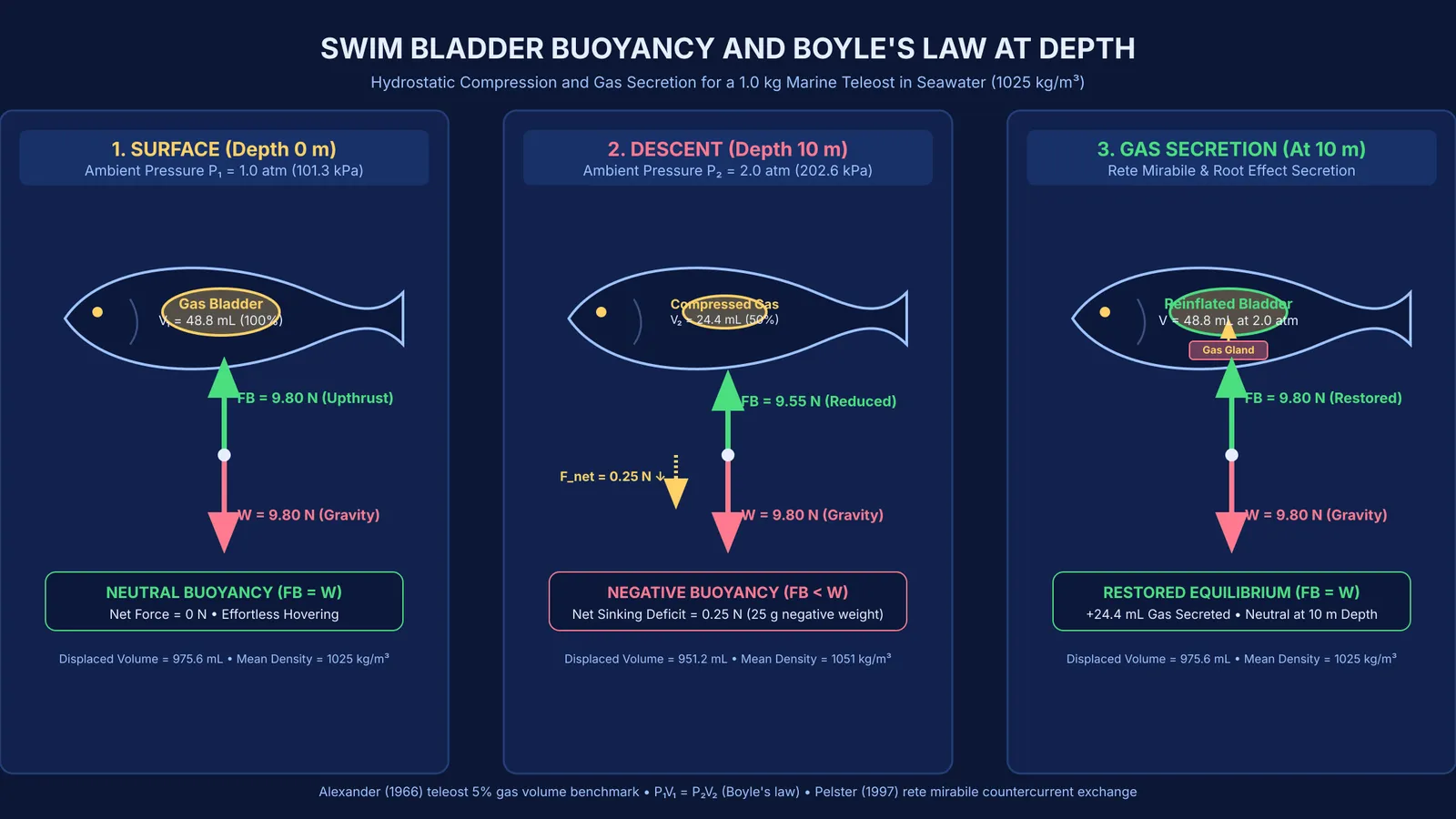
While an internal gas pocket enables effortless hovering, it creates an inherent physical instability. As demonstrated by R. McNeill Alexander (1966) and explained in calculating hydrostatic pressure at depth, water pressure increases by approximately 1 atm (101.3 kPa) for every 10 metres of descent. By Boyle's law, gas volume varies inversely with pressure. If a neutrally buoyant fish descends 10 metres, surrounding pressure doubles from 1 atm to 2 atm, compressing the swim bladder to half its initial volume.
This compression reduces displaced volume and diminishes the buoyant force, making the fish denser than water so it sinks faster. Conversely, ascending reduces ambient pressure, expanding the gas and accelerating the fish toward the surface in a runaway feedback loop.
How do fish fill the swim bladder against high water pressure?
To counter depth changes, bony fish adjust gas content through two anatomical adaptations:
Physostomous fish (such as salmon and herrings) retain a pneumatic duct connecting the swim bladder to the oesophagus, gulping air at the surface or burping it to vent.
Physoclistous fish (including perches and cods) lack a gut connection, regulating gas entirely through the bloodstream.
Pumping gas into a bladder at depth requires remarkable physiology. As R. W. Root (1931) discovered, teleost hemoglobin exhibits the Root effect: lower blood pH reduces hemoglobin's oxygen-carrying capacity, releasing oxygen into plasma against steep partial pressures. Gas gland cells secrete lactic acid and carbon dioxide, acidifying the blood. A microcapillary network called the rete mirabile then acts as a countercurrent multiplier. As reviewed by Bernd Pelster (1997)60230-7), this countercurrent loop traps and concentrates oxygen, generating hyperbaric gas tensions that diffuse into the bladder. During ascent, a muscular sphincter opens to the vascularized oval window, reabsorbing gas into the blood.
Connecting hydrostatic mechanics to comparative physiology can feel daunting when preparing across distinct syllabi. The Fermi Concept Library covers every concept in physics, chemistry, biology, mathematics and computing, each with its own lesson and its place in the map, showing how pressure connects to respiration and buoyancy.
Why do sharks and cartilaginous fish lack a swim bladder?
Cartilaginous fish (class Chondrichthyes), including sharks and rays, lack a swim bladder entirely. Under NEET animal kingdom classification rules, NCERT biology notes that the absence of an air bladder forces cartilaginous fish to swim constantly to avoid sinking. Instead of compressible gas, sharks rely on lipid-rich livers and dynamic lift.
A shark's liver accounts for 20% to 30% of its body weight. As E. D. S. Corner, E. J. Denton, and G. R. Forster (1969) showed in the *Proceedings of the Royal Society of London*, deep-sea sharks store large quantities of squalene, a hydrocarbon with a specific gravity of approximately 0.86. Squalene yields 80% more lift per unit weight than cod-liver oil and does not compress with depth. Furthermore, a cartilaginous skeleton (density ~1.1 g/cm³) is nearly half as dense as bone (~2.0 g/cm³), and wing-like pectoral fins generate upward dynamic lift as the heterocercal tail produces forward thrust.
How can you solve buoyancy and depth problems step by step?
Applying the 5% teleost bladder benchmark established by R. McNeill Alexander (1966), consider a 1.00 kg marine fish at the surface (0 m, 1.0 atm) in seawater (density 1025 kg/m³):
Initial volume: Displacing 1.00 kg of water requires 975.6 mL. With a 5% bladder, gas volume V₁ = 48.8 mL and tissue volume is 926.8 mL.
Descent to 10 m: Pressure doubles to 2.0 atm. By Boyle's law (P₁V₁ = P₂V₂), the bladder compresses to V₂ = 24.4 mL, reducing total volume to 951.2 mL.
Buoyancy deficit: Buoyant force drops to FB = 1025 kg/m³ × 9.512 × 10⁻⁴ m³ × 9.8 m/s² = 9.555 N. Weight is W = 1.00 kg × 9.8 m/s² = 9.800 N, creating a net sinking force of 0.245 N (equivalent to an apparent weight of 25.0 g).
Restoring balance: To restore neutral buoyancy (FB = W), the gas gland must secrete 24.4 mL of gas at 2.0 atm (48.8 mL at standard temperature and pressure).
When solving equilibrium problems that combine Archimedes' principle with the ideal gas law, tracking free-body diagrams across changing hydrostatic pressures is essential. The Fermi Problem Library has worked problems with a step-by-step solver that explains the reasoning rather than printing an answer, helping you track each upward buoyant force against downward weight.


