

On this page
A wooden block, an ice cube and an iceberg all obey one rule. Derive it once and a family of board and JEE problems becomes one problem in different costumes.
What fraction of a floating body is under water?
A floating body is in equilibrium, so the upward buoyant force equals its weight. Archimedes' principle says the buoyant force on an object equals the weight of the fluid it displaces (OpenStax University Physics, Volume 1, section 14.4).
Call the body's volume V and the submerged volume V_sub. Then:
Weight of the body = ρ_body × V × g
Buoyant force = ρ_liquid × V_sub × g
Set them equal and cancel g: V_sub / V = ρ_body / ρ_liquid
So the fraction under the liquid is the body's average density divided by the liquid's; OpenStax writes it as "fraction submerged = ρobj/ρfl". Notice what is missing: g, the shape and the size. A big plank and a small chip of the same wood float at the same fraction.
The word "average" matters. A steel hull plus the air inside it has an average density below water's, which explains how a heavy steel ship floats on water.
Why is about 90% of an iceberg under water?
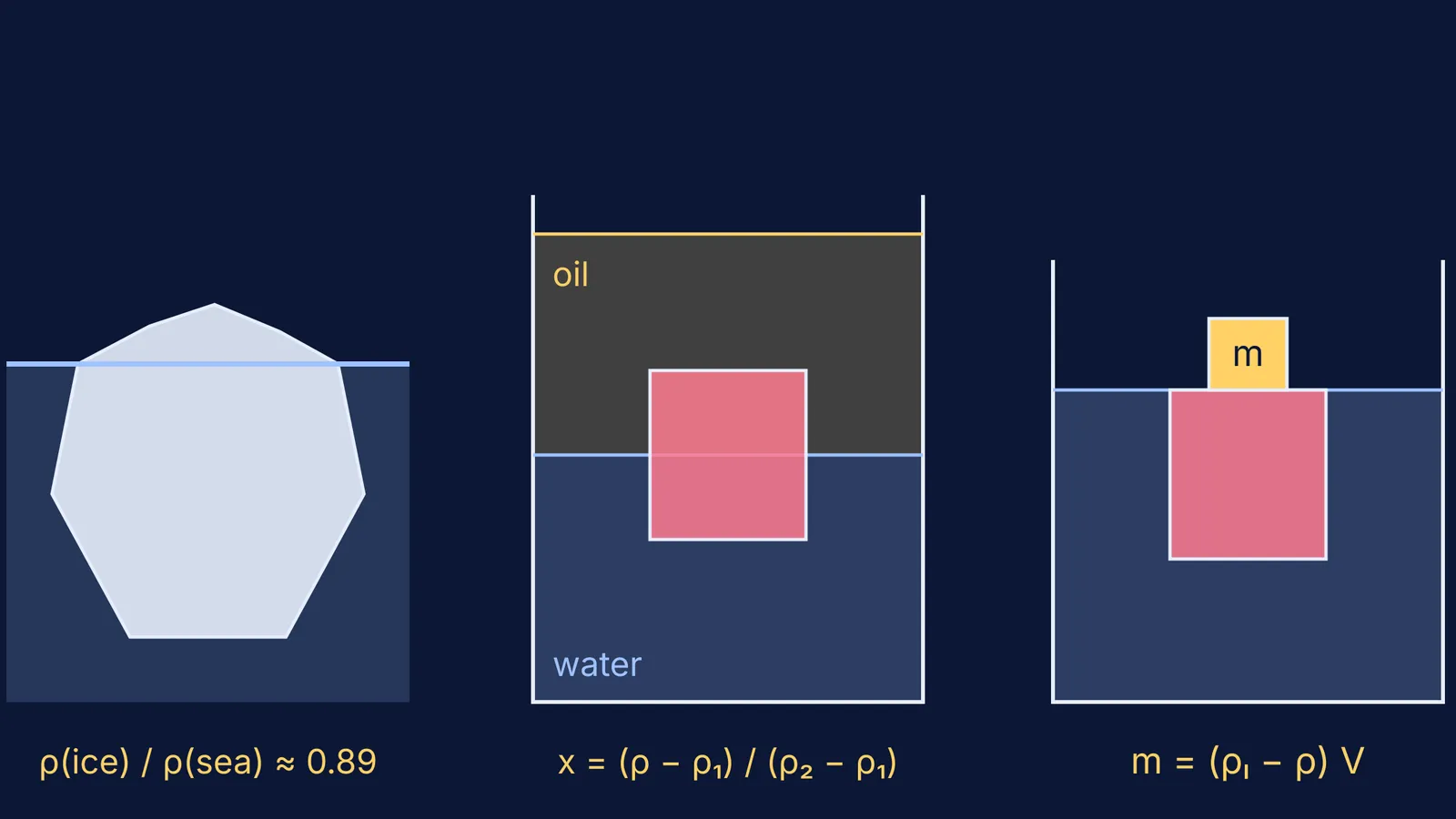
A NOAA classroom activity gives the density of ice as about 0.92 g/mL and seawater as about 1.03 g/mL (NOAA Global Monitoring Laboratory, Icebergs activity). Divide: 0.92 / 1.03 ≈ 0.89, so roughly 89% of an iceberg's volume sits below the surface.
The US Geological Survey puts it in round numbers: "Ninety percent of an iceberg is below the waterline" (USGS Water Science School, NOAA image). The USGS page on water density adds that the density of ice can vary because ice can contain air (USGS, Water density), so treat 90% as a rule of thumb, not a constant.
Now put the same ice in fresh water, which the NOAA sheet takes as 1.0 g/mL (NOAA): 0.92 / 1.0 = 0.92. An ice cube sits slightly deeper in your glass than an iceberg does in the denser sea.
How do you solve a block floating between two liquids?
Say a block of density ρ floats at the boundary between a lighter liquid (density ρ₁) on top and a heavier one (ρ₂) below, with the top layer deep enough to cover the block. Let x be the fraction of the block's volume in the lower liquid. Each liquid pushes up with the weight of the liquid displaced in it, so:
ρVg = ρ₂xVg + ρ₁(1 − x)Vg, which gives x = (ρ − ρ₁) / (ρ₂ − ρ₁).
Worked example: a block of density 800 kg/m³ floats between oil of 600 kg/m³ and water of 1000 kg/m³. Then x = (800 − 600) / (1000 − 600) = 0.5, so half the block is in each liquid.
Quick check: if ρ₁ = 0, x reduces to ρ/ρ₂, the single-liquid rule. If x falls outside 0 to 1, the block is not floating at the boundary at all. The same layer-by-layer thinking shows up when you find the density of oil with a U-tube and water.
How much extra load sinks a floating block to the brim?
"To the brim" means the top face is just level with the surface, so the whole volume V is under. The buoyant force ρ_l V g now carries the block (mass M) and the load (mass m):
(M + m)g = ρ_l V g, so m = ρ_l V − M = (ρ_l − ρ)V.
Worked example: a 10 cm wooden cube of density 600 kg/m³ floats in water of 1000 kg/m³. Its volume is 0.001 m³ and its mass is 0.6 kg. Before loading, 6 cm of its height is under water (600/1000 of 10 cm). The load needed on top is m = (1000 − 600) × 0.001 = 0.4 kg.
The trap: a load hung under the block, fully in the water, gets its own buoyant force. For a metal load of density 8000 kg/m³, the balance becomes m(1 − 1000/8000) = 0.4 kg, so m ≈ 0.457 kg. A hanging load has to be heavier than one sitting on top.
How do you check a buoyancy answer?
Draw the body and mark which part of its volume sits in which liquid.
List every weight: the body, any load, anything tied on.
List every buoyant force: one for each liquid and each submerged object.
Set total weight equal to total buoyant force and cancel g.
Sanity-check: every fraction between 0 and 1, and a denser liquid gives a smaller submerged fraction.
If step 1 is hard, try our buoyancy and density simulation; the Fermi Simulation Lab has interactive simulations for ideas that are easier to see than to read. For more variants worked line by line, the Fermi Problem Library has a step-by-step solver that explains the reasoning rather than printing an answer.


