

On this page
If you drop a solid block of steel into a lake, it sinks instantly. Yet the world's oceans are filled with massive steel ships carrying thousands of tonnes of cargo. This paradox comes down to one of the most elegant rules in physics: the relationship between shape, density, and the water pushed aside.
Understanding why heavy ships float requires looking past the material they are made of and focusing on the volume they take up.
What is average density?
Density is a measure of how much mass is packed into a given volume. Solid steel has a density of approximately 7,850 kg/m³ (Wikipedia). Liquid water has a density of about 1,000 kg/m³. Because solid steel is nearly eight times denser than water, a solid block of it sinks immediately.
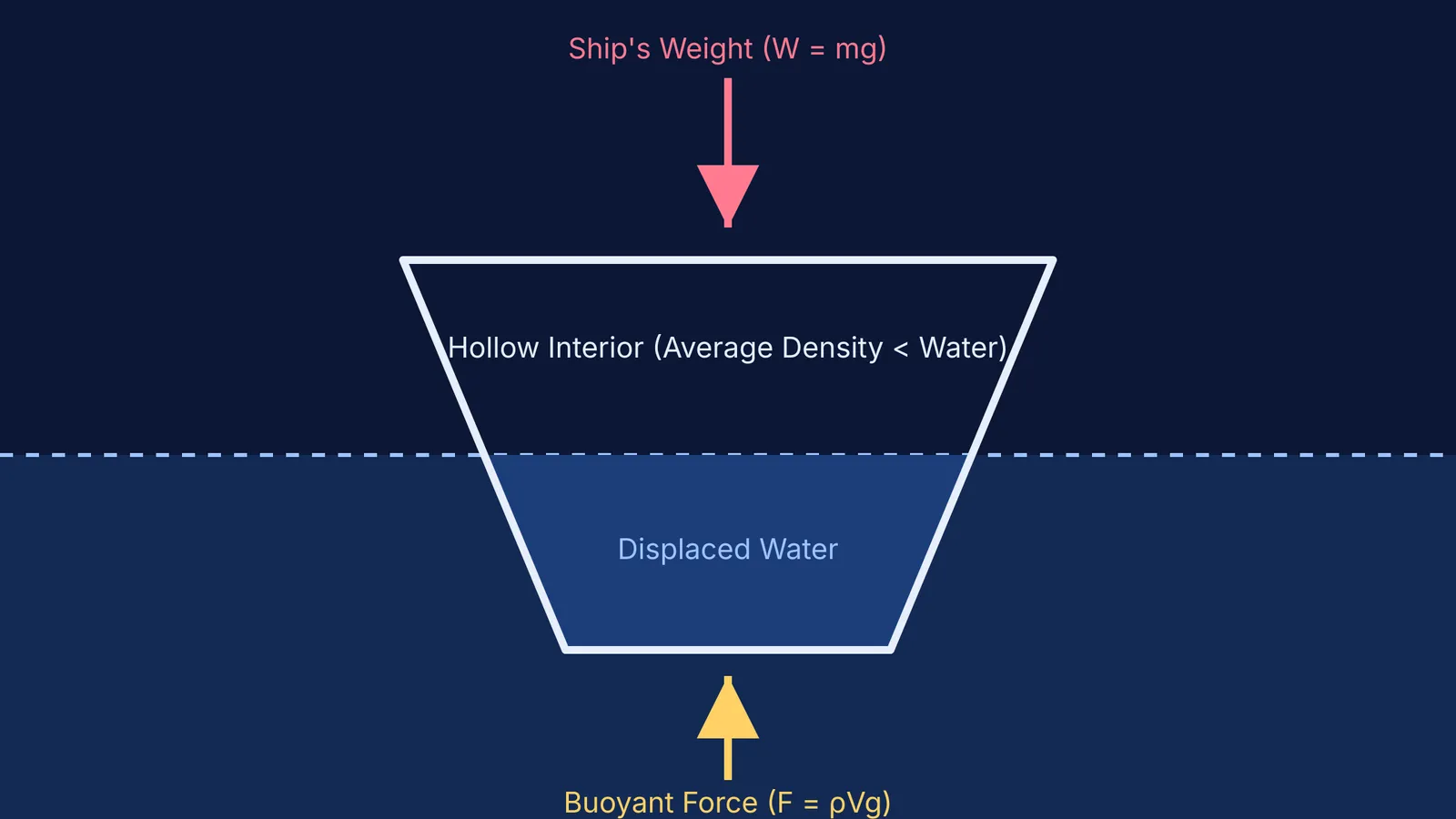
However, a ship is not a solid block. Its hull is a large, hollow shell that surrounds a massive volume of air, which has a very low density of roughly 1.2 kg/m³ (Wikipedia). When you calculate a ship's average density—its total mass (steel, cargo, and air combined) divided by its total volume—the result is far less than 1,000 kg/m³. As long as the overall average density is lower than that of water, the object will float.
How does Archimedes' principle keep it afloat?
The physics of floating is governed by Archimedes' principle, which states that an object submerged in a fluid experiences an upward buoyant force equal to the weight of the fluid it displaces (Wikipedia).
When a ship enters the water, its hull pushes water out of the way. Gravity pulls the ship down, but the water pushes back up. The ship will sink into the water until the weight of the water it has displaced exactly matches its own total weight. Because of its large hollow volume, the hull can displace enough water to generate a massive buoyant force before the ship is fully submerged.
To see this balance of forces in action, you can use the Fermi Simulation Lab to drop blocks of different shapes and densities into a virtual tank and watch how the buoyant force responds as the submerged volume changes.
How much water does a ship actually displace?
The exact amount of water pushed aside is called the ship's displacement. This is a practical measure of a ship's actual weight.
When the RMS *Titanic* set sail, its displacement was 52,310 tonnes (Wikipedia). This means the portion of the ship sitting below the water line pushed aside exactly 52,310 tonnes of seawater. The upward force from that displaced water is what kept the heavy steel vessel from sinking under its own weight. If cargo is added to a floating ship, it becomes heavier and sinks slightly deeper, displacing more water until the upward buoyant force once again matches the new total weight.
A framework for solving buoyancy problems
If you are tackling problems about floating objects for your school physics exams, rely on a structured approach rather than guessing.
Find the displaced volume: The volume of the submerged part of the object is exactly equal to the volume of fluid pushed aside.
Calculate the buoyant force: Multiply the volume of the displaced fluid by the fluid's density and the acceleration due to gravity (F = ρVg).
Compare the forces: If the upward buoyant force equals the object's downward weight, the object floats in equilibrium.
For a deeper dive into the equations behind submerged objects, see our guide on Fluid mechanics: pressure, buoyancy and Bernoulli mistakes to avoid. If you want to understand how the water's push changes as you go deeper, our walkthrough on Pressure at depth and gauge pressure: hydrostatics problems explains the maths. You can also trace these ideas back to their foundations in Force and pressure in Class 8: contact forces, non-contact forces.


