

On this page
When two immiscible liquids—such as oil and water—are poured into a U-shaped tube, they do not mix. Instead, they settle at different levels, reaching a stable equilibrium where the lighter liquid sits higher than the denser one. This simple setup is a classic manometer problem in fluid mechanics, and it offers a direct way to find the density of an unknown liquid without needing a weighing scale.
What is the hydrostatic pressure principle?
The key to understanding a U-tube lies in hydrostatics. In a fluid at rest, the hydrostatic pressure at a given depth is calculated using the formula P = ρgh, where ρ is the density, g is gravity, and h is the depth below the surface (Wikipedia). Because of this principle, the pressure at any given horizontal level within a continuous, static fluid must be identical.
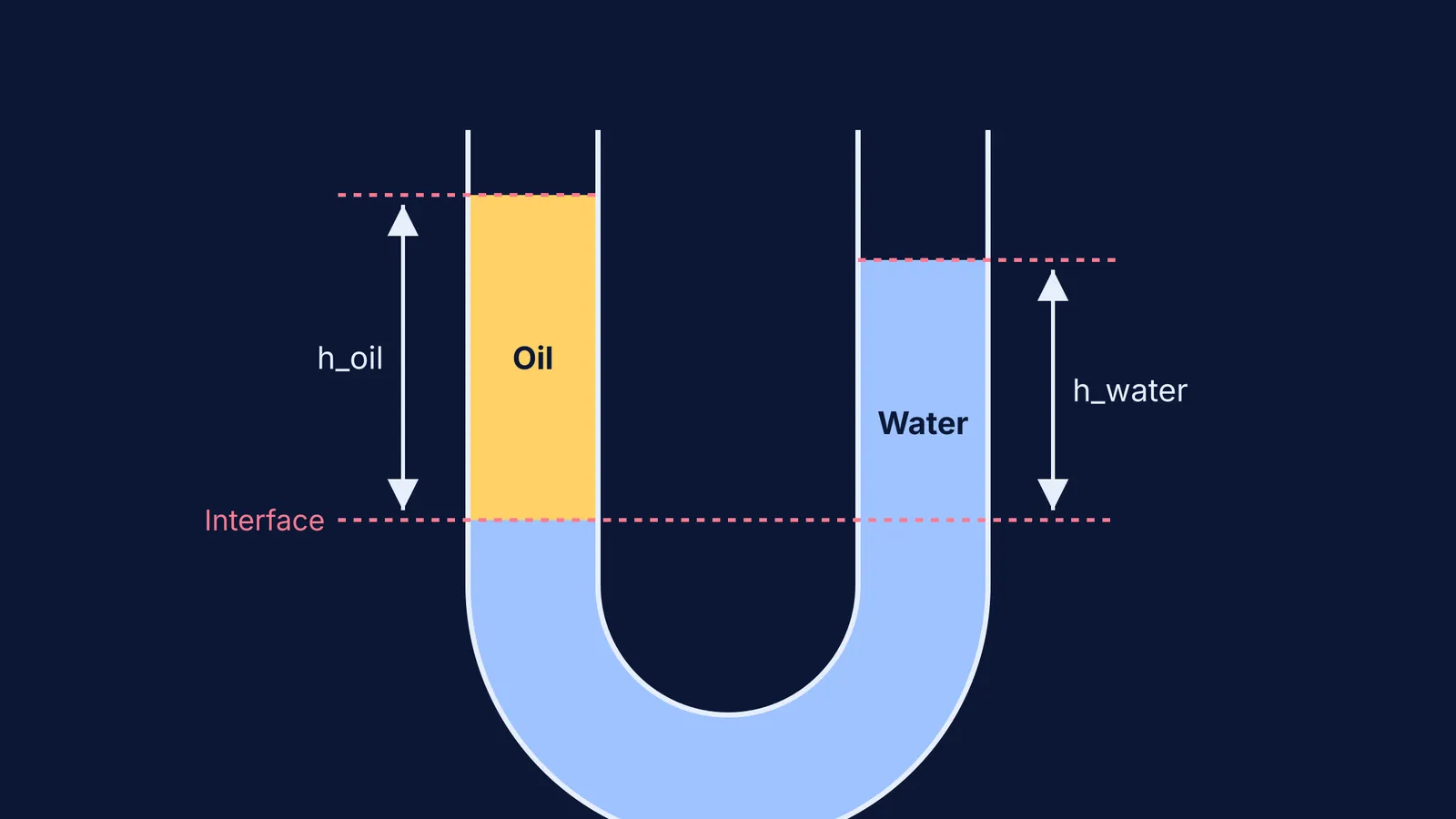
When you pour water into a U-tube, it fills the bottom bend and rises into both arms. If you then pour oil into the left arm, it pushes the water down on that side and forces it up the right side. The two liquids meet at a visible boundary called the interface. If you draw a horizontal line straight across from this interface to the other arm, you are entirely within the water layer. Because the fluid below this line is continuous, the pressure must be identical in both arms at this specific depth.
Why do oil and water sit at different heights?
The pressure pushing down on the left side of the interface comes from the atmosphere plus the weight of the oil column above it. On the right side, the pressure comes from the atmosphere plus the weight of the water column above the line.
Because the atmospheric pressure presses down equally on the open tops of both arms, it cancels out of our calculations. Equating the liquid pressures at the interface gives us ρ_oil × g × h_oil = ρ_water × g × h_water.
Gravity (g) also cancels out, leaving a beautifully simple relationship: ρ_oil × h_oil = ρ_water × h_water. This equation shows that the heights of the liquid columns above the interface are inversely proportional to their densities. To find the density of the oil, you just rearrange the formula to ρ_oil = ρ_water × (h_water / h_oil).
How to find the density of oil with a U-tube?
Let us put this into practice with a worked example. Suppose you pour water into a U-tube, knowing its density is 1000 kg/m³ (Wikipedia), followed by an unknown oil.
Locate the interface where the oil and water meet in the left arm.
Measure the vertical height of the oil column above this interface. Let's say h_oil = 10.0 cm.
Draw a horizontal line from the interface across to the right arm.
Measure the vertical height of the water column above this line. Let's say h_water = 8.0 cm.
Plug the numbers into the formula: ρ_oil = 1000 × (8.0 / 10.0).
Calculate the result: ρ_oil = 800 kg/m³.
This confirms the oil is less dense than water, which matches why it floats. If you are preparing for exams and need to strengthen your grasp on hydrostatics, the Fermi Concept Library covers every concept in physics, each with its own lesson and its place in the map.
How to avoid common mistakes?
When solving U-tube manometer problems, a few classic errors can throw off your answer.
Measuring from the bottom: Do not measure the heights from the bottom of the U-tube. Always measure from the horizontal level of the interface between the two liquids.
Mixing up units: Ensure your heights are in the same units, such as both in cm or both in m. Since the formula uses a ratio, the length units will cancel out, but they must match exactly.
Forgetting trapped gas: In tubes open to the air, atmospheric pressure cancels out. But if one arm of the U-tube is sealed and contains a trapped gas, you must include the absolute gas pressure in your equation.
If you are stuck on a homework question where the tube has varying widths or an angled arm, the Fermi Problem Library has worked problems with a step-by-step solver that explains the reasoning rather than printing an answer. You can also review related scenarios, like how to handle a manometer with two immiscible liquids, or brush up on other pressure, buoyancy and Bernoulli mistakes to avoid in fluid mechanics.


