

On this page
Rest a metre rule on your two index fingers, one near each end, and slowly bring your hands together. You cannot make the fingers meet anywhere you like. One finger slides, stops, then the other slides, and they always meet under the rule's centre of mass. The reason is a simple contest between static and kinetic friction, and you can work it out step by step.
This demonstration is well studied by physics teachers. A laboratory activity published in Physics Education describes exactly this changeover, with the fingers taking turns to slide and stop as they close in on the centre of mass, and models it with static and kinetic friction (Massalha, Lanir and Gluck, Physics Education, 2011). The friction values below are our own round illustrative numbers, not measurements.
How much weight does each finger carry?
The rule is in equilibrium, so the two upward normal reactions add up to its weight, and their moments about the centre of mass (CM) cancel. Call the distances of the fingers from the CM d_L and d_R. Taking moments:
N_L × d_L = N_R × d_R
N_L + N_R = W
So N_L = W × d_R/(d_L + d_R) and N_R = W × d_L/(d_L + d_R). Each finger's load is set by the other finger's distance from the CM. The finger farther from the CM carries less. This is the same load sharing you use for reaction forces on a beam on two supports, applied while the supports move.
Which finger slides first, and why?
As you push your hands inward, the rule barely moves sideways, so the horizontal friction forces from the two fingers on the rule must be nearly equal and opposite. Both grow together as you push harder. The finger whose limit is reached first gives way.
Each finger's friction limit is μs × N. The finger with the smaller load has the smaller limit, so the finger farther from the CM slides first. It is not the finger you push harder, and it is not your stronger hand.
Once it slides, its friction drops to μk × N, the kinetic value, which is lower. The drop from μs to μk when an object starts moving is what you see on a static versus kinetic friction pull graph. Here it decides when the fingers swap.
When do the fingers swap?
The sliding finger moves inward, so its distance from the CM falls and its load rises. Its kinetic friction μk × N_moving rises with it. Meanwhile the still finger's load falls, and so does its limit μs × N_still. The swap happens when the two meet:
μk × N_moving = μs × N_still
Using the load formulas, the W and the (d_L + d_R) cancel, leaving a rule in distances only. If the left finger is sliding, it stops when
d_L = (μk/μs) × d_R
At that moment the right finger starts to slide, and the left one now holds, because it carries more load. So each stop is (μk/μs) times the previous distance. The distances shrink by the same factor every time, so they approach zero: the fingers meet at the CM.
Worked example: a 100 g rule with fingers at 10 cm and 80 cm
Take a uniform 100 g metre rule, so its CM is at the 50 cm mark. Use illustrative values μs = 0.5 and μk = 0.4, and g = 9.8 m/s².
Weight. W = 0.100 × 9.8 = 0.98 N.
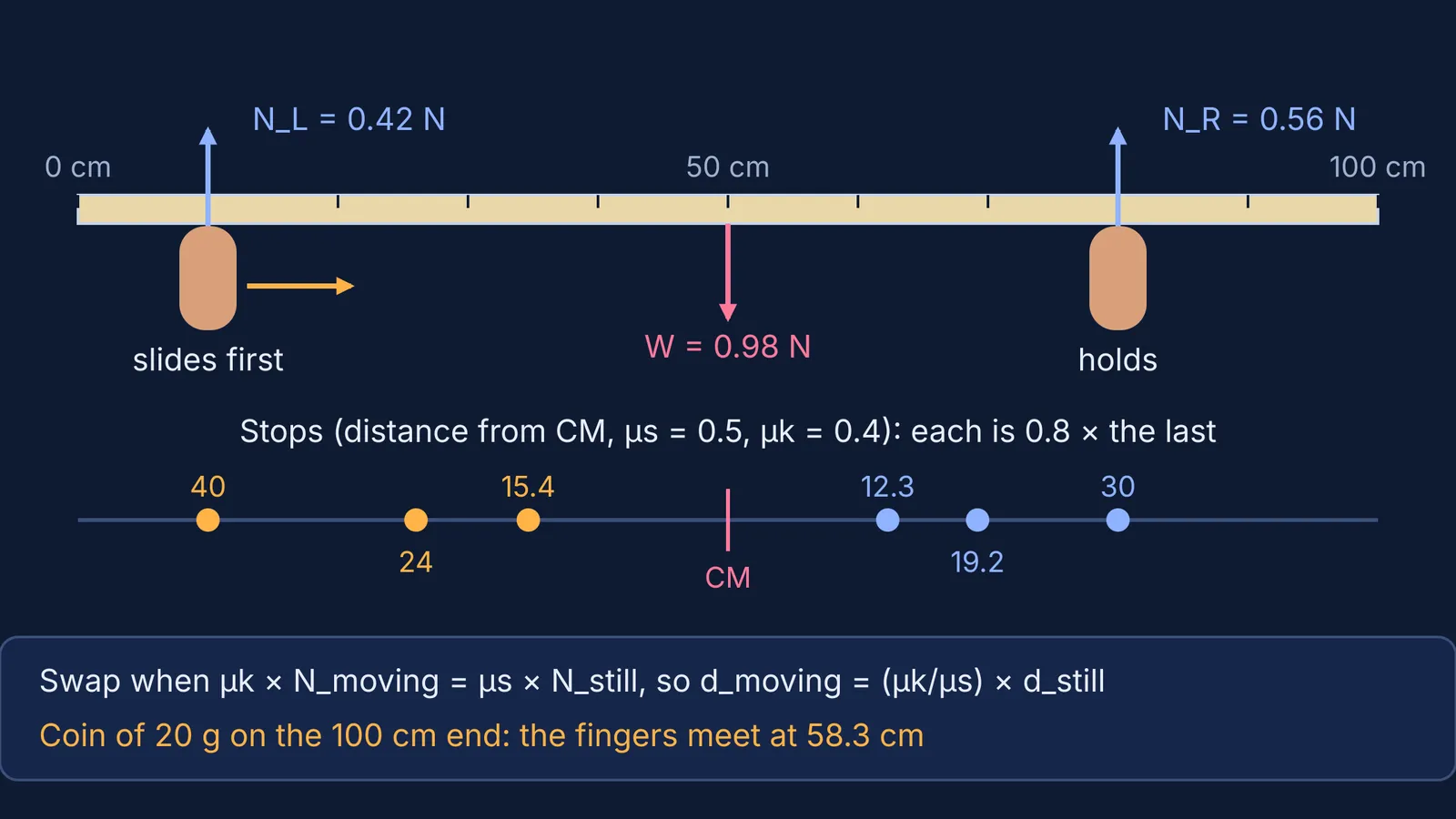
Distances from the CM. d_L = 50 − 10 = 40 cm, d_R = 80 − 50 = 30 cm.
Loads. N_L = 0.98 × 30/70 = 0.42 N. N_R = 0.98 × 40/70 = 0.56 N.
Limits. Left: 0.5 × 0.42 = 0.21 N. Right: 0.5 × 0.56 = 0.28 N. The left limit is lower, so the left finger slides first.
First stop. The left finger slides until d_L = 0.8 × 30 = 24 cm, so it travels 16 cm, to the 26 cm mark.
Check the swap. Now N_L ∝ 30 and N_R ∝ 24. Left kinetic: 0.4 × 30 = 12. Right limit: 0.5 × 24 = 12. They are equal, so the right finger starts to slide. The left finger's limit is 0.5 × 30 = 15, larger than the right's kinetic 0.4 × 24 = 9.6, so it holds.
The sequence. The right finger stops at 0.8 × 24 = 19.2 cm from the CM, then the left at 15.4 cm, the right at 12.3 cm, the left at 9.8 cm, and so on. Each stop is 0.8 times the last.
How many turns. After 19 slides the gap between the fingers is 0.97 cm, under 1 cm, and it is centred on the 50 cm mark.
The ratio μk/μs sets how fast they close in. A ratio of 0.8 gives many short turns. If μs = 0.6 and μk = 0.3, the ratio is 0.5, so each stop halves the distance and the fingers meet in far fewer, longer slides.
Why does it find the centre of mass, not the middle?
Nothing in the argument used the middle of the rule. Every step used distances from the CM. So the fingers meet at the CM wherever you start them and whatever the rule looks like.
Tape a 20 g coin to the 100 cm end. The new CM is at (100 × 50 + 20 × 100)/120 = 58.3 cm. Repeat the slide and the fingers meet near the 58.3 cm mark, not at 50 cm. This is a quick way to find the centre of mass of a stick, a broom or a cricket bat without a balance. Near the Earth the centre of gravity and the centre of mass are the same point; when they differ is covered in centre of gravity versus centre of mass.
What if μs were equal to μk? Then the moving finger would stop the instant the loads balanced, and the fingers would creep in together almost smoothly. The visible turn-taking needs μs > μk. Real fingers are not point supports, and the friction of skin on wood is not a fixed constant, so treat the 0.8 ratio as illustrative. The meeting point does not depend on it.
For more beam, moment and friction problems worked one line at a time, the Fermi Problem Library has a step-by-step solver that explains the reasoning at each stage.
Quick checklist
Loads from moments: N_L = W × d_R/(d_L + d_R), N_R = W × d_L/(d_L + d_R).
The finger farther from the CM carries less load and slides first.
Swap when μk × N_moving = μs × N_still, which gives d_moving = (μk/μs) × d_still.
Each stop is μk/μs times the last: 40, 30, 24, 19.2, 15.4 cm for a ratio of 0.8.
The fingers meet at the centre of mass, wherever they start.
Turn-taking needs μs > μk.


