

On this page
A wet dog stands still for a moment, then twists its whole body from side to side and sends water flying. The rhythm is not random. When Andrew Dickerson, Zachary Mills and David Hu filmed 33 wet mammals from 16 species with high-speed cameras, they found Labradors shaking at about 4.5 Hz, rats at about 18 Hz and mice at about 29 Hz (Dickerson, Mills and Hu, J. R. Soc. Interface 2012). Circular motion and surface tension explain why small animals must shake faster; a simple model gets the trend right, though not the exact numbers.
Why does a wet dog shake instead of drying in the sun?
Evaporation is expensive. Turning water into vapour takes about 2,257 kJ per kilogram. A dog carrying 0.45 kg of water in its fur would need about 1.0 MJ to dry by evaporation alone. The 2012 study estimates that a 27 kg (60 lb) dog with that much water would spend about 20% of its daily food energy just air-drying (Dickerson and colleagues, 2012). Wet fur also lets heat escape much faster than dry fur, so the animal gets cold while it waits.
Shaking costs almost nothing in comparison. In the same study, the energy of a shake was a thousandth or less of the energy needed to evaporate the water, and the fur kept only about 30% of its water after shaking.
What holds a water drop on fur?
Surface tension. A drop sitting on hairs is gripped round its edge. As a rough model, take a drop of radius r held by a force of about 2πrσ around its rim, where σ is the surface tension of water, about 0.072 N/m. This is the same force-per-length idea you meet in surface tension acting on a wire frame, applied to a curved rim.
For a 1 mm drop:
Grip: 2π × 0.001 × 0.072 = 4.5 × 10⁻⁴ N
Mass: (4/3)π × (0.001)³ × 1000 = 4.2 × 10⁻⁶ kg
Weight: 4.2 × 10⁻⁶ × 9.81 = 4.1 × 10⁻⁵ N
The grip is 11 times the weight, so gravity alone cannot pull the drop off. Setting weight equal to grip gives the largest drop that stays: r = √(3σ/(2ρg)) ≈ 3.3 mm. Bigger drops drip off on their own. Smaller ones stay in the fur until something pulls harder than gravity.
How fast must the skin swing to fling a drop off?
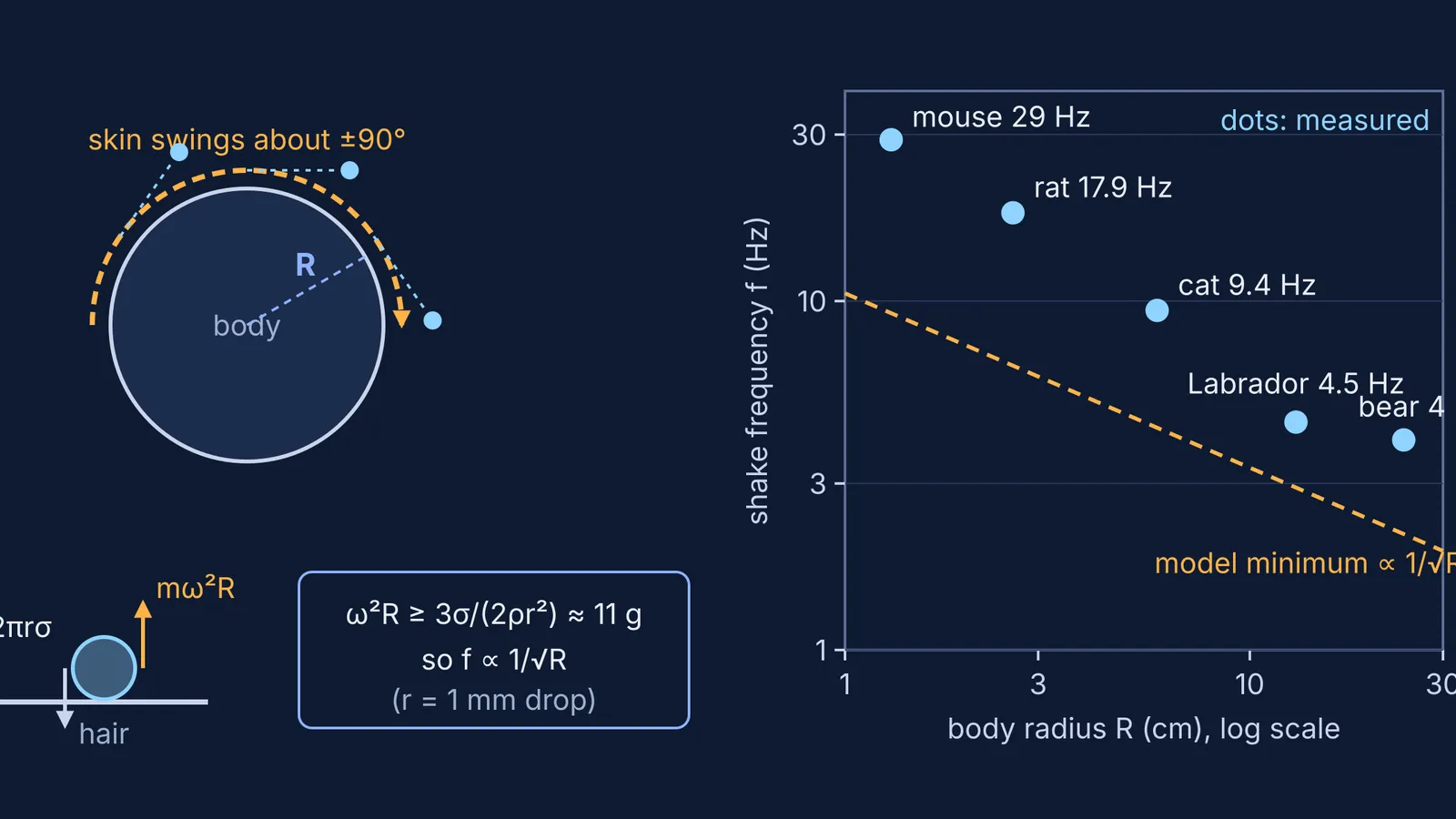
When the skin swings, a drop on it moves in an arc of radius R about the backbone. To stay on that arc it needs a centripetal force mω²R, and the only thing supplying it is the surface-tension grip. Once mω²R is bigger than the grip, the drop leaves along the tangent. For a drop of radius r:
(4/3)πr³ρ × ω²R > 2πrσ, so ω²R > 3σ/(2ρr²)
The animal's size R has dropped out of the right-hand side. For drops of the same size, every animal needs the same acceleration ω²R.
Worked example: a Labrador
Take r = 1 mm, σ = 0.072 N/m, ρ = 1000 kg/m³, and a body radius R = 13 cm, close to the chest measurements of the Labradors in the study.
Needed acceleration. ω²R = 3 × 0.072 / (2 × 1000 × 10⁻⁶) = 108 m/s², which is about 11 g.
Needed peak angular speed. ω = √(108 / 0.13) = 28.8 rad/s.
Turn it into a frequency. The skin does not spin in a circle. It swings back and forth, roughly in simple harmonic motion, through about ±90° (A = π/2 rad). For an angle θ = A sin(2πft), the peak angular speed is 2πfA. So f = ω/(2πA) = 28.8 / (2π × 1.571) = 2.9 Hz.
Compare with the measurement. Labradors shake at about 4.5 Hz. At that rate the peak angular speed is 2π × 4.5 × 1.571 = 44.4 rad/s, and the peak acceleration is 0.13 × 44.4² = 256 m/s², about 26 g. That is more than twice the 11 g the model asks for, so the dog clears the threshold with room to spare.
All the units check: σ/(ρr²) is (N/m)/(kg/m³ × m²) = N/kg = m/s².
Why do smaller animals have to shake faster?
If ω²R is fixed, then ω ∝ 1/√R, and so is the frequency for a given swing amplitude. Shrink the radius by a factor of 10 and the needed frequency goes up by √10, about 3.2 times. Using the same 108 m/s² and ±90° swing, with chest radii from the study, the model's minimum frequencies come out as:
Mouse (R = 1.3 cm): minimum 9.2 Hz, measured about 29 Hz
Rat (R = 2.6 cm): minimum 6.5 Hz, measured about 17.9 Hz
Cat (R = 5.9 cm): minimum 4.3 Hz, measured about 9.4 Hz
Labrador (R = 13 cm): minimum 2.9 Hz, measured about 4.5 Hz
Brown bear (R = 24 cm): minimum 2.2 Hz, measured about 4.0 Hz
Every animal shakes faster than the minimum, and frequency falls as size rises, as the model says. But the measured frequencies fall more steeply. The study's fit is f ∝ R^(−0.77), not R^(−1/2), and the authors put the gap down to describing a whole body by a single chest measurement. Treat the 1/√R law as the reason for the trend and the measured values as the facts. The drop size and the 2πrσ grip are model assumptions, which is why the model gives estimates, not predictions to the hertz. The authors report peak centripetal accelerations between about 10 g and 70 g across the animals they filmed, with the largest values in the smallest animals.
This is a scaling argument in the same spirit as the square-cube law for bones and body size: a fixed physical requirement forces different behaviour at different sizes.
Why does loose skin help a dog shake dry?
The backbone of a shaking dog twists through only about ±30°. The loose skin swings a further 60° or so on top of that, making about ±90° in all, according to the study's video analysis. At the same frequency, three times the amplitude means three times the peak speed, and since the centripetal acceleration goes as ω², nine times the acceleration. With the backbone alone, a Labrador at 4.5 Hz would reach only 0.13 × (2π × 4.5 × π/6)² ≈ 28 m/s², about 3 g, far below the 11 g needed. The loose skin is what makes the shake work.
A washing machine does the same job with steady rotation instead of a swing; the spin cycle explained covers that case. If you want to watch how peak speed and acceleration change through one swing of simple harmonic motion, try the Simulation Lab.
Quick checklist
A drop clings with a surface-tension grip of roughly 2πrσ; a 1 mm drop is held with 11 times its weight.
To fling it, mω²R must beat the grip, giving ω²R > 3σ/(2ρr²), about 11 g for a 1 mm drop.
Fixed ω²R means ω ∝ 1/√R, so small animals must shake faster.
For a swing, peak angular speed is 2πfA, not 2πf.
Measured frequencies (about 29 Hz for a mouse, 4.5 Hz for a Labrador) fall faster than the model, as R^(−0.77).
Loose skin triples the swing amplitude and multiplies the acceleration by nine.


