

On this page
Surface tension is the tendency of a liquid surface to shrink into the smallest possible area. When a soap film forms on a wire frame, it pulls inwards like a stretched rubber sheet.
For students solving problems on surface tension and viscosity, a common trap is forgetting that a thin film has more than one side.
What is surface tension?
Surface tension (T) is defined as the force per unit length acting along the surface of a liquid. It is caused by the cohesive forces between liquid molecules. Molecules deep inside the liquid are pulled equally in all directions, but those at the surface are pulled inwards, creating tension.
Pure water has a surface tension of 0.0728 N/m at 20 °C [[1]](https://en.wikipedia.org/wiki/Surface_tension). When you add soap, the soap molecules gather at the surface and weaken these water-water bonds. A typical soap solution has a much lower surface tension of about 0.025 N/m. This lower tension is what allows the water to stretch into thin, stable films without snapping. If you have concept gaps around intermolecular forces, the Fermi Concept Library explains every concept in physics, chemistry, biology, mathematics and computing, helping you build a solid foundation before tackling numerical problems.
Why does a soap film have two surfaces?
If you dip a wire ring into water and pull it out, no film forms. But dip it into a soap solution, and a stable film stretches across the gap.
A liquid drop or a puddle has only one free surface exposed to the air. A soap film, however, is a microscopic sandwich: a thin layer of water trapped between two layers of soap molecules. Because the film is suspended in the air, both its front (top) and back (bottom) faces are free surfaces in contact with the air.
How to find the force due to surface tension on a wire frame soap film?
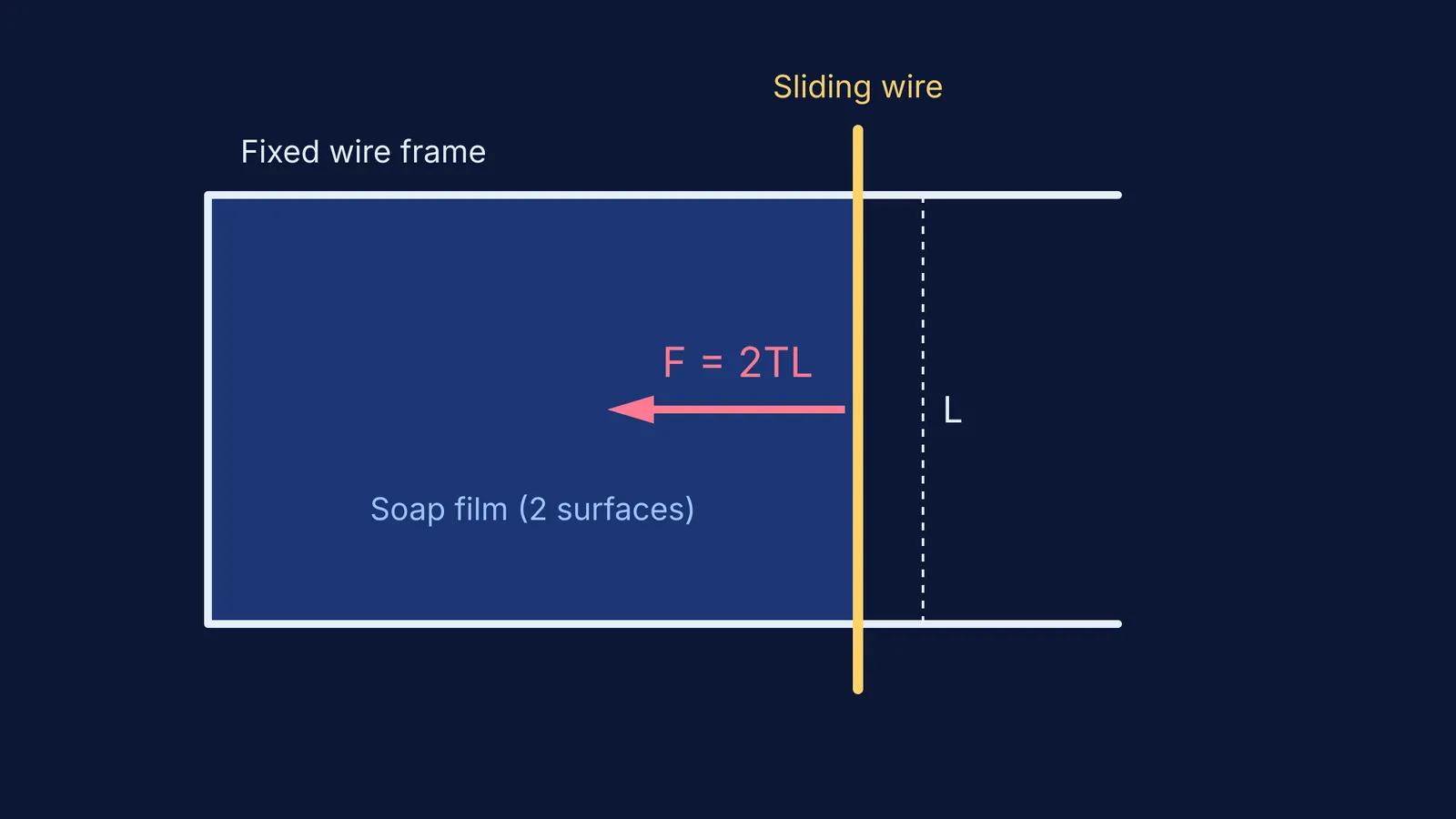
A classic physics experiment uses a U-shaped wire frame with a straight, sliding wire of length L placed across its open end. When a soap film forms in the rectangular gap, it tries to contract, pulling the sliding wire inwards.
To find the total force F pulling the slider, we use the definition of surface tension: Force = Tension × Length.
However, because the soap film has two surfaces touching the air, each surface exerts its own pull on the wire:
The top surface pulls with a force of TL.
The bottom surface pulls with a force of TL.
The total force on the sliding wire is the sum of both: F = 2TL
A worked example
Suppose you have a slider of length 10 cm (0.1 m) on a wire frame, and the soap solution has a surface tension of 0.025 N/m. What force is required to hold the slider in place?
The film pulls the slider inwards with a force: F = 2 × 0.025 N/m × 0.1 m = 0.005 N
To keep the slider in equilibrium, you must pull it outwards with an equal and opposite force of 0.005 N, using the same principles you apply when solving statics problems with Lami's theorem for concurrent forces.
If you keep dropping factors of two in these fluid mechanics problems, the Fermi Problem Library has a step-by-step solver that explains the reasoning behind each surface tension formula rather than just printing an answer.
Work done in stretching a soap film
If you pull the slider outwards by a distance x, you are doing work against the surface tension.
The work done is calculated from force and displacement: W = F × x = (2TL) × x
Notice that L × x is the new area you added to one face of the film. Let's call this ΔA. Because you added area to both the front and the back, the total new surface area is 2ΔA.
This gives us the surface energy formula: W = T × (2ΔA)
This proves that surface tension (T) can also be thought of as the surface energy per unit area. Whether you are finding the force on a wire or the pressure inside a bubble, accounting for every free surface is the key to the right answer.


