On this page
If you have ever read folklore about 60-foot giants striding across the landscape, physics has some bad news: such creatures would be instantly crushed under their own weight.
In 1638, Galileo Galilei published his masterpiece *Two New Sciences*, laying the foundation for modern physics and biomechanics (Wikipedia). Through a dialogue between characters, Galileo introduced what we now call the square-cube law. He explained that if you scale an animal up proportionally, its weight increases much faster than the strength of its bones, making enormous terrestrial giants physically impossible.
You can see this principle at work when learning how to solve physics problems step by step: geometry dictates the limits of physical reality. If you want to review the mathematics behind scaling and biomechanics, the Fermi Concept Library maps out every concept in physics and biology, each with its own lesson.
What is the square-cube law?
The square-cube law states that as a shape grows in size, its volume grows faster than its surface area (Wikipedia).
Imagine a wooden cube that is 1 cm tall, wide, and deep. If you double its dimensions to 2 cm:
Its surface area (and its cross-section) increases by the square of the multiplier: 2² = 4 times larger.
Its volume (and therefore its mass) increases by the cube of the multiplier: 2³ = 8 times heavier.
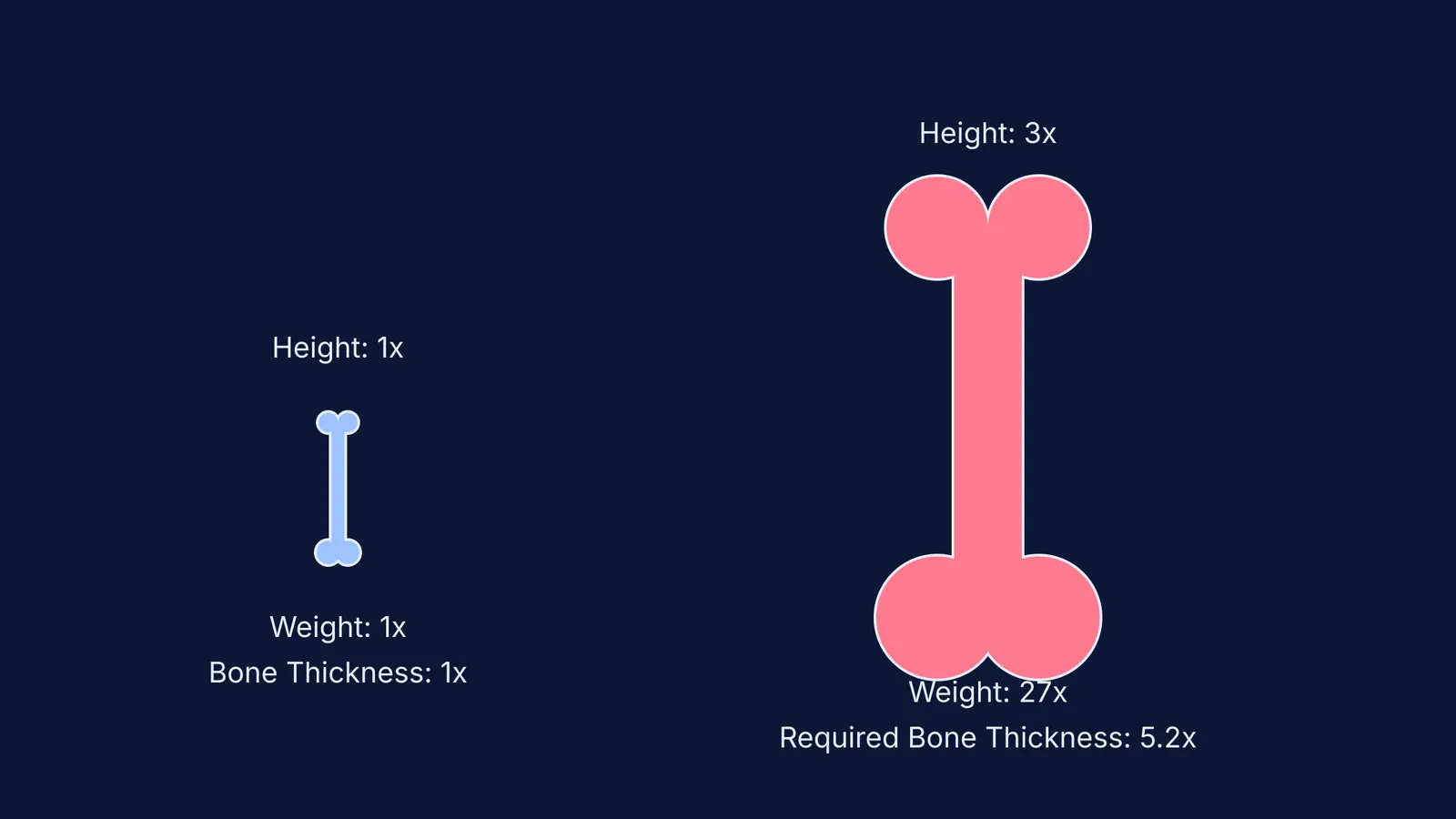
For an animal, its weight depends on its volume, but the structural strength of its bones and muscles depends on their cross-sectional area. As an animal scales up, it becomes proportionately heavier and weaker. This is why it is critical to learn physics from first principles, not formulas: memorising a formula is not enough if you cannot visualise how mass itself scales geometrically.
Why can't giants exist?
In his book, Galileo argued that nature could not produce "a giant ten times as tall as a man of normal stature unless it either employs some extremely hard and resistant material for making his bones, or else enlarges them out of all proportion" (Wikipedia).
The biologist J.B.S. Haldane later illustrated this with the mathematics of a 60-foot giant, scaled up exactly ten times from a 6-foot human (Wikipedia):
The giant's mass would increase by a factor of 1,000 (10³).
The cross-sectional strength of its leg bones would only increase by a factor of 100 (10²).
As a result, every square inch of the giant's leg bones would have to support ten times more weight than a normal human bone. Because a normal human thigh-bone fractures under about ten times the human body weight, the 60-foot giant would snap its legs the moment it tried to take a step.
Even at smaller scales, the stress of gravity is immense. Robert Wadlow, the tallest documented person in history at 2.72 metres (8 ft 11 in), required leg braces just to walk because of the extreme pressure his height placed on his skeleton (Wikipedia). When you need to solve complex structural physics problems like these, the Fermi Problem Library provides a step-by-step solver that explains the reasoning rather than just printing an answer.
How do large animals support their weight?
Nature solves the scaling problem by changing the blueprints. Rather than simply enlarging a mouse to create an elephant, nature uses allometric scaling: larger animals have disproportionately thick, pillar-like legs compared to smaller, spindly-legged creatures (Wikipedia).
There is one exception to the terrestrial limit: the ocean. The blue whale is the largest animal ever known, reaching massive sizes because the buoyancy of water negates some of the effects of gravity (Wikipedia). By resting their weight on the water rather than a skeletal structure, aquatic mammals bypass the crushing reality of the square-cube law.
If you are struggling to picture how mass, geometry, and buoyancy affect forces, the Fermi Simulation Lab offers interactive simulations for the ideas that are easier to see than to read.
How can you check if a structure will scale?
Whether you are building a bridge model, designing a 3D-printed part, or studying biomechanics, use this four-step framework to check if a scaled-up design will support its own weight:
Identify the scaling factor (x): Determine how many times taller the new object is compared to the original.
Calculate the new mass: Multiply the original mass by the cube of the scale factor (x³).
Calculate the new structural strength: Multiply the original cross-sectional area of the support beams (or bones) by the square of the scale factor (x²).
Determine the stress multiplier: Divide the new mass by the new strength (x³ ÷ x² = x).
If the new stress multiplier (x) is greater than the safety margin of the material, the structure will fail. You must either use a stronger material or artificially thicken the supports, exactly as Galileo predicted in 1638.