

On this page
A saline drip has no motor. The bag hangs on a stand, the fluid runs down a tube into a thin plastic cannula in a vein, and gravity does the pushing. That makes it a clean fluids problem: hydrostatic pressure on one side, blood pressure in the vein on the other, and viscous resistance in between. This post works through the physics only. Setting up, adjusting or moving a drip is a job for trained medical staff, and nothing here is a guide to doing it.
What pushes saline from a drip bag into a vein?
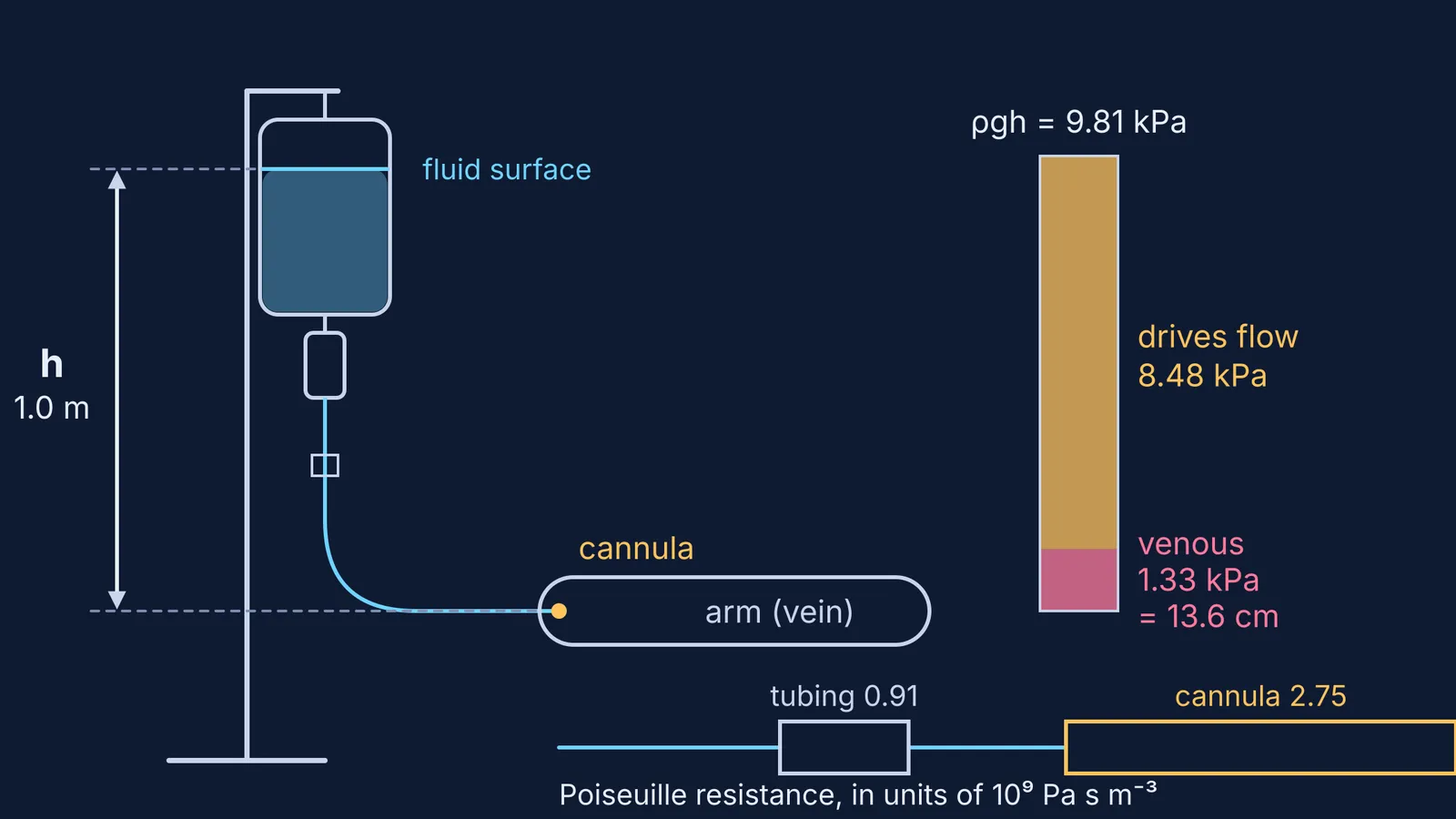
The pressure of a liquid column. If the surface of the saline in the bag is a height h above the cannula, the gauge pressure at the cannula is ρgh. This is the same rule you use for pressure at the bottom of a tank, covered in pressure at depth and gauge pressure. Two points matter:
h is measured from the cannula to the liquid surface in the bag, not to the bottom of the bag and not to the floor.
Only the vertical height counts. A long, looping tube does not change the pressure at its end when nothing is flowing.
Saline enters the vein only if ρgh is greater than the pressure of the blood in that vein. Whatever is left over drives the flow.
How much pressure does the drip have to beat?
Venous pressure, not arterial pressure. The 120/80 mmHg you know from what systolic and diastolic blood pressure mean is in the arteries. Blood has lost most of that pressure by the time it returns through the veins: in the right atrium, at the end of the venous system, it is commonly about 5 mmHg (LibreTexts physiology text). An arm vein sits a little upstream of that, so its pressure is somewhat higher and varies from person to person.
For the examples below we use a round illustrative value of 10 mmHg. It is not a measured value for any patient.
For comparison, just matching an arterial pressure of 120 mmHg would need a saline column of about 1.63 m, which is why a drip goes into a vein.
What is the minimum height for a drip to flow?
Set ρgh equal to the venous pressure.
Convert the pressure. 1 mmHg = 133.3 Pa, so 10 mmHg = 1333 Pa.
Pick the data. Saline is only slightly denser than water, so take ρ = 1000 kg/m³ and g = 9.81 m/s².
Solve for h. h = P/(ρg) = 1333/(1000 × 9.81) = 0.136 m.
Check units. Pa/(kg m⁻³ × m s⁻²) = (kg m⁻¹ s⁻²)/(kg m⁻² s⁻²) = m. Good.
So with 10 mmHg in the vein, the fluid surface has to be about 13.6 cm above the cannula just to stop blood from moving back up the line. Below that height, the pressure difference reverses. Every centimetre above it adds driving pressure.
How fast does a drip flow when the bag is 1 m up?
Here is a full worked example. For the cannula we use a real part: the BD Venflon Pro Safety 20G, which its manufacturer's technical data sheet lists with an inner diameter of 0.83 mm, a length of 32 mm and a gravity flow rate of 67 mL/min. For the tubing (the giving set) we use illustrative values: 1.8 m long with a 3.0 mm bore. Real sets vary. Take the viscosity of saline as about 1.0 × 10⁻³ Pa s, close to water at room temperature.
Driving pressure. ρgh = 1000 × 9.81 × 1.0 = 9810 Pa. Subtract the venous 1333 Pa: ΔP = 8477 Pa.
Resistance of each part. Poiseuille's law gives Q = ΔP/R with R = 8ηL/(πr⁴). For the cannula, r = 0.415 mm and L = 0.032 m, so R = 2.75 × 10⁹ Pa s m⁻³. For the tubing, r = 1.5 mm and L = 1.8 m, so R = 0.91 × 10⁹ Pa s m⁻³. The r⁴ is why a 3 cm cannula out-resists 1.8 m of tubing; the general law is explained in why flow through a narrow tube depends on radius to the fourth.
Add in series. R = 2.75 + 0.91 = 3.65 × 10⁹ Pa s m⁻³. The cannula is 75% of the total.
Flow. Q = 8477/3.65 × 10⁹ = 2.32 × 10⁻⁶ m³/s = 139 mL/min.
Sanity check. The data sheet says 67 mL/min. Our answer is about twice that, so something in the model is off.
Why is the Poiseuille answer too high?
Poiseuille's law assumes slow, smooth flow in a long tube. Check that assumption.
Speed in the cannula. v = Q/(πr²) = 2.32 × 10⁻⁶/5.41 × 10⁻⁷ = 4.3 m/s.
Reynolds number. Re = ρvd/η = 1000 × 4.3 × 0.83 × 10⁻³/10⁻³ ≈ 3560. That is past the usual laminar limit of about 2000.
Energy to speed up. The saline is almost still in the bag and must be accelerated to v. By Bernoulli that costs ½ρv² = 9.2 kPa, which is more than the whole 8.5 kPa we have.
So the model contradicts itself. A better estimate adds the speed-up term: ΔP = RQ + ½ρ(Q/A)², where A is the cannula's cross-section. Solving this quadratic with the same numbers gives Q ≈ 84 mL/min, with Re ≈ 2150. That is much closer to the measured 67 mL/min. The rest of the gap comes from losses at the narrow entrance and the hub, and from the fact that the manufacturer's figure is a bench test under its own standard conditions, not a measurement in a patient.
Does hanging the bag twice as high double the flow?
No. Using the same parts:
h = 0.5 m: ΔP = 3572 Pa. Poiseuille gives 59 mL/min; with the speed-up term, 44 mL/min.
h = 1.0 m: ΔP = 8477 Pa. Poiseuille gives 139 mL/min; with the speed-up term, 84 mL/min.
h = 1.5 m: ΔP = 13,382 Pa. Poiseuille gives 220 mL/min; with the speed-up term, 116 mL/min.
Two things stop the flow from being proportional to h. The venous pressure is subtracted first, so tripling h from 0.5 m to 1.5 m nearly quadruples ΔP. Then the ½ρv² term grows with the square of the speed, so the flow rises more slowly than ΔP at higher speeds.
In practice the height is not what sets the rate. The roller clamp on the tubing squeezes the bore, which adds a large, adjustable resistance in series, and the drip chamber turns the flow into drops that staff can count. Where an exact rate matters, hospitals use infusion pumps. Again, these are decisions for trained staff.
If you want to work more pressure and flow problems like this one step by step, the Fermi Problem Library has a step-by-step solver that explains the reasoning at each stage.
Quick checklist
Pressure at the cannula is ρgh, with h from the cannula to the liquid surface in the bag.
The drip must beat venous pressure; at an illustrative 10 mmHg that needs about 13.6 cm.
Driving pressure is ρgh minus venous pressure.
Resistances in series add; the thin cannula dominates because R ∝ 1/r⁴.
Always check the Reynolds number and ½ρv² before trusting Poiseuille's law.
Flow is not proportional to height.


