

On this page
Many students expect a tube half as wide to carry a quarter as much, because the area is a quarter. The real answer is a sixteenth, and it is a classic trap in fluids questions.
What does Poiseuille's law say?
For smooth, layered flow of a viscous liquid through a long tube, the flow rate is Q = (P₂ − P₁)πr⁴/8ηl, where r is the radius, η the viscosity and l the length, as given in OpenStax College Physics 2e, section 12.4. The same section defines laminar flow as "the smooth flow of the fluid in layers that do not mix."
The law is named after the French scientist J. L. Poiseuille (1799–1869), who worked it out while trying to understand how blood flows, OpenStax notes. Gotthilf Hagen published the same result independently in 1839, a year or two before Poiseuille's papers of 1840–41, which is why it is also called the Hagen–Poiseuille equation.
You can also write the law like Ohm's law: Q = (P₂ − P₁)/R, with resistance R = 8ηl/πr⁴ (OpenStax University Physics, section 14.7). If you need a refresher on η and its units, see our post on the SI unit of viscosity and the poise.
Why is it radius to the fourth, not squared?
Flow rate is area × average speed. The area, πr², gives you one factor of r². The second r² comes from the speed.
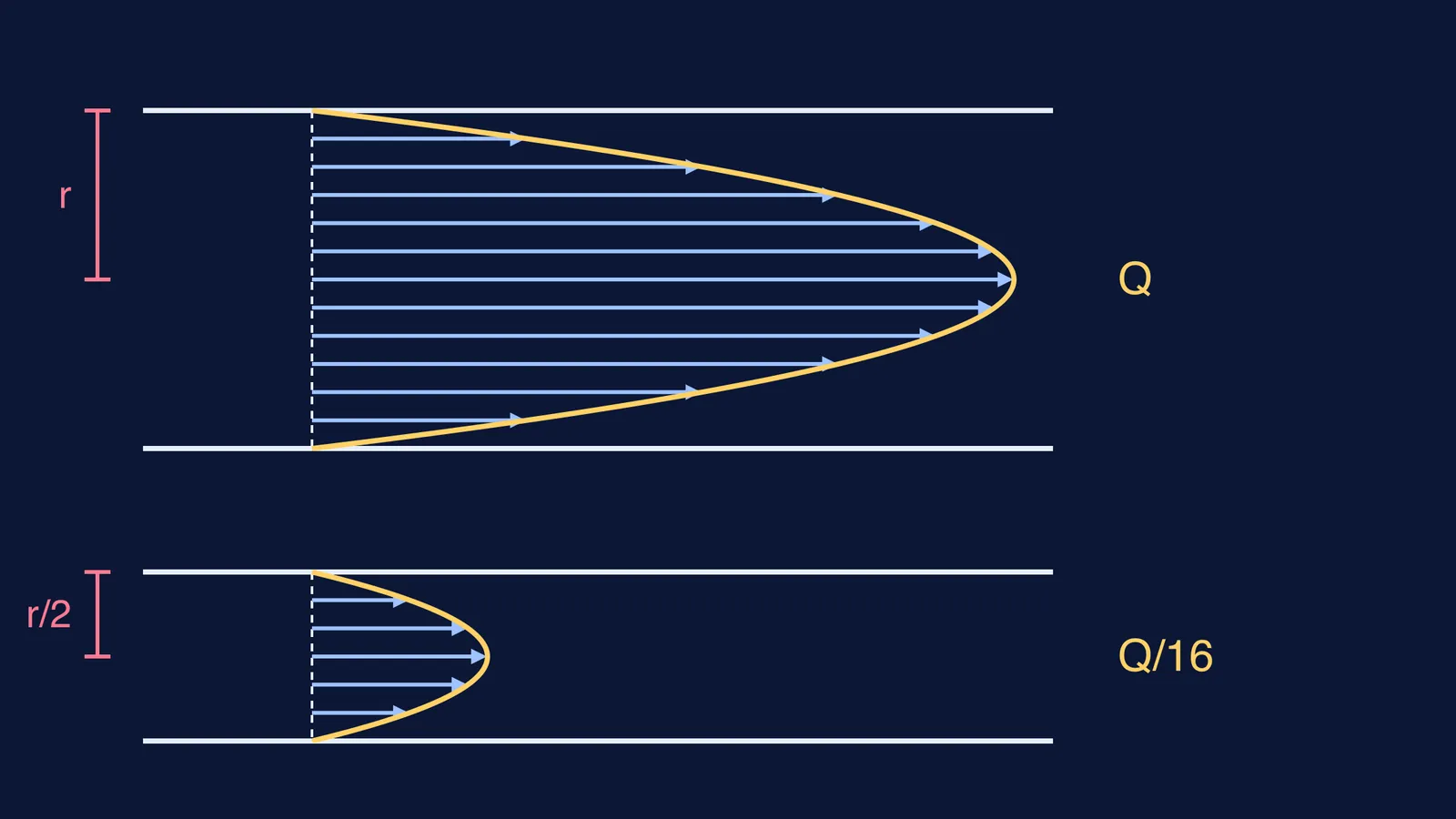
A viscous liquid's speed is zero at the walls and rises steadily to its maximum at the centre of the tube (OpenStax University Physics). Here is why that peak speed grows as r².
Inside a tube of radius r, take a cylinder of liquid of radius s on the same axis. The pressure pushes on its ends, so the driving force is (P₂ − P₁) × πs².
Viscous drag acts on its curved side, of area 2πsl. Drag per unit area is η times how quickly the speed changes across the layers.
Balance the two forces. The rate of change of speed comes out proportional to s. Adding it up from the wall, where the speed is zero, to the axis gives a centre speed of (P₂ − P₁)r²/4ηl, which grows as r².
Working this through gives a parabolic speed profile, and the average speed is exactly half the centre speed, which works out to (P₂ − P₁)r²/8ηl (Hagen–Poiseuille equation). Multiply that by πr² and you get Poiseuille's law. So the r⁴ is r² for area times r² for speed.
What happens to the flow if you halve the radius?
OpenStax puts it plainly: halve a tube's radius and the flow rate falls to one-sixteenth of what it was (OpenStax University Physics). Keep the liquid, length and pressure difference the same:
Ratio of flow rates: Q₂/Q₁ = (r₂/r₁)⁴ = (1/2)⁴ = 1/16.
To push the original flow through the narrow tube, you would need 16 times the pressure difference.
Two tubes of radius r/2 side by side carry 2 × 1/16 = 1/8 of one tube of radius r, though their total area is half.
Make the radius 10% bigger and the flow grows by 1.1⁴ ≈ 1.46, so about 46% more.
Make it 10% smaller and the flow drops to 0.9⁴ ≈ 0.66, about a third less.
A radius cut of only 5% brings the flow down to about 0.81 of its original value. OpenStax's Example 12.7 finds that if plaque halves the blood flow in an artery at the same pressure difference, the radius has shrunk by only about 16% (OpenStax College Physics 2e). Questions about your own health belong with a doctor, not a formula.
Compare that with heat conduction through a rod, which scales only with area, r², as explained in our post on the rate of heat flow through a rod.
When does the r⁴ rule stop working?
The derivation assumes laminar flow of an incompressible liquid whose viscosity stays constant, in a long straight tube of constant width (Hagen–Poiseuille equation). Turbulent flow and short, wide pipes break it. Bernoulli's equation ignores viscosity, which is why Giovanni Venturi's narrow-pipe speed-up and Poiseuille's law answer different questions.
How do you check an r⁴ answer in an exam?
Run this three-step check before you mark an option:
Write down which quantities stay fixed: pressure difference, length or liquid. A question that keeps the flow fixed is asking for the pressure, not Q.
Raise the radius ratio to the fourth power. Only square it if the question is about area or the speed of an ideal fluid.
Sense-check: if halving r gave you 1/2 or 1/4, go back.
If you want more practice, the Fermi Problem Library has worked problems with a step-by-step solver that explains the reasoning rather than printing an answer. The Fermi Concept Library has a lesson on each fluids concept, showing where it fits on the map.


