

On this page
Squeeze water through the narrow part of a pipe and it moves faster, and its pressure there drops. That can sound backwards at first. Giovanni Battista Venturi measured the effect in experiments he published in 1797, and the flow meter named after him sits in the NCERT fluids chapter today.
Who was Giovanni Battista Venturi?
Venturi was born on 11 September 1746 in Bibbiano and died on 10 September 1822 in Reggio Emilia, according to his Wikipedia biography. He was a physicist and a Catholic priest who taught at the University of Modena, and he also worked as a diplomat and a historian of science.
What did Venturi discover about flow in narrow pipes?
In 1797 Venturi published *Recherches expérimentales sur le principe de la communication latérale du mouvement dans les fluides* in Paris, a book whose full French text is on Wikisource. He ran water through short tubes and fixed glass side tubes to them, their lower ends dipped in coloured liquid or mercury. Where the pressure in the flow fell below the air outside, liquid was pushed up the side tube.
In his Experiment XV, the water ran through a cone that widened after its narrowest section. Venturi put three glass tubes along it: mercury rose 53 lignes (an old French unit of length) in the tube at the narrowest section, 20.5 lignes in the next one downstream and 7 in the third, as recorded in the 1797 text. The pressure was lowest where the pipe was narrowest and recovered as it widened.
Today this is called the Venturi effect: the drop in pressure when a moving fluid speeds up as it passes from a wider section of pipe into a narrower one (Wikipedia: Venturi effect). We now explain it with Bernoulli's principle, named after Daniel Bernoulli, whose *Hydrodynamica* was published in 1738 (Wikipedia: Hydrodynamica); read Daniel Bernoulli and the book behind the equation.
How does a venturimeter work?
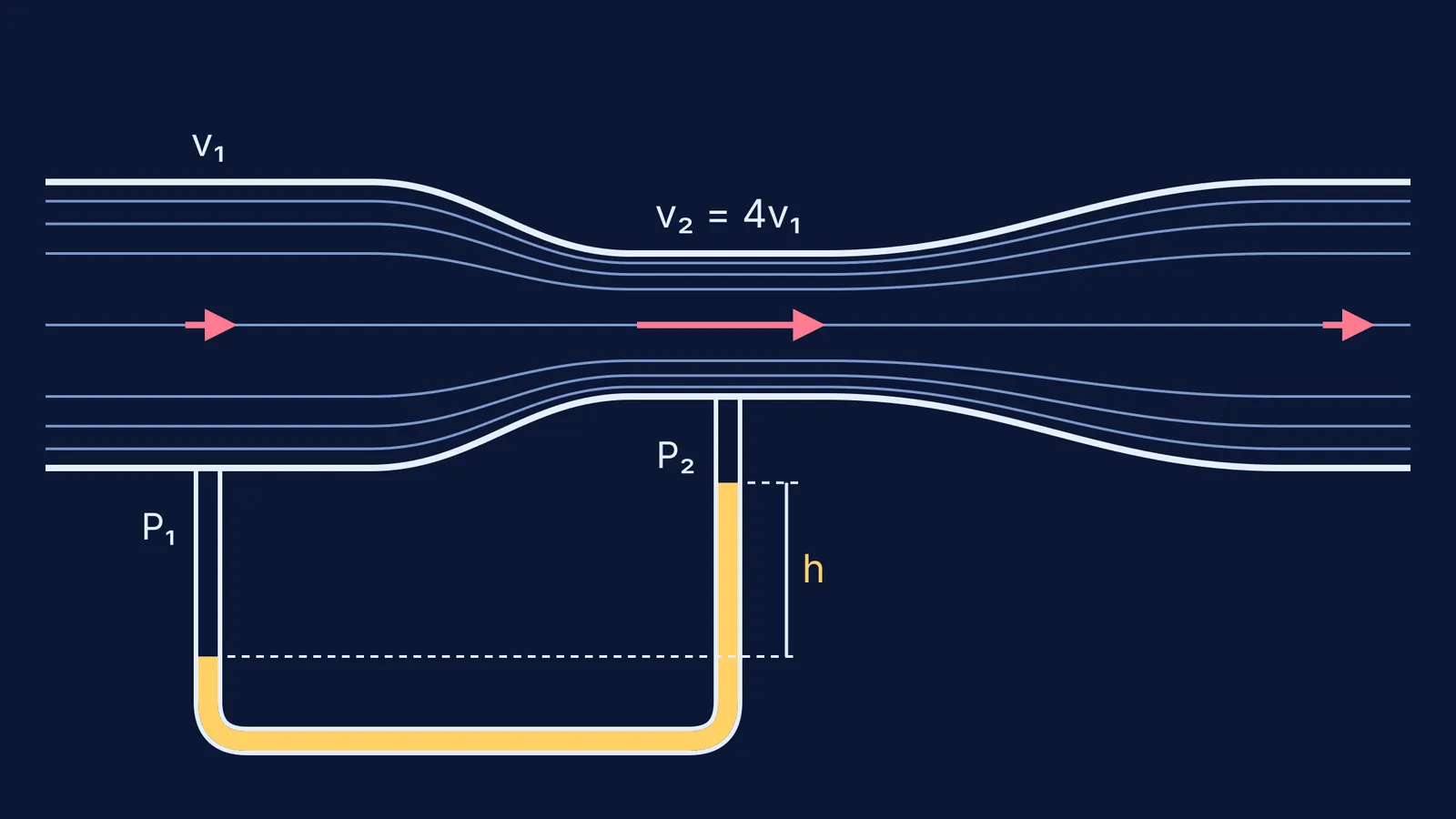
The NCERT Class 11 textbook defines it this way: "The Venturi-meter is a device to measure the flow speed of incompressible fluid" (NCERT Physics Part II, Mechanical Properties of Fluids). It is a broad tube with a narrow throat, plus a U-tube manometer joining the two sections. In three steps:
Continuity: if the wide area is A and the throat area is a, the throat speed is v₂ = (A/a)v₁.
Bernoulli's equation at equal heights gives P₁ − P₂ = ½ρv₁²[(A/a)² − 1].
The manometer shows this pressure difference as a height difference h, so you can work back to v₁.
The same chapter says the principle also explains car carburettors, filter pumps, Bunsen burners, atomisers and sprayers. Clemens Herschel filed a US patent on 12 December 1887, granted on 17 April 1888 as no. 381,373, and it describes the "sucking action" through an opening at the narrowest point of a Venturi tube (Google Patents, US381373A; Wikipedia: Clemens Herschel).
Worked example: how big is the pressure drop?
Water flows at 1.0 m/s through a horizontal pipe 10 cm across, which narrows to a 5 cm throat. A mercury manometer joins the two sections. Use the densities in Table 10.1 of the NCERT fluids chapter: water 1.00 × 10³ kg/m³ and mercury 13.6 × 10³ kg/m³. Take g = 9.8 m/s².
Area ratio: area goes as diameter squared, so A/a = (10/5)² = 4, not 2.
Throat speed: v₂ = 4 × 1.0 = 4.0 m/s.
Pressure drop: P₁ − P₂ = ½ × 1000 × (4² − 1) × 1.0² = 7500 Pa.
Manometer, textbook form: 7500 = 13600 × 9.8 × h, so h ≈ 0.056 m, about 5.6 cm.
Sharper form: water sits above the mercury in both arms, so use (ρ_mercury − ρ_water)gh, giving h = 7500 / (12600 × 9.8) ≈ 6.1 cm. Check which form your question expects.
Flow rate: Q = A v₁ = π × (0.05)² × 1.0 ≈ 0.0079 m³/s, about 7.9 litres per second.
The diagram at the top is drawn to scale for these numbers. If flow is easier to see than to read about, the Fermi Simulation Lab has interactive simulations for ideas like this one.
Which venturimeter mistakes cost marks?
Using the diameter ratio where the area ratio belongs, which makes the speed and pressure drop far too small.
Putting the higher pressure at the throat. The narrow section has the higher speed and the lower pressure.
Mixing up v₁ and v₂. NCERT's formula gives the speed at the wide section.
Forgetting the assumptions. The NCERT chapter notes that Bernoulli's equation ignores viscosity, needs an incompressible fluid and does not hold for turbulent flow.
For more traps, read our list of pressure, buoyancy and Bernoulli mistakes to avoid, then try Torricelli's law for the speed of a water jet, which comes from the same equation.
If your answer to a numerical keeps coming out wrong, the Fermi Problem Library has worked problems with a step-by-step solver that explains the reasoning rather than printing an answer. Then redo the example with a 4 cm throat.


