

On this page
Have you ever looked up on a crisp, clear night and seen a massive, ghostly ring encircling the moon? This eerie and beautiful sight has sparked myths and weather folklore for centuries. But the real answer to why a ring forms around the moon lies high above the earth, suspended in thin clouds, and governed by the strict rules of geometry and optics.
In short The ring around the moon is an optical phenomenon called a 22-degree halo. It forms when moonlight is refracted by millions of microscopic hexagonal ice crystals suspended in high-altitude cirrus clouds, bending the light rays towards your eyes.
What causes a ring around the moon?
The moon itself is not producing the ring. The halo is created by the Earth's atmosphere, specifically by high-level clouds known as cirrostratus or cirrus clouds. These clouds form anywhere between 6,000 and 20,000 metres above sea level, where temperatures are so low that moisture freezes into solid ice rather than liquid water droplets (Wikipedia).
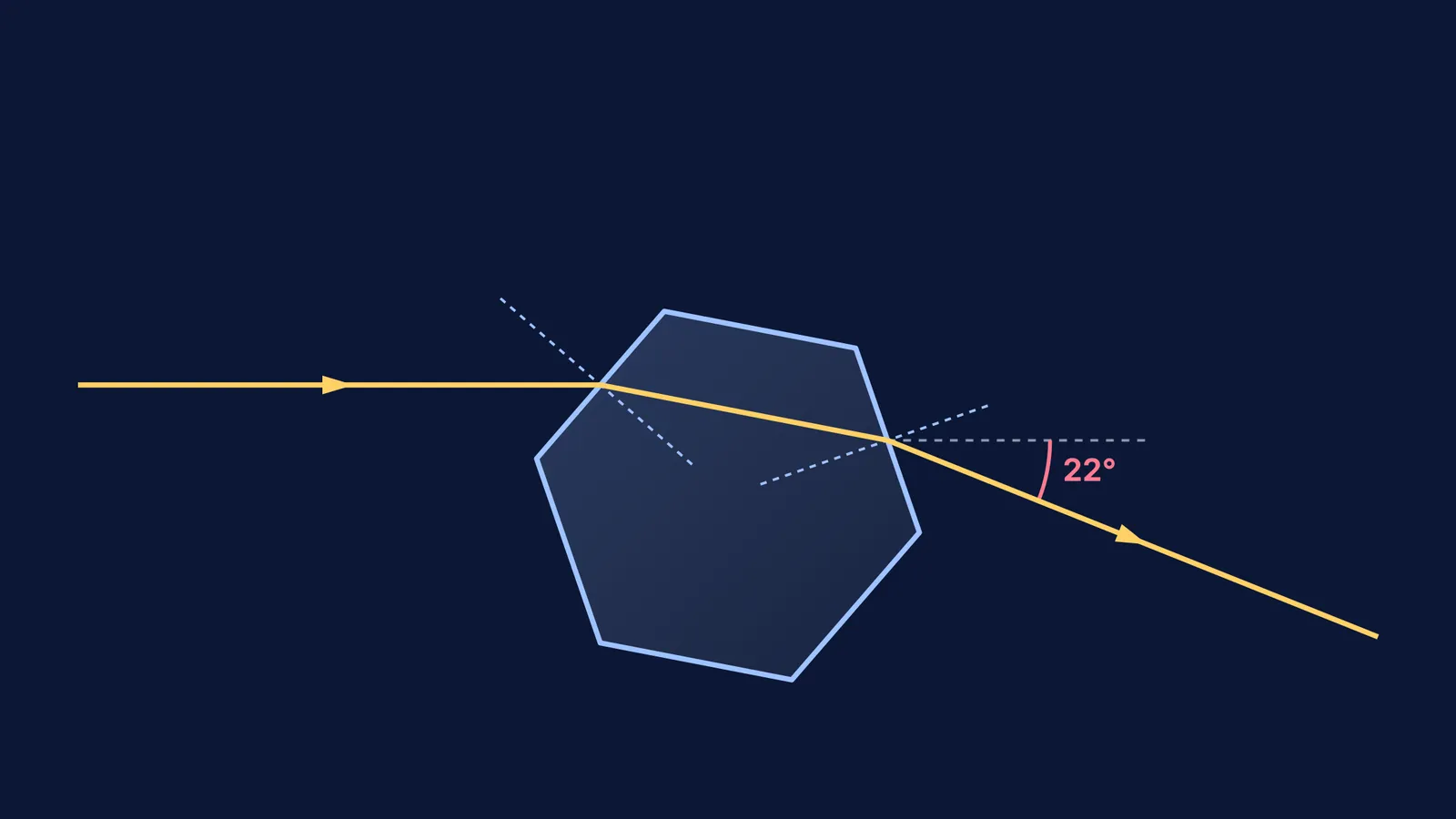
These clouds are packed with millions of tiny ice crystals. Because of the molecular structure of water, these crystals freeze into a hexagonal (six-sided) shape. When moonlight passes through this high-altitude ice sheet, the crystals act like a vast, suspended field of tiny prisms, catching the light and redirecting it back down to the ground.
Why is the halo exactly 22 degrees wide?
Whether you are looking at a lunar halo or a solar halo (its daytime equivalent), the ring always appears at a specific, consistent size: exactly 22 degrees away from the moon or sun. For scale, 22 degrees is roughly the width of your outstretched hand at arm's length (Wikipedia).
The reason for this precise angle comes down to the geometry of the ice crystals and the physics of refraction. As light enters one face of a hexagonal ice crystal and exits through an alternating face, it passes through a 60-degree angle. When light travels from air into ice, it slows down and bends, a property measured by the refractive index. The refractive index of ice is approximately 1.31.
Through a process called minimum deviation, the vast majority of the light passing through a 60-degree ice prism is bent from its original path by an apparent radius of approximately 22 degrees. Because the ice crystals in the clouds are tumbling and pointing in all random directions, there are always enough crystals perfectly aligned to bounce that 22-degree light straight into your eyes, creating a complete circle.
Can a lunar halo predict the weather?
Old weather folklore claims that a ring around the moon means rain or snow is coming soon. Unlike many old sayings, this one has a solid grounding in meteorology.
Because these high clouds often come a few days before a large storm front, folklore says a lunar halo warns of approaching storms. However, it is an unreliable sign because these clouds can occur without any weather change (Wikipedia).
Exploring refraction and prisms
The same principles that create a massive halo in the night sky apply to the glass prisms you might use in a physics lab.
To understand how light bends depending on the angle at which it hits a surface, you can review our guide to deviation vs incidence: the prism i-d graph practical explained.
For a look at how different colours of light bend by slightly different amounts, see dispersion of white light by a glass prism, explained for Class 10.
If you struggle to picture how light rays bend through different shapes and materials, the Fermi Simulation Lab provides interactive simulations for the ideas that are easier to see than to read. You can adjust the refractive index and the prism angle to see exactly why the light converges at 22 degrees.
The next time you spot a ring around the moon, you can impress your friends with the knowledge that they are looking at moonlight bent by billions of tiny, six-sided ice prisms floating miles above their heads.


