

On this page
After a rain shower, you might spot two concentric arcs spanning the sky: a bright primary rainbow below, and a fainter secondary bow higher in the sky with inverted colours. Their geometry is an inevitable outcome of wave and ray optics across suspended raindrops.
What causes a secondary rainbow to form?
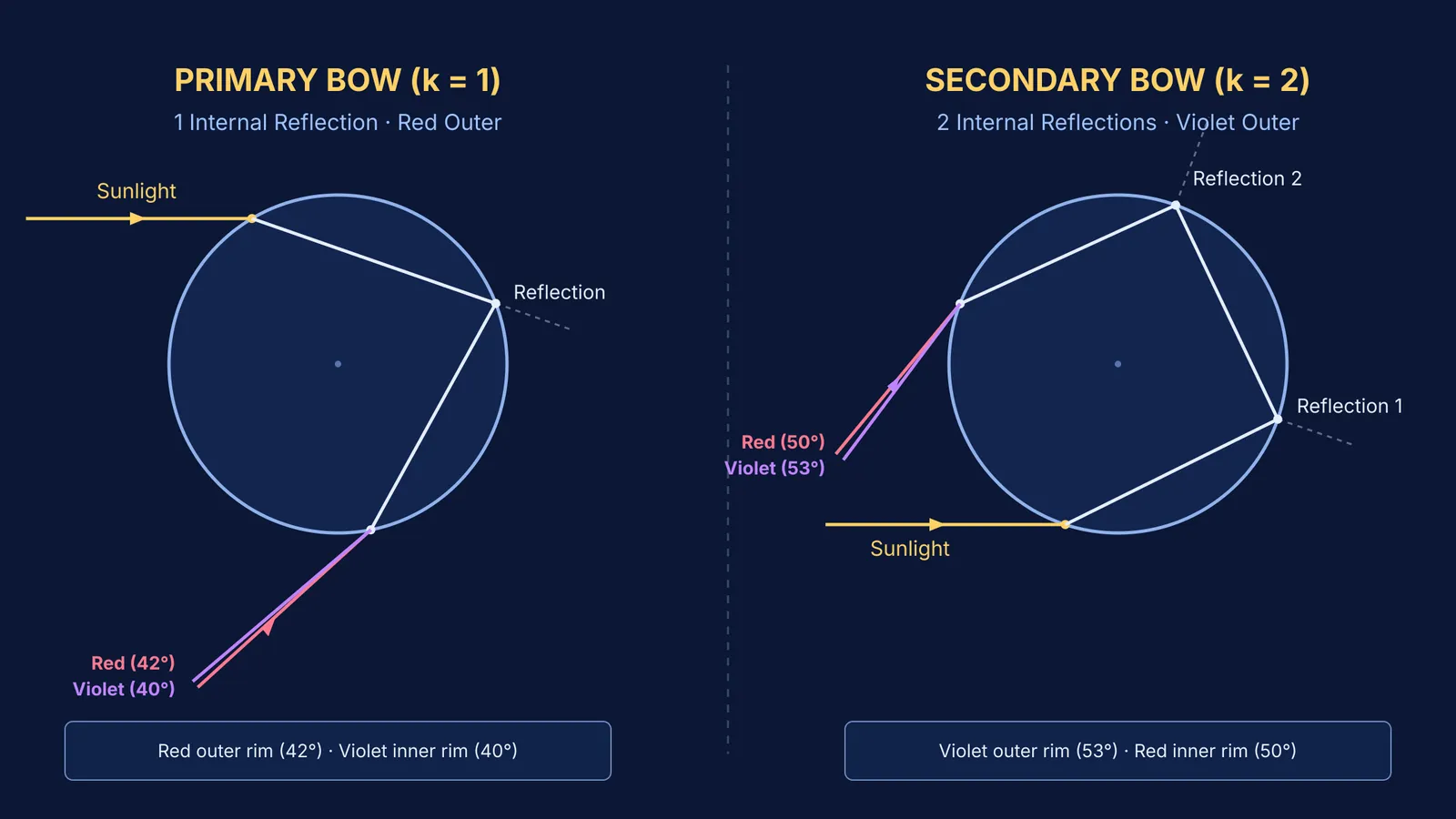
Every rainbow relies on refraction, internal reflection, and dispersion. When sunlight enters a raindrop, light refracts and bends toward the normal. In a primary rainbow, light reflects once off the rear boundary and exits at 40° to 42° relative to incoming sunlight, per the National Weather Service.
A secondary rainbow forms along a steeper path through the drop's lower half. Rays refract upward, reflect off the rear inner surface, reflect a second time off the upper-front surface, and refract downward toward your eye. With two internal reflections, emergent rays concentrate at 50° to 53° around the anti-solar point, according to OpenStax University Physics. The principles governing dispersion of white light by a glass prism apply here, but the extra bounce expands the exit angle.
Why are the colours reversed in a double rainbow?
In the primary rainbow, red forms the outer rim at 42° and violet lines the inside at 40°. In the secondary rainbow, violet sits outside at roughly 53° and red sits inside at roughly 50°, as detailed by OpenStax University Physics.
This inversion occurs because each internal reflection reverses the spatial order of the rays. As sunlight enters water, violet bends more sharply than red because water's refractive index varies from 1.342 for violet (410 nm) to 1.331 for red (660 nm), per OpenStax University Physics. In a primary bow, red exits at 42.3° and violet at 40.4°, placing red higher in the sky.
In the secondary rainbow, two reflections cross the ray paths inside the droplet. Violet emerges at roughly 53° from the anti-solar point, whereas red emerges at roughly 50°. Because violet exits at the steeper angle, raindrops higher in the sky direct violet light to your eyes, putting violet on the outer rim.
Why is the secondary rainbow so much fainter?
A secondary rainbow is noticeably dimmer than the primary arc. Many students assume raindrops trap light by total internal reflection, but total internal reflection only occurs when the angle of incidence exceeds the critical angle.
Inside a raindrop, rays strike the boundary at 40° to 45.5°, well below water's 48.6° critical angle. Each bounce is partial Fresnel reflection: over 90% of light refracts out, leaving under 10% reflected internally. With two bounces, intensity drops quadratically. Together with an angular spread of about 3.5°, these reflection losses leave the secondary bow less than half as bright as the primary bow, as physicist Jearl D. Walker showed in the *American Journal of Physics*. Understanding how the speed and wavelength of light change across different media explains why light escapes at each boundary.
What is Alexander's dark band between the rainbows?
The sky between the two rainbows looks noticeably darker than the surrounding air. This corridor is known as Alexander's dark band, named after Alexander of Aphrodisias, who first recorded it around 200 AD.
Ray optics shows that droplets cannot scatter light into the angular gap between 42° and 50°. One-reflection rays only emerge up to 42°, brightening the sky under the primary bow. Two-reflection rays only emerge at 50° or higher, brightening the sky above the secondary bow. As H. Moysés Nussenzveig showed in *Scientific American*, because no concentrated rays exit between 42° and 50°, virtually no light reaches your eyes from that strip.
The Fermi Simulation Lab provides interactive simulations for ideas that are easier to see than to read, allowing students to trace how light folds into caustics inside drops.
How can you calculate rainbow angles from first principles?
Rainbow problems test the calculus of minimum deviation, as analyzed in the *American Journal of Physics*. In 1637, René Descartes showed that rays concentrate where deviation D(i) reaches a stationary point. For k internal reflections, D(i) = 2(i − r) + k(π − 2r). Differentiating with Snell's law (sin i = n sin r) yields the Descartes condition:
cos i = √((n² − 1) / (k(k + 2)))
Evaluating this for water (n = 4/3) clarifies the two bows:
Primary bow (k = 1): cos i = √((n² − 1) / 3), giving i ≈ 59.4°, r ≈ 40.2°, and viewing angle 180° − D ≈ 42° with red outside.
Alexander's dark band: Forbidden gap from 42° to 50° where no rays exit.
Secondary bow (k = 2): cos i = √((n² − 1) / 8), giving i ≈ 71.8°, r ≈ 45.5°, and viewing angle D − 180° ≈ 51° with violet outside.
Reviewing refraction through a transparent sphere reinforces these boundary conditions. The Fermi Problem Library offers worked problems with a step-by-step solver that explains the reasoning rather than printing an answer.


