

On this page
When you look up at a dark storm cloud, it is easy to forget how high it is. A typical rain cloud sits around 2,000 metres (6,500 feet) above the ground. If a drop of water were to fall from that height in a vacuum, the consequences would be disastrous.
How fast would rain fall without air resistance?
If Earth had no atmosphere, gravity would be the only force acting on the rain. The drop would accelerate downwards at 9.8 metres per second squared for its entire journey.
Using the standard equations of motion for constant acceleration—the same ones used to calculate the distance in the nth second in Class 11 physics—we can find the final speed (v² = u² + 2gh). A drop falling from 2,000 metres would hit the ground at roughly 200 metres per second (about 450 mph) National Weather Service.
To put this into perspective, kinetic energy increases with the square of velocity. A drop travelling at 200 metres per second would carry over four hundred times the energy of a normal raindrop. At that speed, rain would hit you faster than a speeding race car. A heavy storm would punch holes in umbrellas, strip leaves from trees, and make it far too dangerous to step outside. The reason we can walk safely through a shower is all down to the physics of fluids.
Why do raindrops not hurt when they fall from so high?
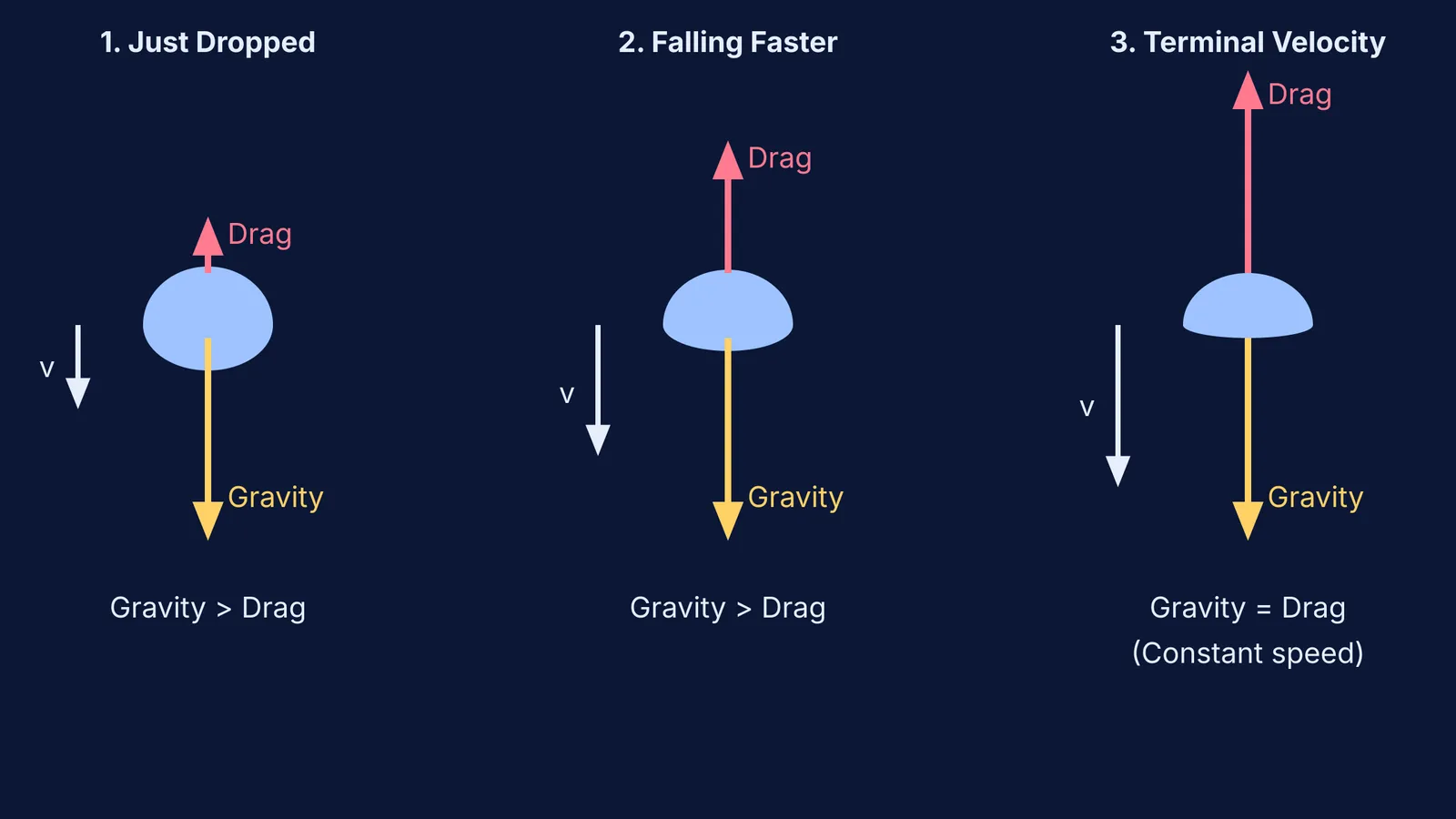
As soon as a raindrop leaves the cloud, it begins pushing through the Earth's atmosphere. To move down, it has to shove air molecules out of the way, and those molecules push back. This upward resisting force is called aerodynamic drag.
Drag increases as the raindrop moves faster, generally growing with the square of the velocity. Because the net force is constantly changing, this is a real-world example of acceleration given as a function of velocity. Gravity pulls down with a constant force, but the upward drag force grows stronger by the millisecond as the drop gains speed.
Eventually, the upward push of the air perfectly balances the downward pull of gravity. The net force becomes zero. From that exact moment, the drop stops accelerating and falls at a steady, constant speed known as terminal velocity.
The balance of forces that leads to terminal velocity is a classic problem in Class 11 physics. If you are trying to understand drag and acceleration, the Fermi Simulation Lab has interactive simulations for the ideas that are easier to see than to read, letting you watch the vectors balance in real time.
What is the terminal velocity of a raindrop?
The exact speed limit of a drop depends on its size. According to the US National Weather Service, different sizes of rain fall at drastically different speeds National Weather Service:
Large raindrops: A drop spanning 5 millimetres falls at a terminal velocity of about 9 metres per second (20 mph).
Drizzle: A tiny drop less than half a millimetre across reaches a terminal velocity of just 1 metre per second (2 mph).
Because water is a liquid, it also deforms the moment it hits your skin. A solid object like a hailstone concentrates all its kinetic energy on one small point, which is why hail can cause serious injuries. A raindrop splashes, spreading its already low energy over a wider area and softening the impact.
Do large raindrops fall faster?
Larger drops are heavier, which means gravity pulls on them with more force. They must fall faster than small drops to generate enough air drag to balance their extra weight.
The reason small drops fall so slowly comes down to the ratio of their surface area to their mass. Drag depends on the surface area pushing through the air, while the downward pull of gravity depends on the drop's mass. As a drop gets smaller, its mass decreases much faster than its surface area. A tiny drizzle drop has very little mass compared to its area, so it only takes a small amount of speed to generate enough drag to balance its weight. In contrast, a large, heavy raindrop must fall significantly faster to build up the necessary air resistance.
However, there is a strict physical limit to how large and how fast a raindrop can get. As a raindrop speeds up, the air pressure pushing against its bottom increases. This pressure physically changes the shape of the water. While rain is often drawn as a pointed teardrop, a real raindrop is flattened by air resistance into the shape of a hamburger bun National Weather Service.
If a drop grows wider than 6 millimetres, the air drag pushing against its flat bottom becomes stronger than the surface tension holding the water together. The drop becomes unstable and rips apart into a shower of smaller, slower droplets. This natural breaking point ensures that no raindrop can ever grow heavy enough, or fall fast enough, to do us any harm.


