On this page
Look at the belt that drives a water pump, an air cooler or a flour mill and you will see that it is not flat. Its cross-section is a trapezium, and it runs in a V-shaped groove cut into the pulley. That shape lets the same belt, at the same tension, carry about 50% more power before it slips. The reason is a simple wedge: pressing a belt into a V makes the walls push on it much harder than a flat pulley would, and friction follows the normal force.
How does a belt drive pass on torque?
A belt carries torque because the tension on one side, T₁ (the tight side), is larger than on the other, T₂ (the slack side). The torque on a pulley of radius r is (T₁ − T₂) × r. Friction between belt and pulley holds that difference. The largest ratio friction can hold, for a belt wrapped through an angle θ, is the capstan law T₁/T₂ = e^(μθ). Where that exponential comes from is derived in why rope tension grows exponentially around a cylinder, so here we take it as known. The only question for a V-belt is what happens to μ.
Why does a V groove press harder than a flat pulley?
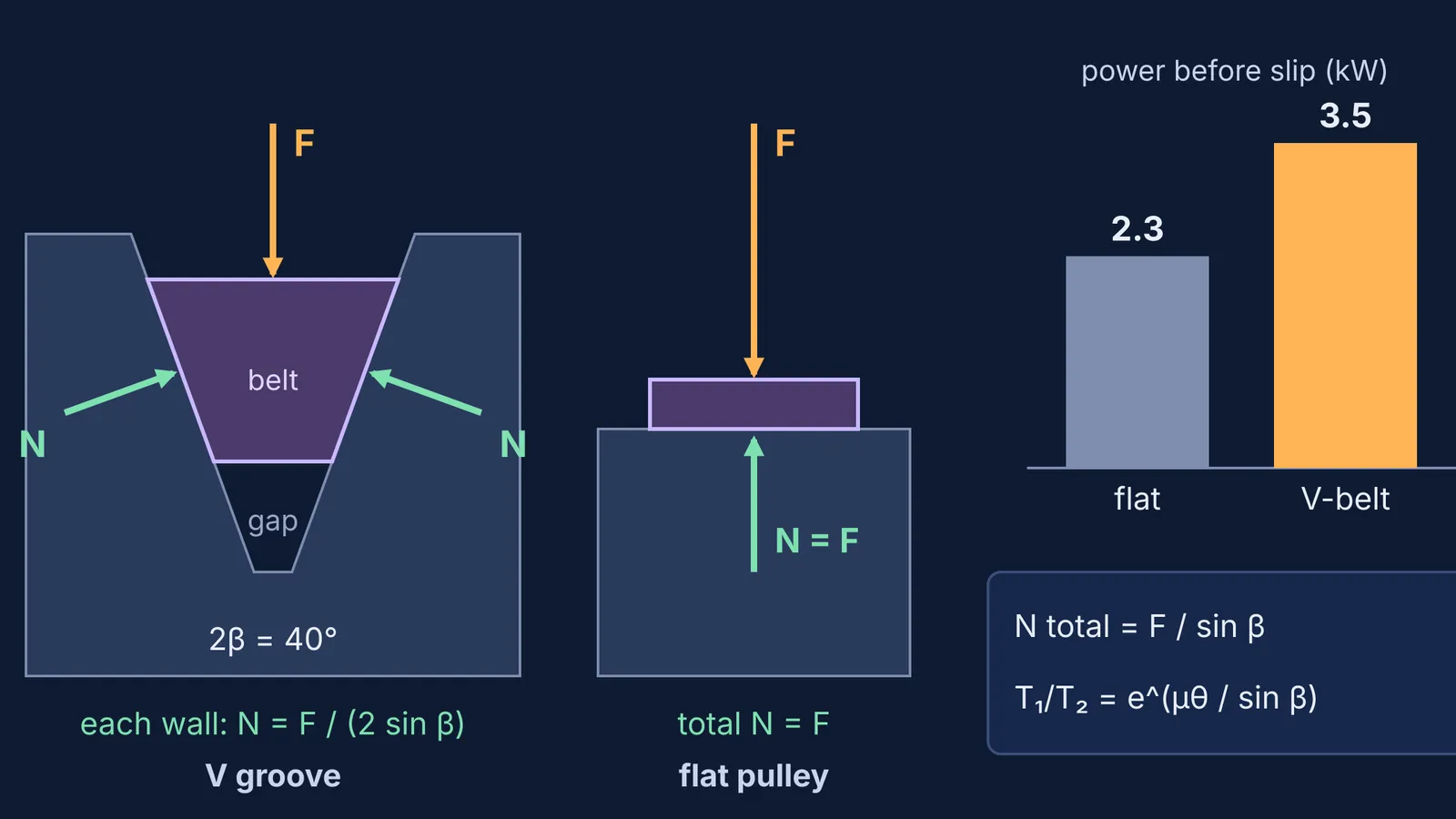
Take a short piece of belt. The belt tension around the curve pushes it towards the pulley axis with some force F. On a flat pulley, the pulley pushes straight back with a normal force N = F, and the friction limit is μF.
Now put the belt in a groove whose two walls meet at a total angle 2β, so each wall leans at β from the centre line. Each wall pushes on the belt at right angles to the wall, with force N. Only the component of N along the centre line, N sin β, balances F, and there are two walls:
2N sin β = F, so N = F / (2 sin β).
The total normal force is 2N = F / sin β. For a small β, sin β is small and the wall forces are much larger than F, just as a thin wedge exerts large sideways forces when you push on it. Friction acts along the belt on both walls, so the friction limit becomes μF / sin β. In the capstan law, μ is simply replaced by μ / sin β:
T₁/T₂ = e^(μθ / sin β)
The number 1/sin β is the wedge factor.
What groove angles do real V-belt pulleys use?
They are not all 40°. Belt makers vary the groove angle with pulley diameter, because a belt's cross-section distorts more when it bends round a small pulley. The Gates Heavy Duty V-Belt Drive Design Manual lists 34° for small classical A and B pulleys and 38° for larger ones, and 36° to 42° for narrow-section (3V, 5V, 8V) pulleys, with the smallest angles on the smallest pulleys. The wedge factor across that range:
2β = 34°: 1/sin 17° ≈ 3.42
2β = 38°: 1/sin 19° ≈ 3.07
2β = 40°: 1/sin 20° ≈ 2.92
2β = 42°: 1/sin 21° ≈ 2.79
A narrower groove grips harder, but the belt also wedges in deeper and has to be pulled back out at every turn, which wastes energy and wears the belt. Real grooves settle in the mid-30s to low 40s.
Worked example: how much more does a V-belt carry?
Illustrative data: belt wrapped through 180° (θ = π), μ = 0.3 for rubber on cast iron (real values vary a lot), tight-side tension limited to T₁ = 500 N, driving pulley of radius r = 5 cm turning at 1,440 rpm, groove angle 40° so β = 20°. Ignore the belt's own centrifugal tension.
Step 1: Angular speed. ω = 1440 × 2π / 60 ≈ 150.8 rad/s. Belt speed = rω ≈ 7.5 m/s.
Step 2: Flat belt. μθ = 0.3 × π ≈ 0.942. T₁/T₂ = e^0.942 ≈ 2.57. T₂ = 500 / 2.57 ≈ 194.8 N.
Tension difference: 500 − 194.8 ≈ 305 N.
Torque: 305 × 0.05 ≈ 15.3 N m.
Power: 15.3 × 150.8 ≈ 2.3 kW.
Step 3: Wedge factor. 1/sin 20° = 1/0.342 ≈ 2.92, so the effective friction coefficient is 0.3 × 2.92 ≈ 0.88.
Step 4: V-belt. μθ / sin β ≈ 0.942 × 2.92 ≈ 2.76. T₁/T₂ = e^2.76 ≈ 15.7. T₂ = 500 / 15.7 ≈ 31.8 N.
Tension difference: 500 − 31.8 ≈ 468 N.
Torque: 468 × 0.05 ≈ 23.4 N m.
Power: 23.4 × 150.8 ≈ 3.5 kW.
Step 5: Compare. Same belt, same maximum tension, and the V-belt passes on about 1.53 times the power. The tension ratio went up sixfold, but the power did not, because the tension difference can never exceed T₁. Once T₂ is small, most of the possible gain is already used.
Units check: tension in N times radius in m gives N m; N m times rad/s gives W.
Why must a V-belt not touch the bottom of the groove?
The whole effect comes from the side walls. If the belt sits on the floor of the groove, the floor takes part of F with an ordinary normal force and the walls take less, so the grip falls back towards that of a flat belt. Gates lists exactly this in its troubleshooting table: in worn grooves, belts bottom out and will not transmit power until they are overtensioned. A worn pulley or the wrong belt size causes it.
The same manual bases its design tensions on a tight-to-slack ratio of 5:1 at 180° of wrap. Compare that with the 15.7 we found as the slip limit. Designers stay well below slip, because a belt that is on the edge of slipping heats up and wears quickly.
Where do you meet belt drives in exam questions?
A gearless scooter runs a V-belt between two pulleys whose effective diameters change with speed; the clutch that connects it is explained in how a centrifugal clutch lets a scooter idle without moving. Why a drive needs different ratios of speed to torque at all is covered in why vehicles need gears. In JEE, the wedge factor turns up as a block in a V-shaped trough or a belt in a grooved pulley, and the method is the same: resolve the wall forces, find total N, then apply μN.
If friction problems with more than one contact surface trip you up, the Fermi Problem Library has a step-by-step solver that explains the reasoning at each step.
Quick checklist
Belt torque = (T₁ − T₂) r; friction sets the largest T₁/T₂.
In a groove of total angle 2β, each wall pushes with F / (2 sin β); total normal force F / sin β.
Capstan law for a V-belt: T₁/T₂ = e^(μθ / sin β).
40° groove: wedge factor 2.92; 34° groove: 3.42.
Worked example: flat 305 N, 2.3 kW; V-belt 468 N, 3.5 kW at the same 500 N.
A belt that bottoms in the groove loses its wedge grip.