On this page
An engine is fussy about how fast it spins; wheels are not. The gearbox and clutch bridge that gap, and with numbers on it, the gear stick becomes a school torque problem.
Why do vehicles need gears?
Internal combustion engines typically run between about 600 and 7,000 rpm, while a car's wheels must turn anywhere from 0 to about 1,800 rpm (Transmission, Wikipedia). No single fixed link works from standstill to highway speed.
Nor is the engine equally strong across its range. Torque is low at idling speed, peaks somewhere between 1,500 and 6,500 rpm depending on the engine, and then falls towards the redline (Power band, Wikipedia). Power is torque multiplied by rotational speed, so peak power comes in the upper range where both are high, according to the same source.
A gearbox keeps the engine near that strong band whatever the road speed, which is why most passenger cars made today with petrol or diesel engines have between 4 and 10 forward gears (Transmission, Wikipedia).
How does a gear ratio multiply torque?
When two gears mesh, the gear ratio is the ratio of their angular speeds, and it equals the ratio of their numbers of teeth (Gear train, Wikipedia). Ignoring losses, the torque ratio of a gear train equals that same speed ratio. A 3.5:1 gear makes the output shaft turn 3.5 times slower with 3.5 times the torque.
The torque at the wheel becomes a forward push only because the road pushes back, as explained in which way friction acts on car wheels when accelerating.
Worked example: one engine, five gears
Take a model hatchback with round numbers we chose, not a real car's specification: peak torque 115 N·m at 4,000 rpm, gear ratios 3.5, 1.9, 1.3, 1.0 and 0.8, a final drive of 4.0, wheels of radius 0.29 m, and 10% of the power lost in the drivetrain. The two rules come from the gear train relations: torque times ratio, speed divided by ratio.
First gear, overall ratio: 3.5 × 4.0 = 14.
Wheel speed at 4,000 rpm: 4,000 ÷ 14 ≈ 286 rpm. Road speed: 286 × 2π × 0.29 m ÷ 60 ≈ 8.7 m/s, about 31 km/h.
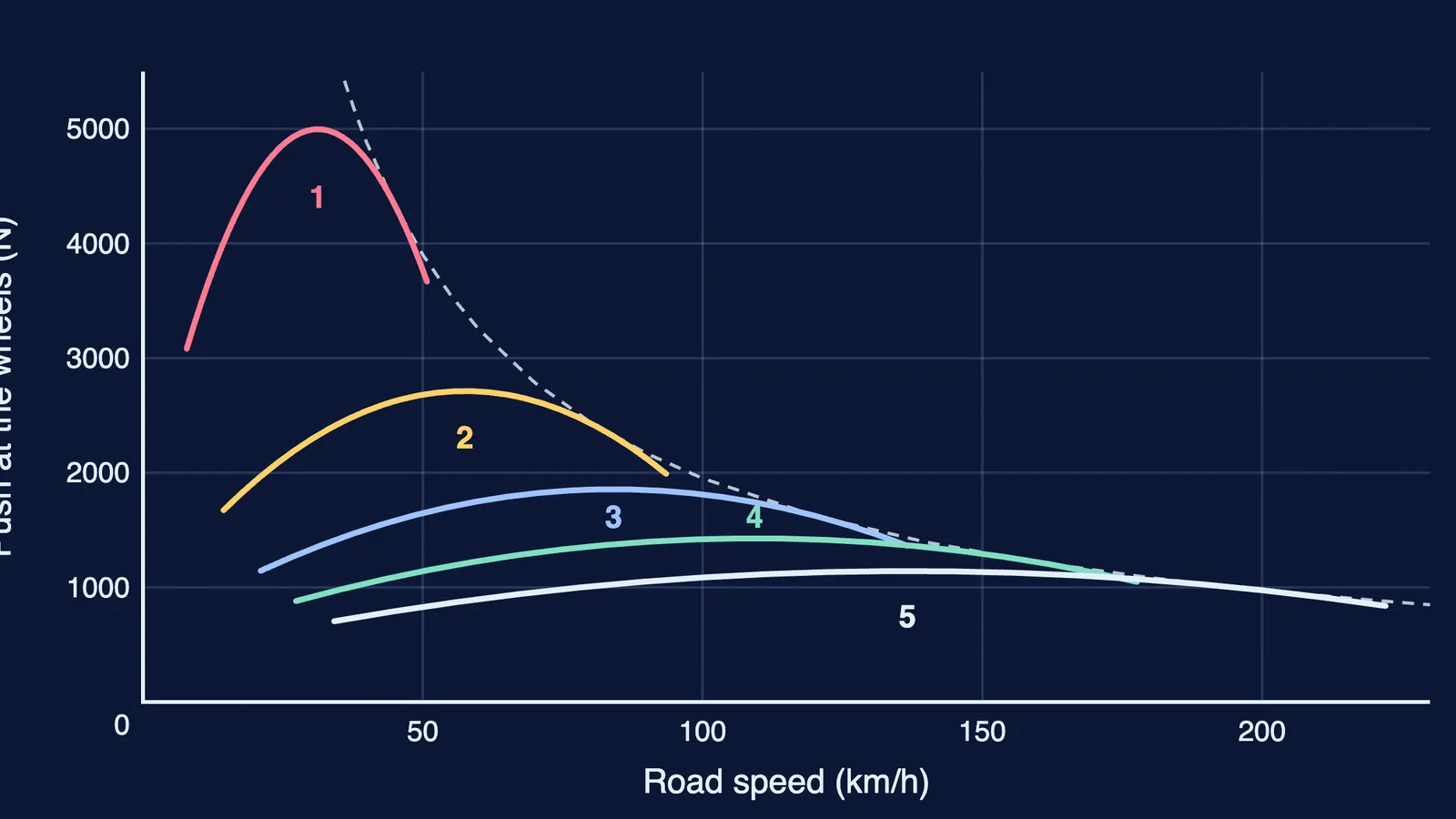
Wheel torque: 115 × 14 × 0.9 ≈ 1,449 N·m. Push on the road: 1,449 ÷ 0.29 ≈ 5,000 N.
Fifth gear, overall ratio 0.8 × 4.0 = 3.2: wheel speed 1,250 rpm, about 137 km/h, wheel torque about 331 N·m, push about 1,140 N.
Same engine, same rpm: first gear gives about 4.4 times the push at less than a quarter of the speed. That is why you pull away in first and climb a ghat road in a low gear; trains meet a similar limit, as why trains need extra engines on steep ghat sections explains.
Why not one gear? With a 6,500 rpm redline, first tops out near 51 km/h. In fifth, even 1,000 rpm means about 34 km/h, so the car could not crawl away from rest. The chart at the top plots all five gears: each covers a slice of road speeds, and together they hug the engine's power limit (dashed).
What does the clutch disconnect?
A clutch lets an output shaft be disconnected from a rotating input shaft; in a car it sits between the engine and the gearbox, and when it is disengaged the engine's speed is no longer set by the speed of the wheels (Clutch, Wikipedia). That matters at two moments:
Moving off. The wheels are at 0 rpm but the engine cannot be. Release the clutch too suddenly while stationary and the engine stalls; releasing it slowly avoids this (Stall, Wikipedia).
Changing gear. In a manual car you press the clutch to disconnect the engine while you move the gear stick; most modern manual gearboxes use synchromesh to match the shaft speeds as the next gear engages (Transmission, Wikipedia).
The common hydraulic automatic does this job with a torque converter instead of a friction clutch, says the same source.
Why do electric cars usually have one gear?
Electric vehicles typically use fixed-ratio or two-speed transmissions, because electric motors can run efficiently across wider ranges of speed, all the way down to standstill (Transmission, Wikipedia). For how riding affects fuel use, see how to calculate your bike's mileage, and what lowers it.
How do you solve a gear problem?
Four steps, for any textbook question:
Multiply the stages for the overall ratio (gearbox × final drive).
Multiply torque by the ratio; divide angular speed by it.
Convert at the wheel: force = torque ÷ radius, speed = angular speed × radius.
Check that force × speed is close to the engine's power, less losses.
If gears trading speed for force is hard to picture, the Fermi Simulation Lab has interactive simulations for ideas that are easier to see than to read. If your sum goes wrong at step 2 or 3, the Fermi Problem Library has worked problems with a step-by-step solver that explains the reasoning. And Fermi's AI tutor works out what you already know and builds a plan for the session.