

On this page
Every bike owner in India has heard a mileage figure quoted at the showroom, and almost every owner gets a different number on the road. The only number that matters is the one your bike gives you, and you can measure it with a petrol pump, the odometer and one division. Then the physics of drag, tyres and speed explains why that number moves.
How do you calculate the mileage of a bike?
Mileage is distance travelled divided by fuel used, written in kilometres per litre (km/L). The full-tank method measures both honestly, because you count exactly the fuel the bike burned.
Fill the tank to the brim at one pump and note the odometer reading.
Ride as you normally do until the tank is well below half.
Go back to the same pump, ideally the same nozzle, and fill to the brim again.
Note the litres on the pump display and the new odometer reading.
Mileage = kilometres ridden divided by litres refilled.
Here is a worked example. The odometer reads 12,430 km at the first fill. A week later it reads 12,640 km, and the refill takes 3.8 litres. You rode 12,640 minus 12,430, which is 210 km, so the mileage is 210 divided by 3.8, about 55.3 km/L.
One test is noisy, because the brim is never filled to quite the same level. Repeat it for three tanks and you have a number you can trust and compare after changing a habit.
Where does the energy in petrol actually go?
Most of it never reaches the wheels. The US government's fuel economy site, run by the Department of Energy and the EPA, says only about 12% to 30% of the energy in the fuel moves a conventional vehicle down the road; the rest is lost in the engine and drivetrain or runs accessories. These figures are for conventional vehicles such as cars, but the same forces act on a bike.
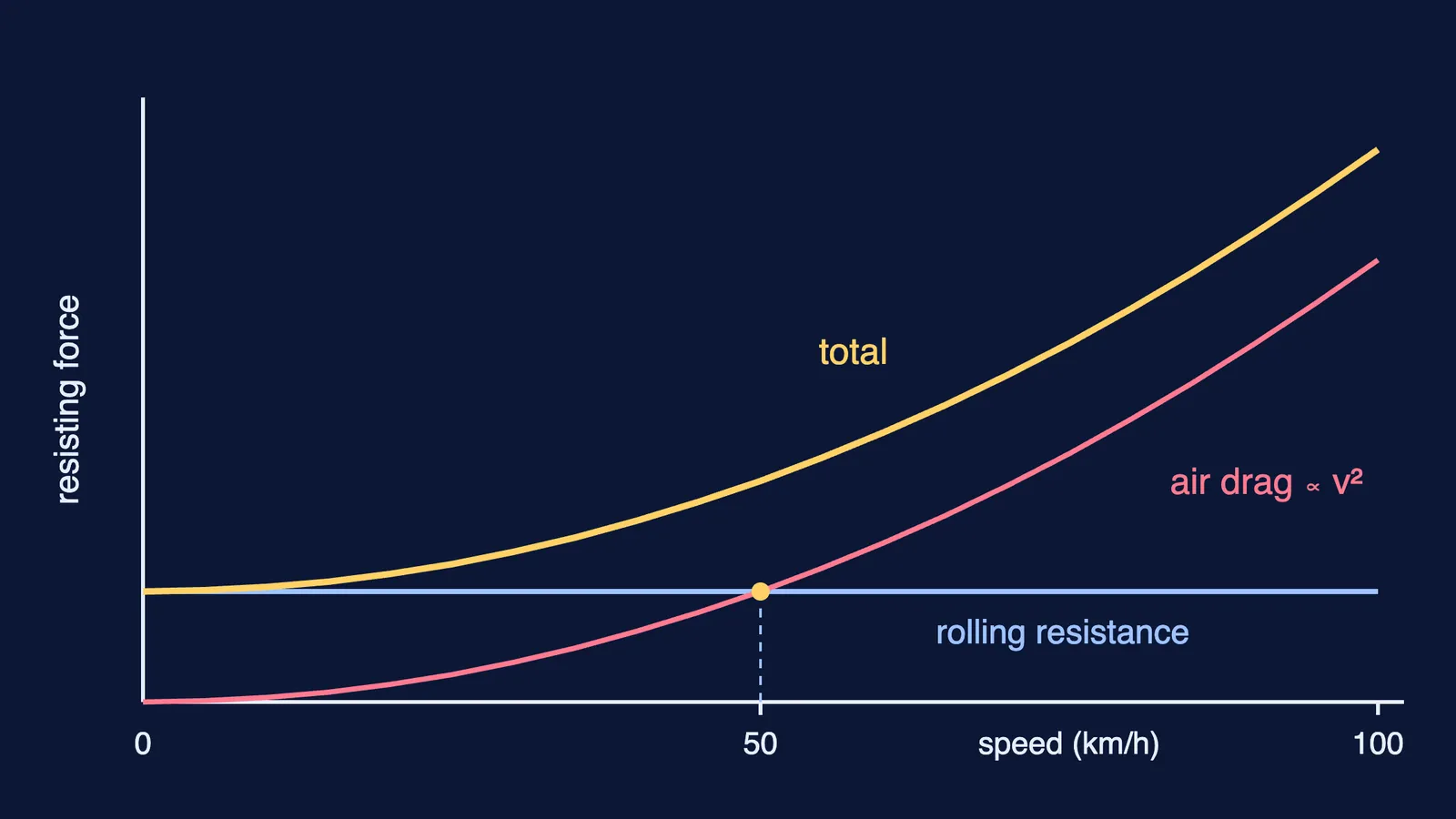
The energy that does reach the wheels is spent pushing against two forces. The same page describes rolling resistance as a force caused by the tyre deforming as it rolls, and aerodynamic drag as wind resistance set by the vehicle's shape and frontal area. Fuel used per kilometre follows the total of these forces, because work is force times distance.
Why does mileage drop at high speed?
NASA's Glenn Research Center states that drag depends on the density of the air and the square of the velocity, along with the size and shape of the body. The drag equation is D = Cd times ρ times V squared times A, divided by 2.
That square is the whole story. Ride at 60 km/h instead of 40 km/h and drag goes up by (60/40) squared, which is 2.25 times, while rolling resistance barely changes. The engine must also deliver that force faster: NASA defines power as force times velocity, so the power spent on drag rises with the cube of speed. If you want to see the numbers for a rider, our post on the power a cyclist spends against air drag works one through, and why streamlined shapes cut fluid friction explains the Cd part.
Road data for cars agrees. The US fuel economy site notes that each vehicle has its own best speed, but mileage usually decreases rapidly above 50 mph (about 80 km/h), and that aggressive driving with hard acceleration and braking can lower it by roughly 15% to 30% at highway speeds and 10% to 40% in stop-and-go traffic.
How much does tyre pressure affect mileage?
A soft tyre squashes more as it rolls, and that extra deformation is rolling resistance you pay for in petrol. For cars, the US fuel economy site estimates that under-inflated tyres lower mileage by about 0.2% for every 1 psi drop in the average pressure of all tyres, and that keeping them at the right pressure improves mileage by 0.6% on average and up to 3% in some cases. Use the pressure in your owner's manual, not the maximum printed on the tyre's sidewall. If you ride tubeless, how tubeless tyres hold air explains why they can lose pressure slowly without you noticing.
How do you test what changes your mileage?
This is a good way to practise thinking like a physicist: measure first, change one thing, measure again, and explain the difference with a force you can name. If the v squared idea is hard to picture, the Fermi Simulation Lab has interactive simulations for ideas that are easier to see than read. And if you want to work through drag and power step by step, Fermi's AI tutor works out what you already know and builds a plan for the session.


