On this page
On a train from Mumbai to Pune or Nashik, you may have felt a bump at Karjat or Kasara as extra locomotives coupled on at the back. These are bankers, and the reason for them is Class 11 physics: inclined planes, friction and power.
What is a banker engine in a ghat section?
A PTI report describes bankers as "the additional locomotives used for pushing trains from the rear in high gradient areas in ghats", and says they also stop a train rolling back if coaches part (Outlook India, PTI report).
The same report says the 14-km Thal ghat (Kasara to Igatpuri) and the nearly 25-km Bhor ghat (Karjat to Khandala) have a gradient of 1 in 37, a rise of 1 metre for every 37 metres of run.
On the Bhor ghat, a set of three locomotives (triple-unit bankers) is attached at Karjat to every ascending train (Panvel–Karjat–Pune line, Wikipedia).
Why can't one engine pull a train up a steep slope?
Gravity along the slope. On an incline of angle θ, a train's weight mg splits into mg cos θ pressing into the track and mg sin θ pulling it back down the slope. For small angles, sin θ is almost exactly the gradient, so on a 1 in 37 ghat (PTI report) about 1/37 of the whole train's weight pulls backwards. On level track that force is zero.
Limited grip. A locomotive moves a train only through friction between its driving wheels and the rail, so the most it can push is μ times the weight on those wheels. For steel on steel, the friction coefficient on railways is typically between 0.35 and 0.5, and under extreme conditions it can fall as low as 0.05 (Adhesion railway, Wikipedia). In tests behind a 2017 wheel–rail adhesion model, adhesion fell as low as 0.06 at high creep with only wear debris and a little water in the contact (Trummer et al., Tribology International, 2017).
So a more powerful motor alone does not help: beyond μ times the weight, the wheels spin. Adding engines adds weight on driving wheels, and that adds grip. Pushing from the back also means the couplings near the front do not carry the whole pull, and the bankers are there to stop the train rolling back if coaches part.
How many engines does a heavy train need on a 1 in 37 ghat?
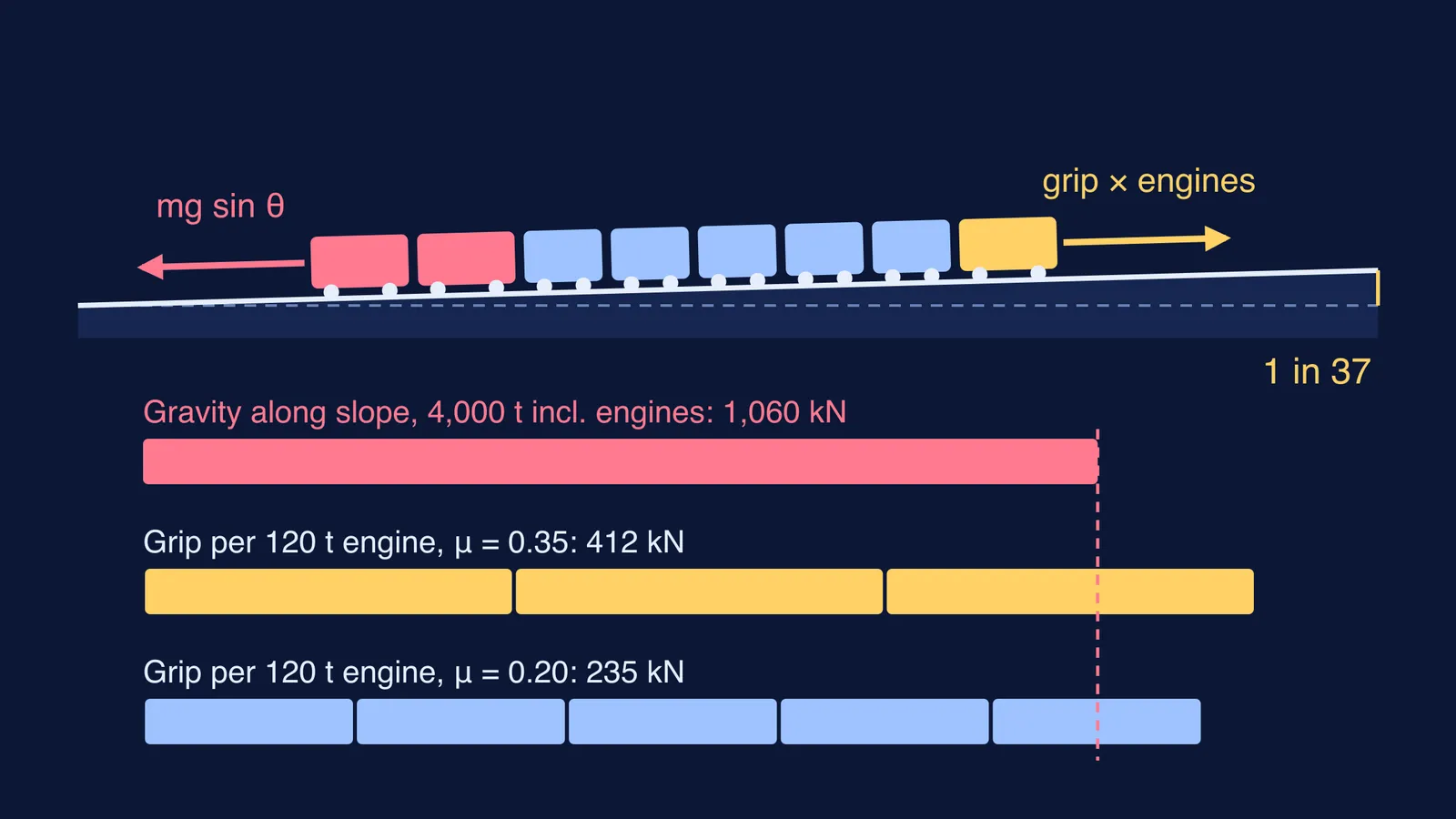
Here is a worked example with round, made-up numbers: a 4,000-tonne freight train (engines included) and 120-tonne engines on the 1 in 37 gradient from the PTI report, with a friction coefficient of 0.35, the low end of the typical range in the adhesion figures above. We ignore rolling resistance and curves, so real trains need more.
Gravity along the slope: 4,000,000 kg × 9.81 m/s² ÷ 37 ≈ 1,060 kN.
Most grip from one engine at μ = 0.35: 0.35 × 120,000 kg × 9.81 m/s² ≈ 412 kN.
Engines needed: 1,060 ÷ 412 ≈ 2.6, so three engines just to keep the train moving at steady speed.
What if wet, dirty rail lowers μ to 0.20 (an illustrative value)? Each engine then grips with about 235 kN, and 1,060 ÷ 235 ≈ 4.5, so five engines.
Power: P = Fv. At 20 km/h (5.56 m/s), fighting gravity alone takes 1,060 kN × 5.56 m/s ≈ 5.9 MW.
For the energy, take the Thal ghat, where the line rises from 289 m at Kasara to 585 m at Igatpuri (Thal Ghat, Wikipedia). Lifting 4,000 tonnes through 296 m takes mgh ≈ 11.6 GJ, about 3,200 kWh, before any friction losses.
Do all trains still need bankers on the ghats?
Not always. In early 2023, railway officials told PTI that the new Vande Bharat trains on the Mumbai–Shirdi and Mumbai–Solapur routes would run through these ghats without bankers, and that both would be fitted with parking brakes to stop them rolling down the gradient (PTI report). Holding the train is a braking problem; pushing it is a grip problem. A train with motors spread along its length has many driven wheels, which adds grip just as extra engines do.
How can you use this to study inclined planes?
Use the ghat as a checklist for any incline problem:
Draw the free-body diagram before writing any equation.
Split mg into mg sin θ along the slope and mg cos θ into it.
For gentle slopes given as 1 in n, use sin θ ≈ 1/n.
Find the largest friction force, μN, and compare it with the force needed.
If the answer asks for power, multiply the force by the speed: P = Fv.
If the split of mg into two components is hard to picture, the Fermi Simulation Lab has interactive simulations for ideas that are easier to see than to read. When an incline numerical goes wrong and you cannot see where, the Fermi Problem Library has worked problems with a step-by-step solver that explains the reasoning rather than printing an answer.
Next time your train stops at Karjat or Kasara, count the engines at the back and try the sum yourself.