On this page
Watch a house cat drink in slow motion and you will see something odd. The tongue does not scoop. It barely touches the water, flicks back up, and a thin column of water follows it into the air. The jaw snaps shut on the top of that column before gravity pulls it back down. A team at MIT and Princeton filmed this with high-speed cameras and showed that the timing is set by a contest between inertia and gravity. It also gives a scaling law you can derive with dimensions.
How does a cat drink water?
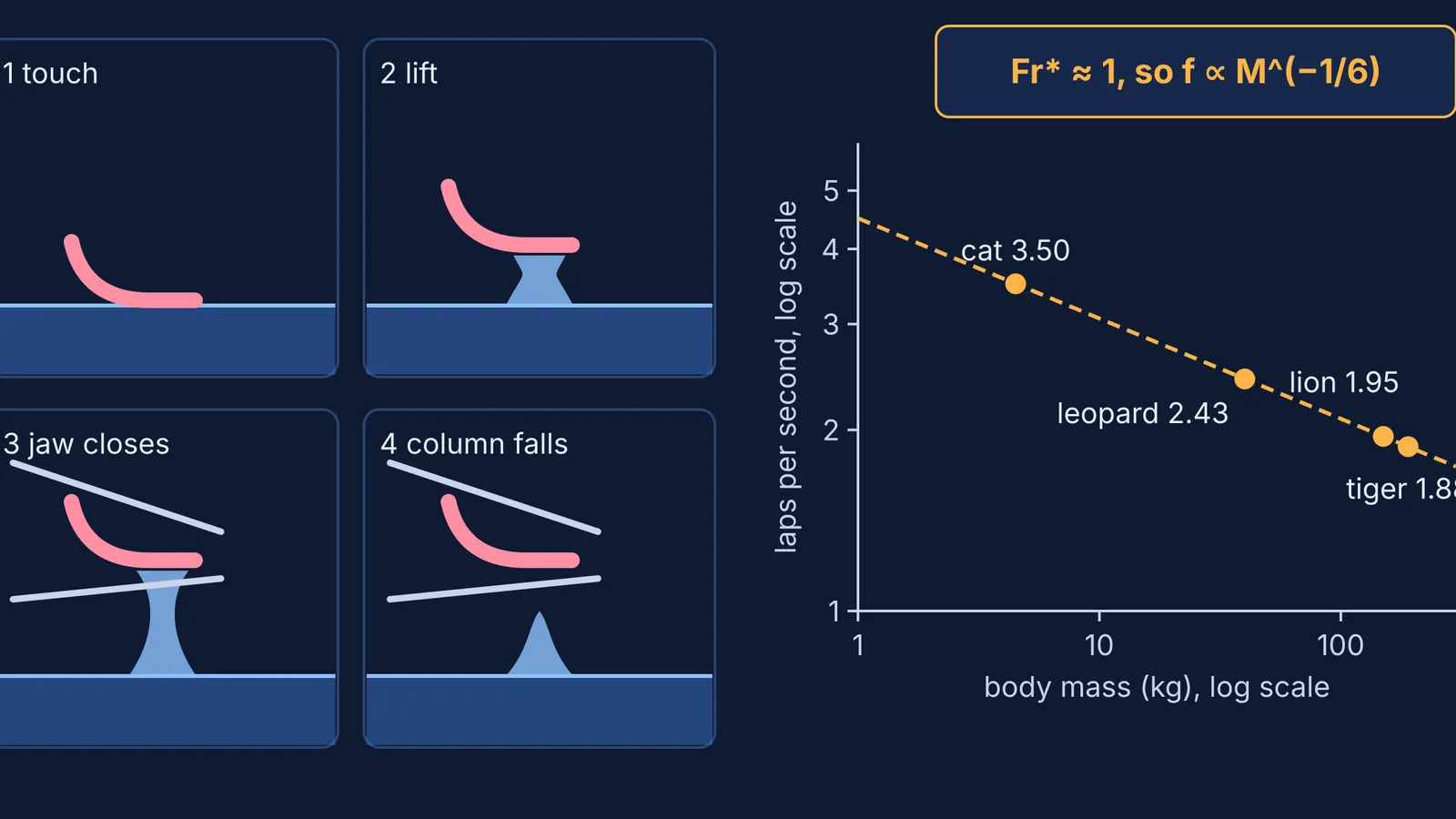
In 2010, Pedro Reis, Sunghwan Jung, Jeffrey Aristoff and Roman Stocker published How cats lap: water uptake by Felis catus in Science. Their high-speed films show four stages.
Touch. The cat curls the tip of its tongue backward, so the top of the tip rests on the water surface. It does not pierce the surface.
Lift. The tongue pulls up fast. Water sticks to the smooth tip and is dragged up behind it as a column.
Close. The column keeps rising and thinning. The cat closes its jaw around the top of it.
Fall. The rest of the column drops back into the bowl.
Only the smooth tip of the tongue is used. The rough, hook-like papillae on the rest of the tongue play no part in drinking. The cat swallows only every 3 to 17 laps, according to the paper.
Do dogs drink the same way?
Not quite. Dogs curl the tongue back further, into a ladle shape, and push it into the water. But a 2015 study of 19 dogs by Gart, Socha, Vlachos and Jung, Dogs lap using acceleration-driven open pumping (PNAS), found that dogs also pull up a liquid column. The difference is the physical regime. Dogs drive the column with a sharp acceleration of the tongue; cats work in a steadier inertial regime.
How fast does a cat's tongue move?
These are measured figures from the Reis paper, not results we derive here:
Peak tongue speed U ≈ 78 cm/s (0.78 m/s).
Height the tongue rises, H ≈ 3 cm.
Width of the tongue tip, R ≈ 5 mm.
Lapping frequency f ≈ 3.5 laps per second (3.5 ± 0.4 Hz, from 10 adult cats).
Water taken per lap ≈ 0.14 mL (± 0.04 mL).
Why does the cat close its mouth at just the right time?
Two forces fight over the column. Inertia keeps the water moving up behind the tongue. Gravity pulls it back down and finally pinches it off. The paper's estimates show viscosity and surface tension matter much less.
A ratio that compares inertia with gravity is called a Froude number. It is the same dimensionless number that William Froude used to scale ship models to full-size hulls. For lapping, the paper uses
Fr = U/√(gR), with R the size of the tongue tip, and
Fr* = (R/H) × Fr^(2/3), the ratio of the time gravity needs to collapse the column to the time the tongue takes to rise.
Lap too fast and the jaw closes before much water has risen. Lap too slow and gravity pinches the column off first. The catch is largest when the two time scales match, so Fr* is of order one. For a house cat, the paper finds Fr* ≈ 0.4, which is indeed of order one.
How does lapping speed change with the size of the cat?
This is where dimensional reasoning pays off. You can derive the law in three lines, the same way you would derive a formula from dimensions.
Assume big and small cats have the same shape. Then H is proportional to R, so R/H is fixed.
Fr* ≈ 1 with R/H fixed means Fr is fixed, so U is proportional to √(gR).
The lapping frequency is about U/H, which is proportional to √(gR)/R = √(g/R). So f ∝ R^(−1/2).
Mass grows as volume, so M ∝ R³ and R ∝ M^(1/3). Putting that in gives f ∝ M^(−1/6). Heavier cats lap more slowly, but gently: 64 times the mass halves the frequency.
Testing eight cat species from zoo films and online videos, the authors fitted f = 4.6 M^(−0.181) (f in laps per second, M in kg), close to the predicted exponent of −1/6 ≈ −0.167.
Worked example: how fast does a lion lap?
Take the measured house-cat values from the Reis paper. For body mass, use a round illustrative value of 4.5 kg for the house cat, 40 kg for a leopard, 150 kg for a lion and 190 kg for a tiger. These masses are typical round figures, not data from the study.
Check the Froude number for the house cat. Fr = U/√(gR) = 0.78/√(9.81 × 0.005) = 0.78/0.221 = 3.52. Then Fr* = (5 mm/30 mm) × 3.52^(2/3) = 0.167 × 2.32 = 0.39. That is of order one, as the theory needs. Both ratios are dimensionless: m/s divided by √(m/s² × m) = m/s.
Write the scaling as a ratio. f_big = f_cat × (M_big/M_cat)^(−1/6), with f_cat = 3.5 Hz.
Leopard. 40/4.5 = 8.89. 8.89^(1/6) = 1.44. f = 3.5/1.44 = 2.4 laps per second.
Lion. 150/4.5 = 33.3. 33.3^(1/6) = 1.79. f = 3.5/1.79 = 1.95, about 2 laps per second.
Tiger. 190/4.5 = 42.2. 42.2^(1/6) = 1.87. f = 3.5/1.87 = 1.9 laps per second.
Compare with the fitted line. The paper's f = 4.6 M^(−0.181) gives 1.86 Hz for 150 kg. The pure −1/6 scaling gives 1.95 Hz, within 5% of the fit.
How long to drink 100 mL? At 0.14 mL a lap, 100/0.14 = 714 laps. At 3.5 laps a second that is 204 s, about 3.4 minutes of steady lapping, or about 0.49 mL each second.
If you want more practice turning a balance of forces into a power law, the Concept Library has short explanations of dimensional analysis and similarity that you can read alongside this sum.
What do students get wrong about cats drinking?
Thinking the tongue is a ladle. The cat's tongue does not dip into the water and carry it up in a cup. The water is pulled up by inertia behind the tip.
Calling the 0.78 m/s a derived result. Tongue speed, lap volume and frequency are measurements from film and a scale. The physics explains why they fit together.
Treating f ∝ M^(−1/6) as exact. It is a scaling model that assumes all cats share one shape. The measured exponent was −0.181 ± 0.024.
Forgetting the same-shape assumption. Size laws for animals, like the one for a wet dog shaking itself dry, all rest on a model of how the body scales. Say which one you use.
Quick checklist
A cat touches the water with the top of its curled tongue tip and pulls up a column.
The jaw closes on the column before gravity pinches it off.
Measured: about 0.78 m/s tongue speed, 3.5 laps a second, 0.14 mL a lap.
Inertia against gravity is a Froude number; the cat laps where Fr* is of order one.
Same shape plus Fr* ≈ 1 gives f ∝ R^(−1/2) ∝ M^(−1/6).
A 150 kg lion should lap about twice a second.