On this page
Cut open a cooked fish and you will find a small, hard, white bead behind each eye. That bead was the lens, and it is a near-perfect sphere. Your own lens is a flattened disc. The reason is one formula you already use in ray optics: the power of a curved surface depends on the difference in refractive index across it. Put an eye under water and that difference almost vanishes at the front of the eye, so the lens has to do the work. Here is why that makes the lens a ball, why a uniform ball still fails, and how the fish fixes it.
Why does the cornea stop working under water?
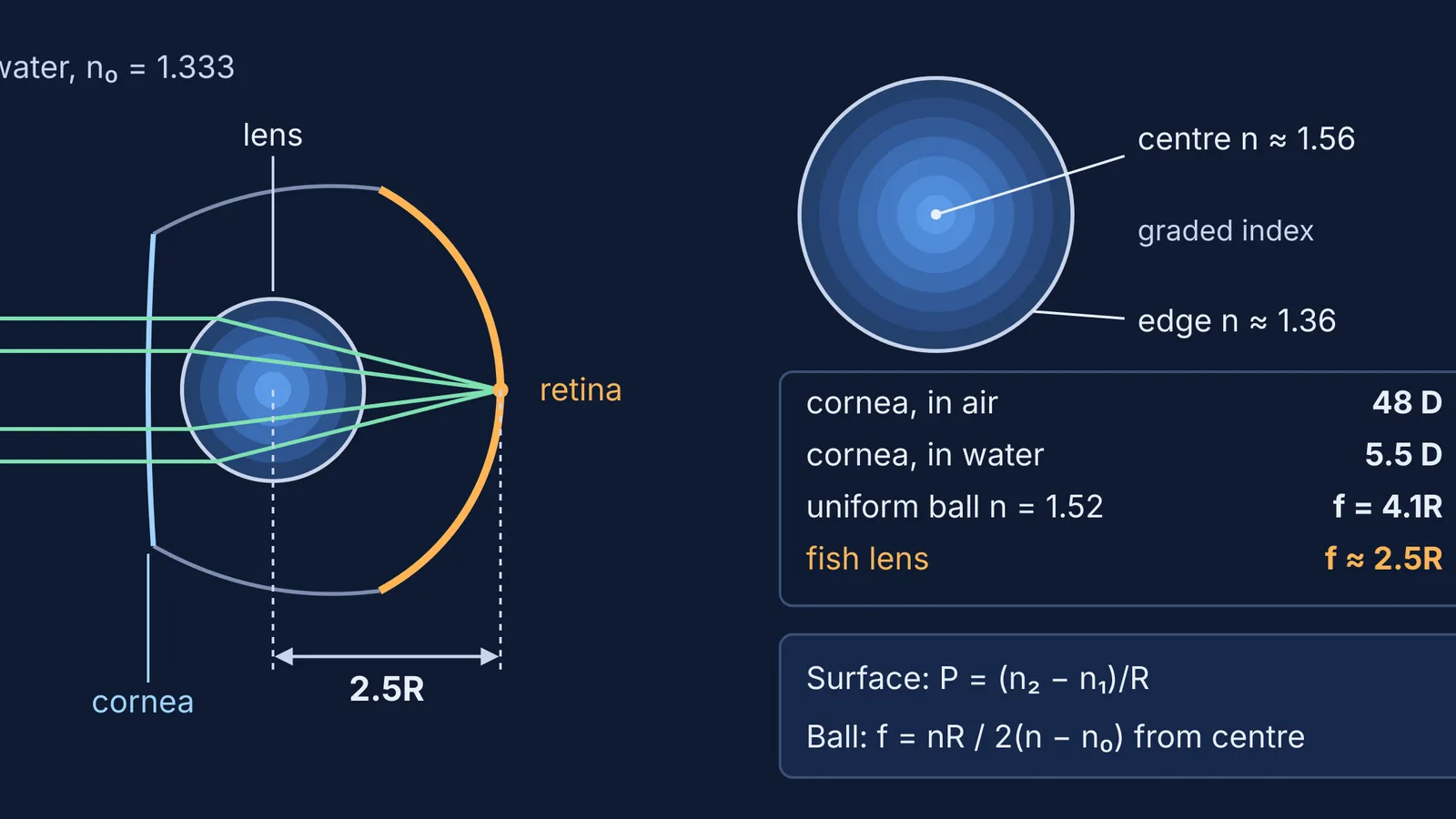
The power of a single curved refracting surface is P = (n₂ − n₁)/R, with R in metres and P in dioptres. For the human cornea, take n₂ ≈ 1.376 and R ≈ 7.8 mm (standard schematic-eye values, approximate).
In air (n₁ = 1): P = (1.376 − 1)/0.0078 ≈ 48.2 D.
In water (n₁ = 1.333): P = (1.376 − 1.333)/0.0078 ≈ 5.5 D.
The cornea keeps only about 11% of its power, so close to nine-tenths is lost. Why this blurs your vision when you swim, and how a mask puts air back in front of the cornea, is covered in why you can't see clearly under water. For a fish, the same sum means the cornea is almost optically useless all the time. As Fernald and Wright put it in a 1983 Nature paper on fish lens growth, the dioptric power of the teleost eye sits entirely in the spherical lens, because water, cornea and the fluid inside the eye have almost the same index.
Why is a sphere the strongest lens shape?
For a given lens size, power grows as the surfaces curve more, because P depends on 1/R. The most curved surface that fits a lens of radius R is a sphere of that same radius, with both faces at full curvature. Any flatter shape bends rays less.
A lens also loses power when the medium around it has a higher index, because the index step at each surface shrinks. That idea, applied to a glass lens dipped in water, is worked out in why a convex lens's focal length grows in water. A fish lens lives in exactly that situation, so it needs every bit of curvature it can get.
What is the focal length of a ball lens in water?
For a uniform sphere of index n and radius R in a medium of index n₀, the focal length is
f = nR / 2(n − n₀)
measured from the centre of the sphere, not from its surface. In air (n₀ = 1) this becomes the familiar f = nR/2(n − 1), which is used for glass beads in how Percy Shaw's cat's eyes reflect headlights. Under water you simply replace 1 by 1.333.
Worked example: can a uniform ball of lens protein focus at 2.5R?
Step 1: Set the target. Biologists measure the distance from the lens centre to the retina and divide it by the lens radius. This is Matthiessen's ratio. In the black bream it falls from about 3.6 in newly hatched larvae to about 2.3 to 2.6 by ten days, according to Shand, Døving and Collin (Vision Research, 1999). About 2.5 is the round value usually quoted for adult fish. So the lens must have f ≈ 2.5R.
Step 2: Try a uniform ball with a glass-like index. Take n = 1.52, about the index of crown glass and close to the dense centre of a fish lens.
In air: f = 1.52R / 2(0.52) ≈ 1.46R.
In water: f = 1.52R / 2(1.52 − 1.333) = 1.52R / 0.374 ≈ 4.06R.
The focus lands about 4.1 radii from the centre, far behind a retina at 2.5R. The fish would be badly long-sighted.
Step 3: Find the index a uniform ball would need. Set f = 2.5R:
n / 2(n − 1.333) = 2.5, so n = 5(n − 1.333), so 4n = 6.665 and n ≈ 1.67.
Step 4: Compare with real lenses. Axelrod, Lerner and Sands (Vision Research, 1988) traced thin laser beams through goldfish lenses and estimated an index of about 1.55 to 1.57 at the centre and 1.35 to 1.38 at the surface. Even the centre is well short of 1.67. A uniform ball made of the densest lens protein still focuses at about 3.4R in water (f = 1.56R / 2(0.227)).
Step 5: Put in sizes. A fish lens 4 mm across has R = 2 mm, so it focuses about 2.5 × 2 = 5 mm from its centre, which is 3 mm behind its back surface. That is where the retina has to be.
How does a graded-index lens solve the problem?
The fish lens is not uniform. Its index is highest at the centre and falls smoothly towards the edge. Axelrod's team found the goldfish data fit a profile of the form n² = a − br², which is the shape Matthiessen proposed in the 19th century. This gradient does two jobs.
More power. A ray inside the lens keeps bending towards the denser middle, not just at the two surfaces. The lens behaves as if it had an index higher than any value actually inside it, so a peak of about 1.56 can do what a uniform ball would need 1.67 to do.
Less spherical aberration. In a uniform ball, rays near the edge focus much closer than rays near the axis, so the image is a blur. In a graded lens the outer rays pass through lower-index material, which weakens their bending and brings them to nearly the same focus as the central rays.
The Fernald and Wright paper confirms a gradient exists in a cichlid fish lens, but its form differed from the one earlier workers had assumed, so no single neat formula fits every species. Each real lens has its own profile.
How does a fish focus on near and far objects?
You focus by changing the shape of your lens. A fish cannot squash a hard sphere into a new shape, so it moves the whole lens towards or away from the retina using a small muscle, the retractor lentis. Shand and colleagues saw this muscle become active in black bream about 10 to 12 days after hatching, around the same time Matthiessen's ratio settled.
If you want to see how a ray bends as the index changes along its path, the Simulation Lab has interactive simulations for ideas that are easier to see than to read. For more numericals on refraction at curved surfaces, try the Fermi Problem Library, whose step-by-step solver explains the reasoning.
Quick checklist
Surface power: P = (n₂ − n₁)/R. The cornea keeps only about 11% of its power against water.
A fish relies on its lens, and a sphere is the most strongly curved shape.
Uniform ball in medium n₀: f = nR / 2(n − n₀), measured from the centre.
n = 1.52 in water gives f ≈ 4.1R; focusing at 2.5R would need n ≈ 1.67.
Real lenses reach only about 1.56 at the centre and use a graded index to make up the power and cut spherical aberration.
Fish focus by moving the lens, not by reshaping it.