On this page
Some railway stations, shopping centres and stadiums have tried floor tiles that make electricity when people walk on them. It sounds like free power from crowds that are moving anyway. Class 11 work and energy tells you how much a tile can really collect, and the answer is a few joules per step. This post works out that limit, checks it against a maker's own claim, and compares a busy floor with a solar panel.
How does a footstep tile make electricity?
When you step on the tile, its top surface sinks a few millimetres under your weight. That downward movement drives a small generator underneath, and a spring pushes the surface back up for the next person.
Pavegen, a London company that makes such tiles, uses magnets and coils rather than piezoelectric crystals. In a 2018 ASME article on Pavegen's tiles, the company's founder explains that piezoelectric material was rejected because its voltage is high but its current is tiny. That fits what you see in how a kitchen gas lighter sparks without a battery: a piezo crystal gives thousands of volts, but the energy in the spark is very small.
Whatever the mechanism inside, the energy has to come from somewhere. The only thing that does work on the tile is your foot.
What is the most energy one step can give?
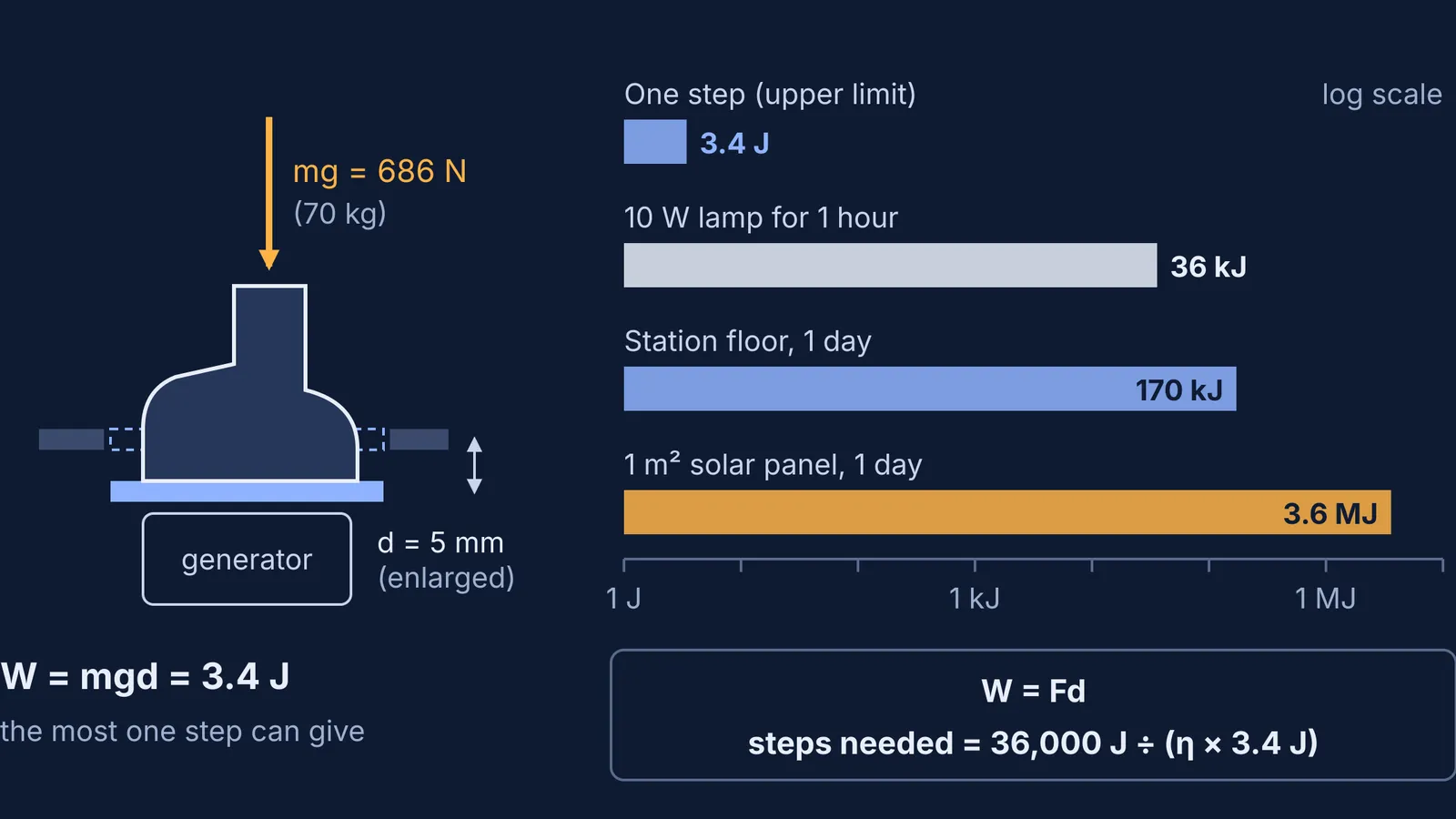
Work is force times the distance moved in the direction of the force: W = Fd. The force your foot puts on the tile is about your weight, mg. The distance is how far the tile sinks, d. So the most a tile can take from one step is:
W = mgd
This is the same mgh you use in the power you use climbing stairs, but with a height of a few millimetres instead of a few metres. That small d is the whole story. No design of generator can get round it, because a tile that does not move has no work done on it.
Worked example: how many steps light a 10 W lamp for an hour?
A 70 kg person walks over a tile that sinks 5 mm. Find the most energy per step, and the number of steps needed to run a 10 W LED lamp for one hour. Take g = 9.8 m/s².
Force. F = mg = 70 kg × 9.8 m/s² = 686 N.
Distance. d = 5 mm = 0.005 m.
Most energy per step. W = Fd = 686 N × 0.005 m = 3.43 J. This assumes your full weight rides the tile all the way down and every joule becomes electricity.
Energy the lamp needs. E = Pt = 10 W × 3600 s = 36,000 J = 36 kJ.
Perfect steps needed. 36,000 J ÷ 3.43 J = about 10,500 steps.
With losses. If only half the work reaches the lamp (an illustrative efficiency, η = 0.5), each step gives about 1.7 J and you need about 21,000 steps.
Check the units: N × m is J, and W × s is J, so both sides of step 5 are in joules and the answer is a pure number of steps.
Ten thousand perfect steps is several hours of steady foot traffic over one tile, just to run one small lamp for an hour.
Do real tiles get close to the limit?
Makers quote figures close to this ceiling. Pavegen's own FAQ page (archived October 2026) claims its systems produce "around 3 joules of energy per footstep or up to 5 watts of power while someone is walking". That is the company's claim, not an independent measurement, and the page does not say how far the tile moves or how heavy the walker is.
You can still test it against physics. For a 70 kg walker, 3 J needs the tile to move at least 3 ÷ 686 = 4.4 mm with perfect conversion, so the claim is within reach for a tile with several millimetres of travel. The same page also says one step is enough to power a 5 W bulb for one second. Check it: 3 J ÷ 5 W = 0.6 s, so one second would need 5 J. Small claims like this are worth recomputing.
Is footstep energy free?
No. It is not taken from nowhere; it is taken from you. When the tile sinks, your body drops a few millimetres with it, and your leg muscles have to lift you back up on the next step. On a hard floor that small extra work is not needed. So a soft tile makes walking very slightly harder, and the electricity is paid for with food energy. The amount per step is tiny, which is why nobody notices.
The same reasoning applies to a hand-powered torch. The shake torch turns the work of your arm into stored energy, and its output is just as small.
A speed-breaker generator works the same way but with a heavier load. A 1000 kg car pressing a plate down 5 cm gives at most mgd = 1000 × 9.8 × 0.05 = 490 J. That is about 140 times a footstep, but it comes from the car's engine, and so from its fuel.
How does a busy station floor compare with a solar panel?
Imagine a busy floor that takes 100,000 steps a day, each giving 1.7 J (half the limit). That is 170,000 J, or 170 kJ, per day. Since 1 kWh = 3.6 MJ, this is 0.047 kWh a day.
Now a solar panel. The Ministry of New and Renewable Energy says most parts of India receive 4 to 7 kWh of sunlight per square metre per day. Take 5 kWh/m² a day and a panel that turns about 20% of it into electricity (a round illustrative value). One square metre then gives 1 kWh = 3.6 MJ a day, which is about 21 times the whole station floor.
That comparison is fair on energy but not on cost: panels also cost money, need space and give nothing at night. The point is only that footstep tiles are better at showing people that energy comes from work than at powering a building. If you want more practice turning everyday devices into W = Fd and E = Pt sums, the Fermi Problem Library has a step-by-step solver that explains the reasoning.
Quick checklist
A tile collects at most W = mgd: weight times how far it sinks.
A 70 kg step on a 5 mm tile gives at most 3.4 J.
A 10 W lamp for an hour needs 36 kJ: about 10,500 perfect steps.
Real losses mean more steps; treat makers' per-step figures as claims and check them.
The energy comes from the walker's muscles, not from nowhere.
1 kWh = 3.6 MJ; convert before comparing with solar or the grid.