On this page
Push an upside-down glass into a bucket of water and the inside stays mostly dry, though water creeps a little way up. A diving bell is the same trick at full size: a heavy open-bottomed chamber lowered on a cable, with people breathing the air trapped inside. The deeper it goes, the higher the water climbs inside it. Two syllabus ideas tell you exactly how high: Boyle's law for the trapped air and pressure P₀ + ρgh for the water.
How does a diving bell keep air inside under water?
The bell is closed at the top and open at the bottom. Lowered rim-first, its air can only escape by bubbling out under the rim, so a fixed amount is trapped. Water still pushes in from below until the air pushes back just as hard.
That balance happens at the water surface inside the bell. At that surface, the air pressure P equals the water pressure at the same depth. If the bell's top is at depth d and the air takes up a length x below the top, the inside water surface is at depth d + x, so P = P₀ + ρg(d + x).
Why does water rise inside a diving bell as it goes deeper?
Boyle's law says that at constant temperature, P × V stays the same for a fixed amount of gas. Take a straight-sided bell of height H and cross-section A. At the surface the trapped air fills the whole bell at P₀, so P₀HA is fixed. At depth, the same air fills only xA at pressure P:
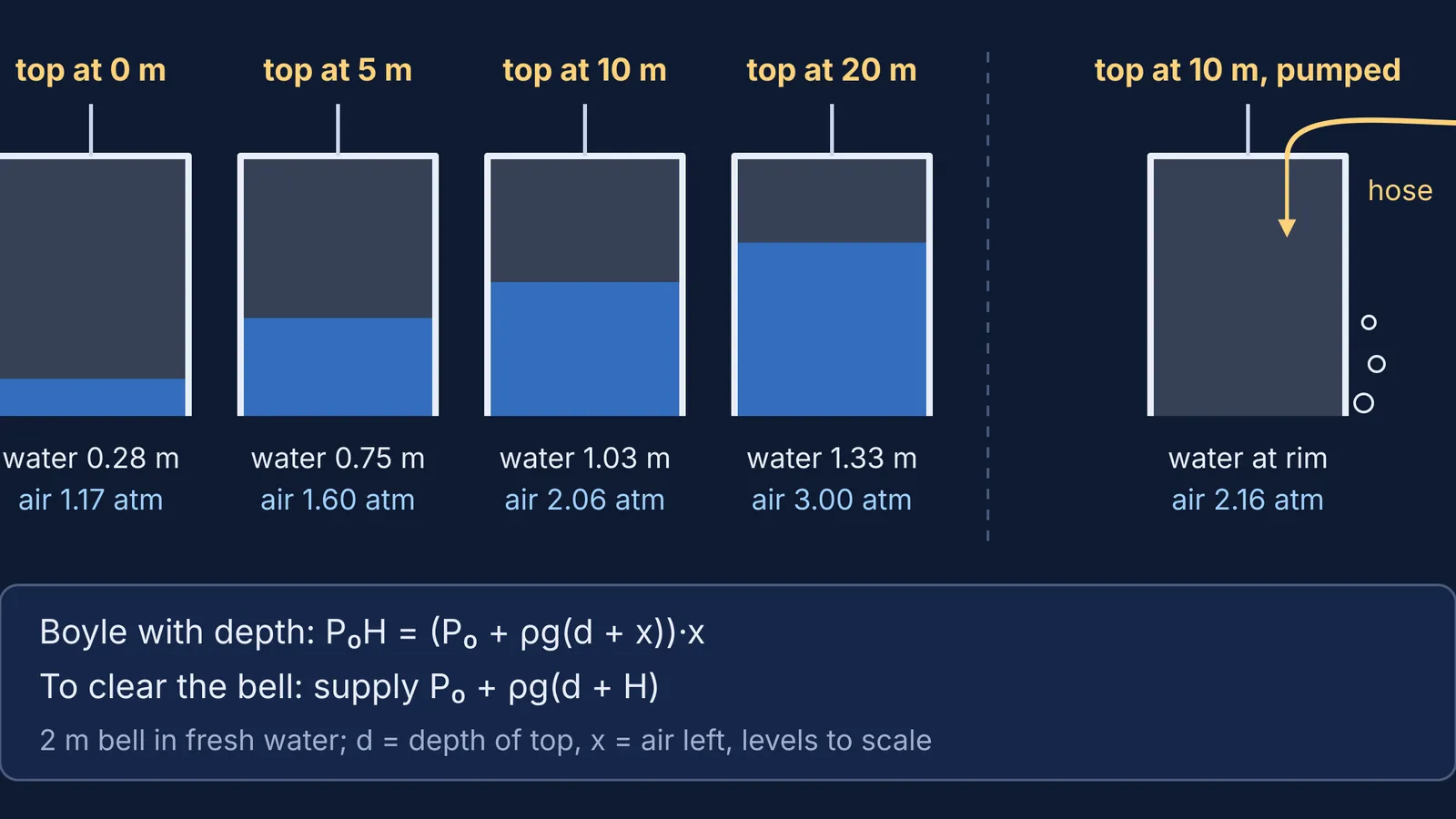
P₀H = (P₀ + ρg(d + x)) × x
The cross-section cancels. As d grows, the bracket grows, so x must shrink. The water rises inside the bell and squeezes the air into the top. The same Boyle's-law-with-depth idea, run backwards, is in how an air bubble grows as it rises from a lake bottom. Here the air is not free to move; it is held in place and the water does the moving.
How much water fills a 2 m bell lowered to 10 m?
Take a straight-sided bell 2 m tall, lowered in fresh water until its top is 10 m below the surface. Assume the air stays at the same temperature.
Data. H = 2 m, d = 10 m, ρ = 1000 kg/m³, g = 9.81 m/s², P₀ = 101 325 Pa.
Unknown. Let x be the length of air left in the bell, in metres. The inside water level is at depth 10 + x.
Boyle's law. P₀H = (P₀ + ρg(10 + x)) × x.
Expand. ρg x² + (P₀ + ρg × 10) x − P₀H = 0, which is 9810x² + 199 425x − 202 650 = 0. Every term is in newtons per metre (Pa × m), so the units match.
Solve. Take the positive root: x = 0.970 m. So 2 − 0.970 = 1.03 m of the bell is water, just over half.
Pressure. P = P₀H/x = 202 650 ÷ 0.970 ≈ 208 900 Pa, which is 2.06 atm. Check: P₀ + ρg(10.97) gives the same 208 900 Pa.
Now repeat the solve for other depths of the top (same bell, fresh water):
Top at the surface: water rises 0.28 m, air at 1.17 atm.
Top at 5 m: 0.75 m of water, 1.60 atm.
Top at 10 m: 1.03 m of water, 2.06 atm.
Top at 20 m: 1.33 m of water, 3.00 atm.
Top at 30 m: 1.49 m of water, 3.95 atm.
Even at the surface some water gets in, because the rim is already 2 m deep. Each extra 10 m adds less water than the one before, because squeezed air gets stiffer. Sanity check: 1 atm is about 10.3 m of fresh water (about 10.1 m of sea water, which is denser), so near 10 m the pressure is about 2 atm and the air should be about halved.
What did Edmond Halley find with his diving bell?
Edmond Halley, of comet fame, described his own bell in The Art of Living Under Water, Philosophical Transactions vol. 29 (the volume covers 1714 to 1716). His figures, from that paper:
The bell held about 60 cubic feet of air (about 1.7 m³), 3 feet across at the top and 5 feet at the bottom.
He noted that at about 33 feet deep the bell would be half full of water. 33 feet is about 10.1 m, close to one atmosphere of sea water, so the air is at about 2 atm and has halved, as Boyle's law predicts.
To refresh the air he sent down lead-weighted barrels of about 36 gallons each, raised and lowered in turn, and let their air into the bell.
He reported that he and four others stayed at nine or ten fathoms (about 16 to 18 m) for over an hour and a half.
Retellings often give other dates and depths; these figures are from his paper.
Why must the air be pumped in at more than twice atmospheric pressure?
To push all the water out, the air must hold the water level at the rim. The rim of our bell is at 10 + 2 = 12 m, so the air pressure needed is:
P₀ + ρg × 12 = 101 325 + 117 720 = 219 045 Pa ≈ 2.16 atm.
That is about 1.16 atm (118 kPa) above atmospheric, so the pump or supply must deliver more than twice atmospheric pressure in absolute terms. Any extra air just bubbles out under the rim.
How much surface air does that take? A full bell at 2.16 atm holds the air that would fill 2.16 bell volumes at the surface. The bell trapped one bell volume on the way down, so the pump must add about 1.16 litres of surface air for every litre of bell. For a 2 m³ bell, that is about 2.3 m³ of surface air.
We held the temperature constant; deep water is often colder, which shrinks the air a little more. Real bells are often wider at the bottom, which changes the geometry but not the pressure condition at the inside water level.
A diver's tank obeys the same law: each breath at depth uses more surface air, as worked in why a scuba tank runs out faster at depth. Breathing compressed air under water carries real risks, and any kind of diving needs proper training. This post is about the physics only, not about how to dive.
For more two-step gas and fluid problems, the Fermi Problem Library has a step-by-step solver that explains the reasoning.
Quick checklist
Trapped air pressure = water pressure at the inside water level: P = P₀ + ρg(d + x).
Boyle's law for the bell: P₀H = (P₀ + ρg(d + x))x. Solve the quadratic and take the positive root.
A 2 m bell with its top at 10 m in fresh water is just over half water, with air at about 2.06 atm.
To clear it, supply air at P₀ + ρg(d + H), which is 2.16 atm at a 12 m rim.
1 atm ≈ 10.3 m of fresh water or about 10.1 m of sea water; say which you use.
State the constant-temperature assumption in your answer.