On this page
You can measure the angle of dip without a dip needle. Take a coil of wire, spin it in Earth's magnetic field, and read the small alternating emf it produces. Do it twice, once with the spin axis vertical and once with it horizontal, and the ratio of the two readings is tan δ. The instrument is called an earth inductor. It is a neat test of which part of a field a rotating coil can feel.
What is an earth inductor?
An earth inductor is a flat circular coil of many turns mounted in a frame, so it can be spun about an axis lying in the plane of the coil. The axis can be set vertical or horizontal. The ends of the coil go through slip rings to a sensitive meter, just like a simple AC generator.
The difference from a generator is that there is no magnet. The field the coil cuts is Earth's own field, which is only a few tens of microtesla. If you need a refresher on the components, angle of dip, declination and the horizontal component covers BH = B cos δ and BV = B sin δ, and the dip circle. This post does not repeat that.
Why does a coil spun about a vertical axis feel only BH?
A coil turning in a uniform field B at angular speed ω has a peak emf ε₀ = NBAω, where N is the number of turns and A the area of one turn. The derivation is in deriving the emf of an AC generator. The point that matters here is that B in that formula is only the part of the field perpendicular to the spin axis.
Think about the flux through the coil. The flux depends on the angle between the field and the coil's normal (the line at right angles to the coil's face).
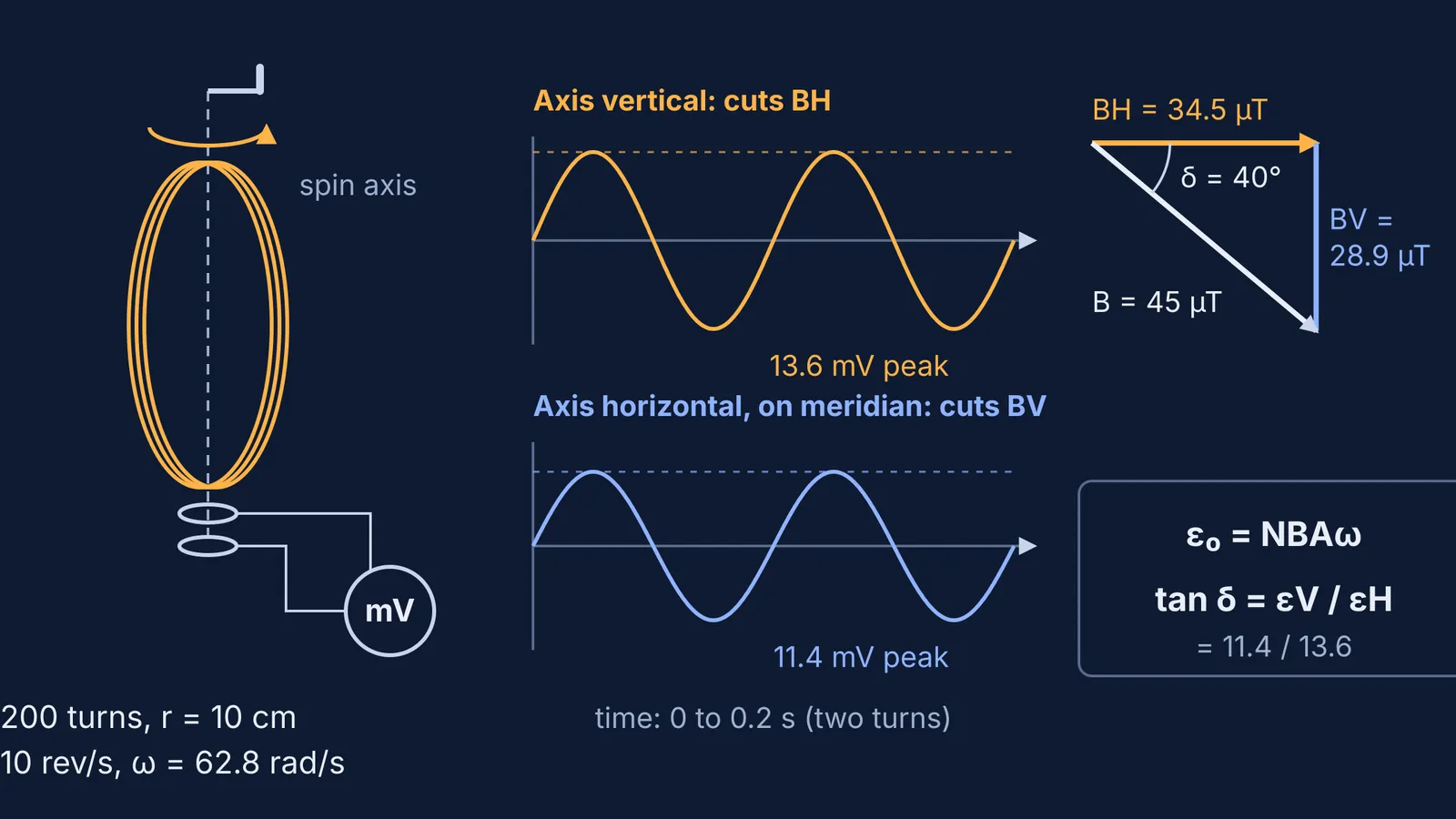
Axis vertical. The normal always stays horizontal and swings round in a horizontal circle. BV is parallel to the axis, so it always lies in the plane of the coil and never passes through it. Only BH links the coil, and the flux is NBH·A cos ωt. Peak emf: εH = NBHAω.
Axis horizontal, along the magnetic meridian (north–south). Now BH lies along the axis and never threads the coil. The normal swings in the vertical east–west plane, so only BV links the coil. Peak emf: εV = NBVAω.
Divide one by the other. N, A and ω all cancel:
εV / εH = BV / BH = tan δ
You do not need to know the coil's area, the number of turns or the exact spin speed, as long as they are the same for both readings.
Worked example: 200 turns at 10 revolutions a second
A coil has 200 turns of radius 10 cm and is spun at 10 revolutions per second. Take Earth's field as 45 µT at a dip of 40°. These are round illustrative values, not those of a particular city. Find both peak emfs and recover the dip.
Area of one turn. A = πr² = π × (0.10 m)² = 0.0314 m².
Angular speed. ω = 2πf = 2π × 10 = 62.8 rad/s.
Components. BH = 45 cos 40° = 34.5 µT. BV = 45 sin 40° = 28.9 µT.
Axis vertical. εH = NBHAω = 200 × 34.5 × 10⁻⁶ T × 0.0314 m² × 62.8 s⁻¹ = 0.0136 V = 13.6 mV peak. The rms value is 13.6/√2 = 9.6 mV.
Axis horizontal along the meridian. εV = 200 × 28.9 × 10⁻⁶ × 0.0314 × 62.8 = 11.4 mV peak, or 8.1 mV rms.
Ratio. εV / εH = 11.4 / 13.6 = 0.839.
Dip. δ = tan⁻¹(0.839) = 40.0°.
Check the units: T × m² is weber, and Wb/s is volt, so NBAω comes out in volts. Notice the ratio is the same whether you use peak or rms readings, as long as both are the same kind.
Also notice how small the answer is. Two hundred turns spun ten times a second give about a hundredth of a volt. Earth's field is weak, which is why a real earth inductor needs many turns, a fast spin and a sensitive meter.
What dip would you measure in different Indian cities?
Earth's field changes a lot across India, and the dip changes even more. The values below come from the World Magnetic Model (WMM2025) for November 2026, run through the British Geological Survey's WMM calculator at sea level. They are rounded.
Delhi: B ≈ 48.8 µT, dip ≈ 45.5°, BH ≈ 34.2 µT, BV ≈ 34.8 µT.
Mumbai: B ≈ 43.6 µT, dip ≈ 28.3°.
Chennai: B ≈ 42.1 µT, dip ≈ 14.8°, BH ≈ 40.7 µT, BV ≈ 10.8 µT.
With the same coil and spin speed, Delhi would give about 13.5 mV (axis vertical) and 13.8 mV (axis horizontal), almost equal because the dip is close to 45°. Chennai would give about 16.1 mV and 4.3 mV, because the field there is nearly horizontal. Local iron, steel furniture or reinforced concrete can shift the readings, so measure outdoors, away from metal.
What happens if the horizontal axis is not along the meridian?
This is where most errors come from. If the horizontal spin axis points east–west instead of north–south, neither component lies along the axis. The normal then swings in the meridian plane, and the coil feels the whole field B. The peak emf becomes NBAω = 17.8 mV for the illustrative field, and dividing that by εH gives 1/cos δ, not tan δ.
At any angle in between, the coil picks up BV plus part of BH, and the ratio gives a wrong, apparent dip. The same idea appears with a dip needle in apparent dip outside the magnetic meridian. The vertical-axis reading has no such problem, because BV is always parallel to a vertical axis.
How was the earth inductor used before electronic meters?
The original method did not spin the coil steadily. The coil was flipped quickly through 180° and connected to a ballistic galvanometer, which measures the total charge that flows. Flipping a coil reverses the flux through it, so the change is 2NBA, and the charge is Q = 2NBA/R, where R is the resistance of the whole circuit. Doing it once with the axis vertical and once with it horizontal along the meridian again gives two charges whose ratio is tan δ.
Both versions rest on Faraday's law. The flip measures a change in flux, the steady spin measures a rate of change of flux, and the ratio is the same either way. Seeing how the flux through a turning coil rises and falls is easier in a moving picture, and the Simulation Lab has interactive simulations for ideas like this that are easier to see than read.
Quick checklist
A coil spun in Earth's field gives ε₀ = NBAω, with B the component perpendicular to the spin axis.
Axis vertical: only BH counts. Axis horizontal along the meridian: only BV counts.
tan δ = εV / εH; the coil's size, turns and speed cancel.
Keep both readings the same kind (both peak or both rms).
An east–west horizontal axis feels the full B, not BV.
Expect millivolts, not volts: Earth's field is only tens of microtesla.