

On this page
You press the button, hear a sharp click, and a tiny blue spark jumps at the tip. There is no battery. The energy comes from your thumb, and the trick that turns it into electricity is called piezoelectricity.
What happens inside a gas lighter when you press it?
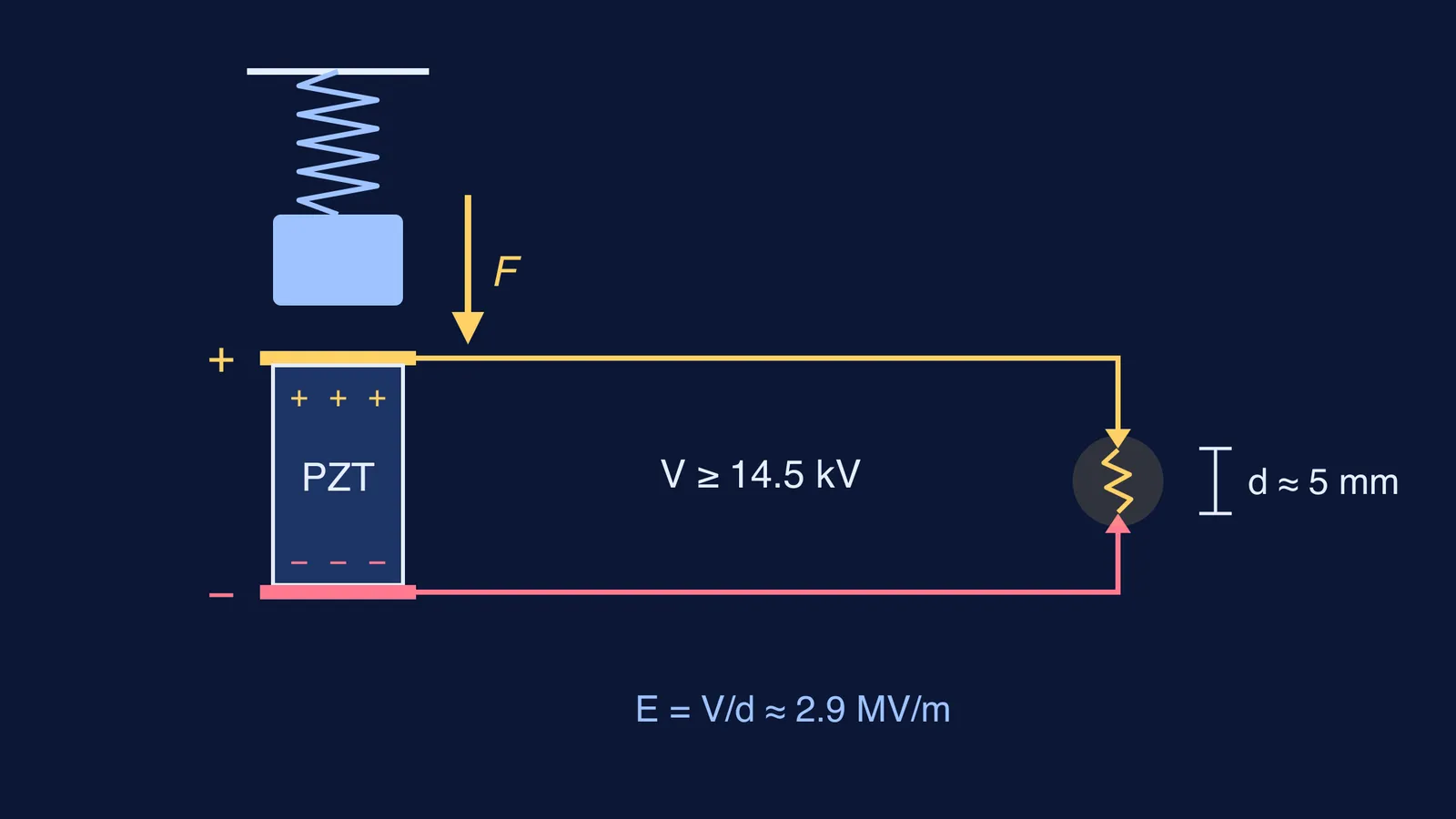
Many click-type kitchen lighters use a piezo igniter. According to Wikipedia's overview of piezo ignition, pressing the button makes a small spring-loaded hammer hit a crystal of lead zirconate titanate (PZT), and the sudden, forceful deformation produces a high voltage and an electrical discharge that ignites the gas.
Step by step:
Your thumb pushes the button and compresses a spring.
Near the end of the travel, the spring is released and the hammer snaps onto the crystal.
The blow squeezes the crystal, so one face becomes positive and the opposite face negative.
Wires carry that charge to two metal points at the tip, separated by a small air gap.
The air in the gap breaks down, a spark jumps across, and the gas coming out of the stove burner catches fire, as the gas lighter article describes.
What is piezoelectricity?
Piezoelectricity is the electric charge that builds up in certain solid materials when they are mechanically stressed (Wikipedia: Piezoelectricity). The same source records that Jacques and Pierre Curie demonstrated the effect in 1880, using crystals including quartz, tourmaline and Rochelle salt. You can read that story in our post on Pierre Curie and the discovery of piezoelectricity.
Why does squeezing make charge? At rest, the crystal's positive and negative ions balance. Press on it and the ions shift slightly, the centres of positive and negative charge separate, and charge appears on opposite faces.
The piezoelectricity article gives the example of a 1 cm cube of quartz under a force of 2 kN producing about 12,500 V. Lighters use PZT, a ceramic, and the piezo ignition article names it as the most common material in these igniters.
Why does the spark need thousands of volts?
Potential difference is the work done per unit charge in moving charge between two points, measured in volts. Between two tips a distance d apart, the electric field is roughly E = V/d. Air is normally an insulator, but above a threshold field it breaks down and conducts. Dielectric strength is about 3 MV/m for air, according to the LibreTexts chapter on dielectric breakdown/05%3A_Electrostatics/5.21%3A_Dielectric_Breakdown).
Now take a real part. A piezoelectric igniter datasheet distributed by Conrad Electronic lists an initial output of at least 14.5 kV across a discharge gap of at least 5 mm. For later presses it lists at least 12 kV across 4 mm, with a rated durability of 15,000 presses.
Worked example: does the datasheet voltage beat the air?
New igniter: E = 14,500 V / 0.005 m = 2.9 x 10^6 V/m, or 2.9 MV/m.
Later presses: E = 12,000 V / 0.004 m = 3.0 x 10^6 V/m, or 3.0 MV/m.
Both answers come out close to air's breakdown strength of about 3 MV/m. The pointed tips help, because charge crowds at sharp points and the field there is stronger than the average V/d, the same idea explained in why charge collects at sharp points.
Why is the spark so brief?
The crystal and its metal faces behave like a small charged capacitor. The blow separates a limited amount of charge, and that charge sets the potential difference. Once the air breaks down, the charge rushes across the gap as a spark and the potential difference collapses. Current needs a potential difference to drive it, as our post on whether current can flow without a potential difference explains, so the spark stops almost at once.
How do you explain a gas lighter in an exam answer?
A five-line answer for a test or viva:
Name the effect: the piezoelectric effect, where mechanical stress on a crystal produces a potential difference across it.
Describe the mechanism: pressing the button releases a spring-loaded hammer that strikes a PZT crystal.
Link it to potential difference: thousands of volts across a gap of a few millimetres gives a field strong enough to break down air, whose dielectric strength/05%3A_Electrostatics/5.21%3A_Dielectric_Breakdown) is about 3 MV/m.
State the result: the air ionises, a spark jumps, and the gas ignites.
Trace the energy: work by your thumb, elastic energy in the spring, kinetic energy of the hammer, electrical energy, then heat and light in the spark.
One slip to avoid: quoting the voltage without the gap. What makes the spark is the field, V/d.
If the shifting charges inside a crystal are hard to picture, the Fermi Simulation Lab has interactive simulations for ideas that are easier to see than to read. The Fermi Concept Library covers every concept in physics, each with its own lesson, including potential difference and electric field.
Tomorrow in the kitchen, trace the chain: thumb, spring, hammer, crystal, kilovolts, spark.


