

On this page
When you first learn Ohm's law, the rule seems absolute: you need a voltage to push a current. But there are specific, extreme environments in physics where this rule gives way. In these cases, an electric current can flow indefinitely without any potential difference driving it.
Why do ordinary wires need a potential difference?
In a standard copper wire, moving electrons constantly collide with the vibrating atomic lattice. These collisions create electrical resistance. Every time an electron bounces off an atom, it loses kinetic energy, and that energy is dissipated into the surrounding material as heat. This is why electrical appliances get warm when they run.
To keep the current flowing, a potential difference must be supplied by a battery or generator to replace the lost energy. A battery acts like a pump, providing the necessary pressure to force electrons through the resistive material. If the potential difference drops to zero—for example, if you disconnect the battery—the collisions quickly sap the electrons of their forward momentum, and the current stops immediately. This is the regime of Ohm's law, where V = IR. Understanding how electrons move through energy bands in conductors, semiconductors and insulators explains why this resistance exists in the first place, and why different materials conduct electricity better than others.
How does a superconductor maintain current without voltage?
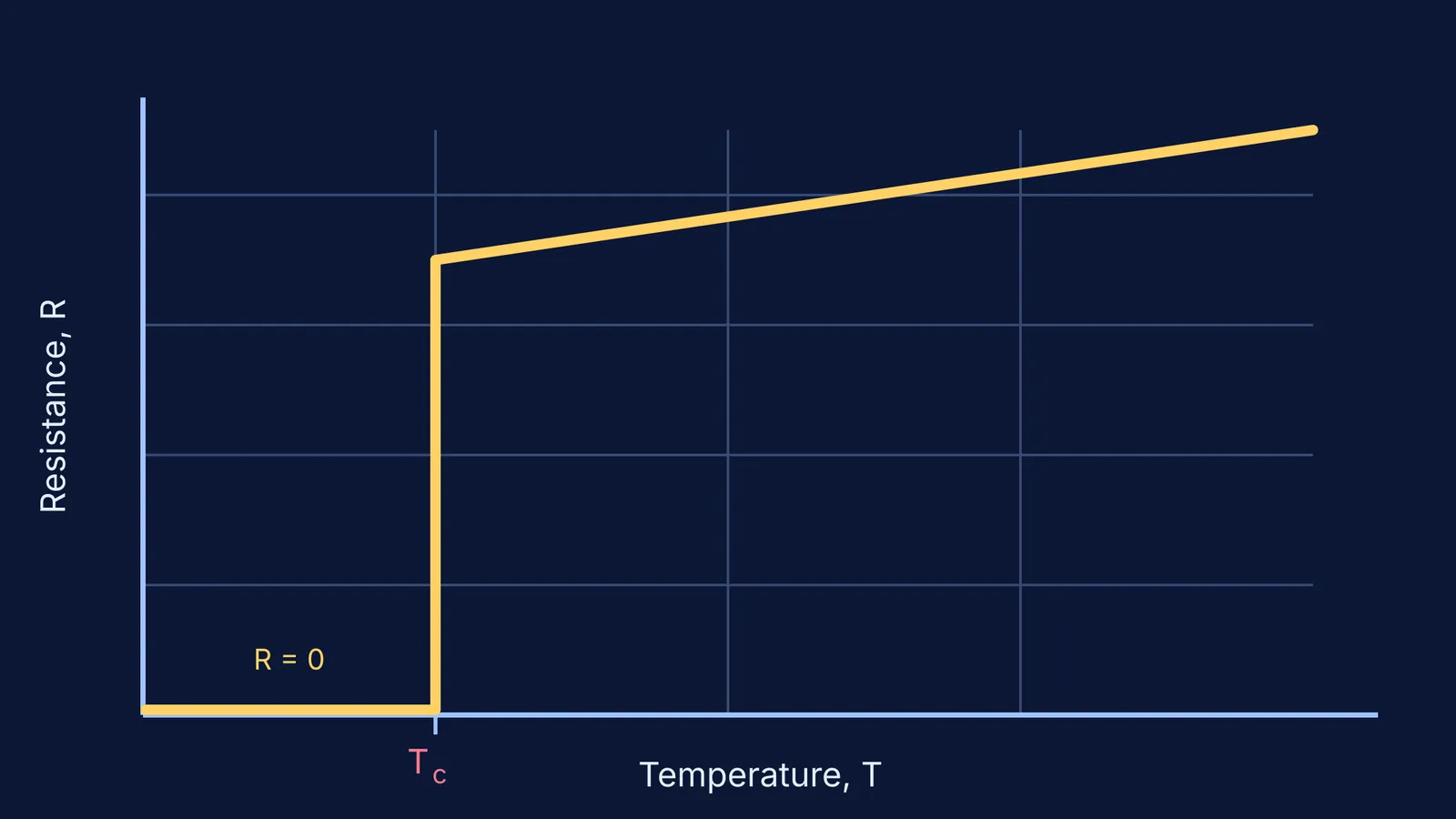
When certain materials are cooled below a specific critical temperature, their resistance vanishes completely. They transition into superconductors. This is a macroscopic quantum effect where electrons pair up into Cooper pairs. These pairs move in a coordinated wave that slips through the atomic lattice without ever colliding with it.
According to Ohm's law, if the resistance is zero, then the required voltage is zero for any steady current. This means a current can circulate through a superconducting loop forever without any potential difference driving it. Once started, this "persistent current" experiences absolutely no friction and loses no energy to heat.
This principle powers the electromagnets inside modern MRI scanners, which require magnetic fields that are both incredibly strong and perfectly stable. These scanners use coils of niobium-titanium superconducting wire immersed in a liquid helium bath, which cools them to a critical temperature of 4.2 K (source). An external power supply gets the current moving initially. Once the target magnetic field is reached, a thermal switch cools down to close the loop, and the external power supply is disconnected completely.
The current continues to flow without any voltage, creating an extremely stable magnetic field that makes high-resolution medical imaging possible. Modern superconducting joints allow this current to circulate indefinitely, operating with electrical resistance lower than 3 × 10⁻¹⁴ ohms (source).
Can current flow in a vacuum without voltage?
Another exception to the voltage requirement occurs inside vacuum tubes, old cathode-ray televisions, and massive particle accelerators.
When electrons are emitted from a heated metal filament into an empty vacuum, a beam of electrons is formed (source). Because they are moving through a vacuum, there is no atomic lattice to crash into and zero electrical resistance. There are no collisions to slow the electrons down.
Since an electric current is defined simply as the flow of charge over time, this beam of electrons constitutes a current. Even though the potential difference across the drift region is exactly zero, the current continues to flow freely until the electrons strike a target or are deflected by a magnetic field.
How do you solve zero-resistance exam problems?
Exam questions in JEE Main, JEE Advanced and NEET-UG often test this exact limit of Ohm's law, asking you to identify when a potential difference is actually necessary. Here is a checklist for evaluating whether a current requires a voltage in a given problem:
Is it a standard metallic conductor? Yes, V = IR applies. Current means a potential difference is present. You can calculate the voltage using standard circuit techniques, such as the node potential method for solving circuits.
Is it a superconductor loop below its critical temperature? No voltage is needed. Current can persist indefinitely without any potential difference driving it.
Is it an ideal inductor in a steady state? Once the current is established, an ideal inductor has zero resistance, so the voltage across it is zero while the current flows steadily.
Is it an electron beam in a field-free vacuum? No voltage is needed in the drift region. The charged particles move forward by their own inertia.
If you need to connect these dots for an upcoming exam, the Fermi Concept Library contains every concept in physics, chemistry, biology, mathematics and computing, each with its own lesson and its place in the map. This helps you trace exactly how resistance leads to macroscopic quantum effects. When you are ready to test your understanding, the Fermi Problem Library has worked problems with a step-by-step solver that explains the reasoning rather than printing an answer.


