

On this page
How do you calculate your power on a flight of stairs?
In physics, power measures the rate at which work is done or energy is transferred. As defined by the National Institute of Standards and Technology, one watt equals one joule of energy transferred per second (1 W = 1 J/s). When you climb a flight of stairs, your leg muscles push your body upward against gravity to elevate your mass.
The work done equals your gain in gravitational potential energy, presented in the NCERT Class 9 Science curriculum as:
W = m × g × h
Here, m is mass in kilograms, g is acceleration due to gravity (approximately 9.8 m/s²), and h is the vertical rise in metres. Dividing this work by time t in seconds gives average mechanical power:
P = W / t = (m × g × h) / t
To see how these definitions connect across the syllabus, explore our guide on work and energy in Class 9.
How much power does a human actually generate?
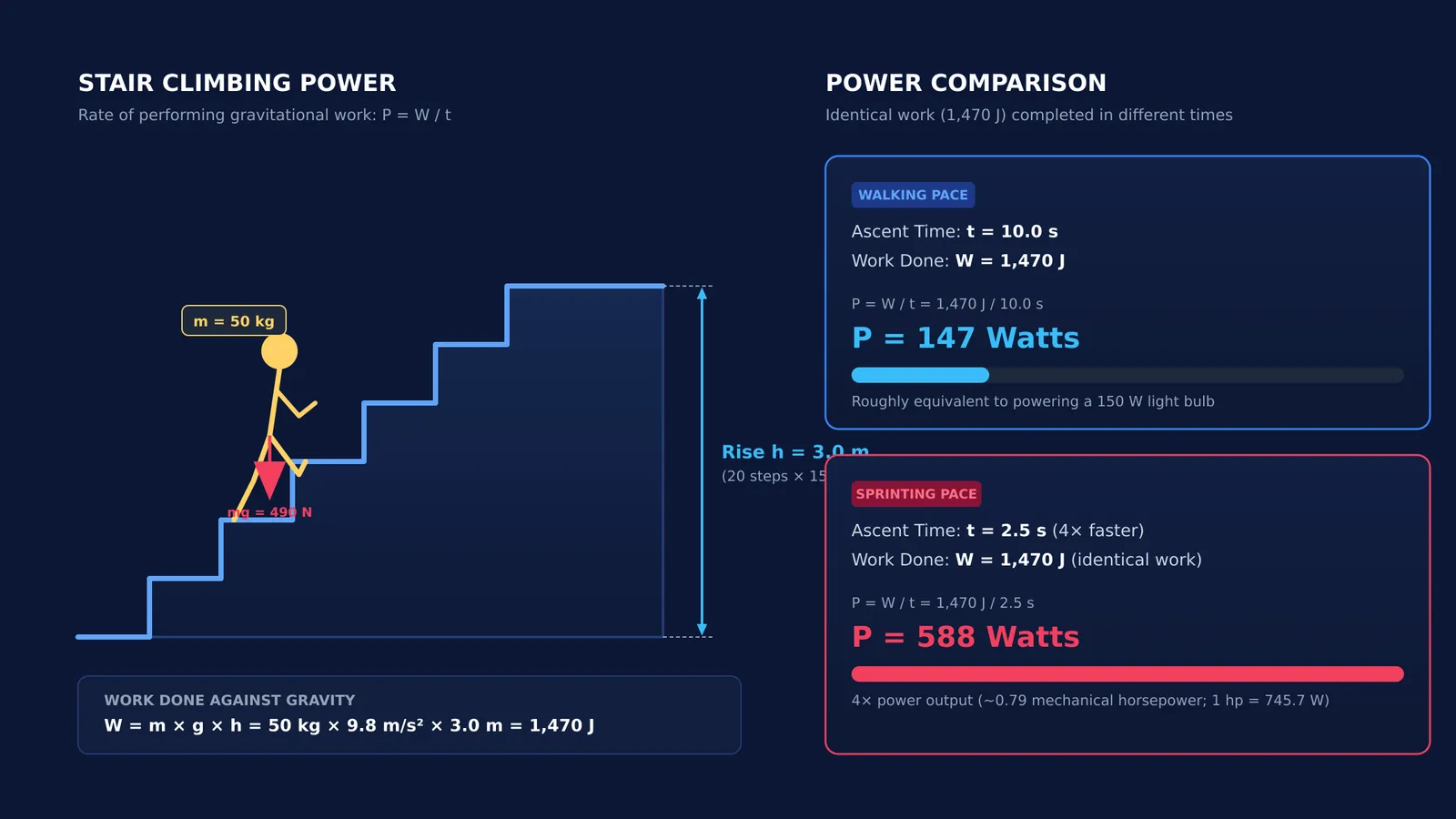
Your mechanical power depends on your ascent speed. In standard physics problems from the NCERT Class 9 Science curriculum, stair climbing serves as the primary model for calculating human power. Consider a 50 kg student ascending a domestic flight of 20 steps, each 15 cm high, for a total vertical rise of 3.0 m:
Vertical work: W = 50 kg × 9.8 m/s² × 3.0 m = 1,470 Joules.
Walking pace (10 seconds): P = 1,470 J / 10 s = 147 Watts.
Sprinting pace (2.5 seconds): P = 1,470 J / 2.5 s = 588 Watts.
At a comfortable walk, a 50 kg student delivers roughly 147 W, comparable to powering a 150 W bulb. In a 2.5-second sprint, the total work remains 1,470 J, but power quadruples to 588 W—nearly 0.79 mechanical horsepower, where one horsepower equals 745.7 W, as catalogued by the National Institute of Standards and Technology.
In exercise physiology, this principle underpins explosive power testing. In a 1966 study in the *Journal of Applied Physiology*, researchers Rodolfo Margaria, P. Aghemo, and E. Rovelli showed that athletes sprinting up stairs can exceed 1,000 W of peak anaerobic power (over 15 to 20 W per kilogram of body mass) in brief bursts.
Why does your body burn more energy than the formula suggests?
The formula P = mgh/t measures external mechanical power against gravity. It does not measure the chemical metabolic energy consumed by your body.
Human muscles do not convert metabolic energy into mechanical work at 100% efficiency. In a 2012 study in *PLOS ONE*, physiologists Lewis G. Halsey, David A. R. Watkins, and Brendan M. Duggan found that stair climbing expends roughly 8.5 kcal per minute (~593 W of metabolic power) taking one step at a time, and 9.2 kcal per minute (~642 W) taking two steps.
Because concentric muscle contractions operate at a mechanical efficiency of only 20% to 25%, your body burns approximately 4 to 5 times more metabolic energy than the mechanical work done against gravity. For 147 W of mechanical output, metabolic demand reaches 600 W to 735 W. The remaining 75% to 80% dissipates as heat, explaining why rapid climbing quickly warms your body.
How can you test your power safely at home?
Measuring your own power turns abstract physics into concrete experience, following the practical staircase investigation in the NCERT Class 9 Science curriculum. You can run this trial in four steps:
Measure mass: Record your mass m in kilograms using a bathroom scale.
Measure vertical height: Measure one step's vertical riser height in metres (typically 0.15 m to 0.18 m). Multiply by step count N to get total height h = N × h_step.
Time your ascent: Start a stopwatch on your first stride and stop it when both feet reach the top landing. Record time t in seconds.
Calculate power: Compute W = m × g × h (with g = 9.8 m/s²), then divide by t to find power in Watts.
This hands-on experiment reflects the active learning approach examined by Nobel laureate Carl Wieman on active learning, where real physical measurements solidify textbook principles.
For ideas that are harder to visualize directly, interactive tools provide immediate clarity. The Fermi Simulation Lab offers interactive simulations for the ideas that are easier to see than to read. When working through complex mechanics numericals, the Fermi Problem Library provides worked problems with a step-by-step solver that explains the reasoning rather than printing an answer. For advanced problem-solving techniques, read our guide on applying the work-energy theorem.


