On this page
On a dark, foggy road, the small lights down the middle seem to switch on just for you. They are road studs that send your own headlight beam back the way it came. Percy Shaw, a road contractor from Halifax in England, filed his first patent for them in 1934, and they work on two rules from Class 10 optics: lenses focus light, and mirrors reflect it.
Who invented cat's eyes, and when?
Percy Shaw was born on 15 April 1890 and died on 1 September 1976 (Wikipedia: Percy Shaw). According to the museum-sector site MyLearning, the only light on his road at night came from the shining tram lines, which he used as a guide. One foggy night he saw a cat on a fence with its eyes shining, and the two together gave him the idea.
His first patent, GB436290, was filed on 3 April 1934 (Google Patents). It describes a rubber block carrying reflectors that will "sink to the level of the road surface" when a wheel runs over it. He founded Reflecting Roadstuds Limited in Halifax on 15 March 1935 (Wikipedia: Cat's eye (road))). Wikipedia's Percy Shaw article says his invention was based on a 1927 patent for a retroreflecting lens by Richard Hollins Murray.
Sales were slow at first, until Ministry of Transport approval and the Second World War blackout boosted production. The firm grew to make more than a million road studs a year, exported all over the world, and Shaw received an OBE for services to exports in 1965 (Wikipedia: Percy Shaw).
How does a cat's eye send light back to the driver?
A retroreflector is a device that sends light back towards its source, over a wide range of angles (Wikipedia: Retroreflector). Your eyes sit close to your headlights, so light sent back to the headlights reaches you too.
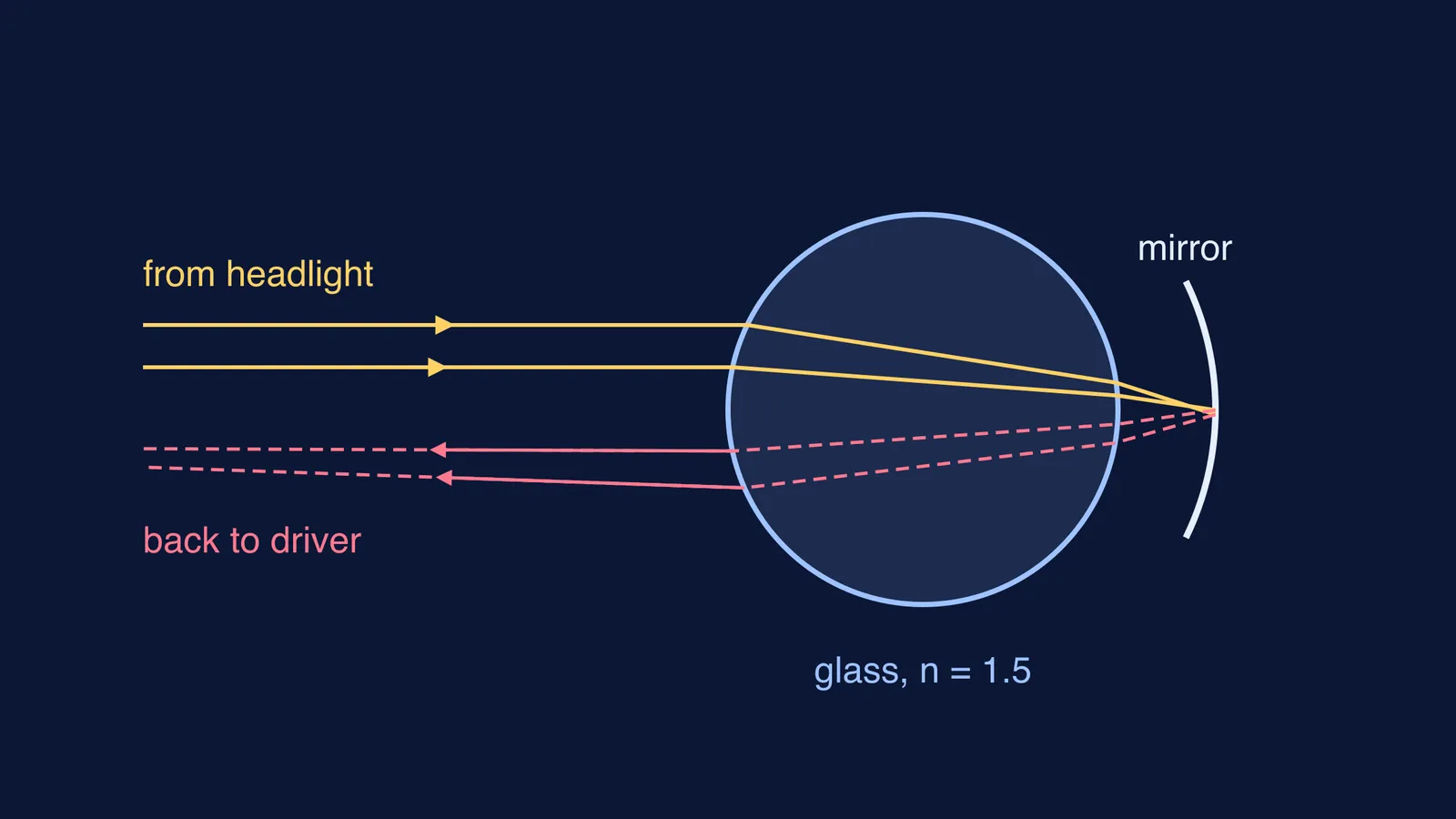
Your headlight beam reaches the stud as nearly parallel rays.
The curved glass acts as a lens and bends them towards one focus.
A mirror sits at that focus.
The reflected rays go back through the lens and leave nearly parallel again, heading towards the car.
The original design had two pairs of these reflectors set in a white rubber dome inside a cast-iron housing, with one pair facing each direction of traffic (Wikipedia: Cat's eye (road))).
Worked example: where does a glass ball focus light?
For a glass ball of diameter D and refractive index n, the effective focal length measured from the centre is EFL = nD / (4(n − 1)), and the back focal length measured from the back surface is BFL = EFL − D/2 (Wikipedia: Ball lens). Take ordinary glass, n = 1.5, and a 20 mm ball (practice numbers, not Shaw's actual glass).
EFL = (1.5 × 20) / (4 × 0.5) = 15 mm from the centre.
BFL = 15 − 10 = 5 mm behind the back surface.
Bare glass focuses 5 mm behind itself, so light reflected off its back comes out spread. Put a curved mirror 15 mm from the centre and the focus lands on it, as in the diagram at the top.
With n = 2, EFL = D/2, so BFL = 0: the focus lands on the back surface itself. That matches the retroreflector article, which says a lone sphere in air works best with an index of about 2.
For the two-surface maths, see refraction through a glass sphere. If ray diagrams are hard to picture, the Fermi Simulation Lab has interactive simulations for ideas that are easier to see than to read.
How do cat's eyes clean themselves in the rain?
Dirt on the glass blocks the light, so Shaw built the cleaning in. His second patent, GB457536, filed on 31 May 1935, says the reflectors "are automatically cleaned" as the block moves (Google Patents). It lists fixed edges the glass is wiped against when pressed down, rubber wipers in the metal casting, and holes that blow trapped air across the glass as jets.
The base tends to hold water after rain, so the fixed rubber wiper cleans wet glass as the dome sinks under a tyre (Wikipedia: Cat's eye (road))). MyLearning compares the rubber closing over the glass to an eyelid.
What can you learn from how Shaw solved it?
Try this check on any invention:
Problem: what goes wrong without it? Losing the road in fog or a blackout.
Rule: what physics does it use? A lens focusing light onto a mirror.
Weak point: what would stop it? Dirt, and tyres.
Fix: how does the design cope? Rubber that sinks, wipers, air jets and rainwater.
Shaw's studs sit in a longer story of safer roads, from John McAdam's crushed-stone roads to Garrett Morgan's caution light. If focal length or refractive index is what stops you, the Fermi Concept Library has a lesson for each concept in physics.
Now redo the worked example with n = 1.8 and find where the mirror goes.