On this page
John Loudon McAdam, a Scottish road builder born in Ayr in 1756 (Wikipedia: John Loudon McAdam), argued that a road does not need a massive foundation to carry heavy carts. In his view it needs dry ground underneath and a waterproof skin of small, sharp-edged broken stone on top. His name survives in a word you still hear at airports: tarmac.
Who was John McAdam and what did he change?
In 1816 McAdam became surveyor to the Bristol Turnpike Trust. He set out his ideas in two treatises, *Remarks on the Present System of Road Making* (1816) and *Practical Essay on the Scientific Repair and Preservation of Roads* (1819) (Wikipedia: John Loudon McAdam). He died in Moffat, Scotland, in 1836.
The 1823 edition of *Remarks*, free on Project Gutenberg, looks back on roads “repaired with large stones, or of the dangerous convex form”, which he says were universal about five years earlier. His central idea was about the ground: “it is the native soil which really supports the weight of traffic”, provided it stays dry. So the road’s real job is to be “a covering impenetrable to rain”.
How did McAdam build a road with crushed stone?
His directions in the same book are short (Project Gutenberg: Remarks on the Present System of Road Making):
Drain the ground first, so the soil sits above the level of any water.
Use clean stone only, with no earth, clay or chalk that would hold water.
Break the stone so that “no piece shall exceed six ounces in weight” (about 170 grams).
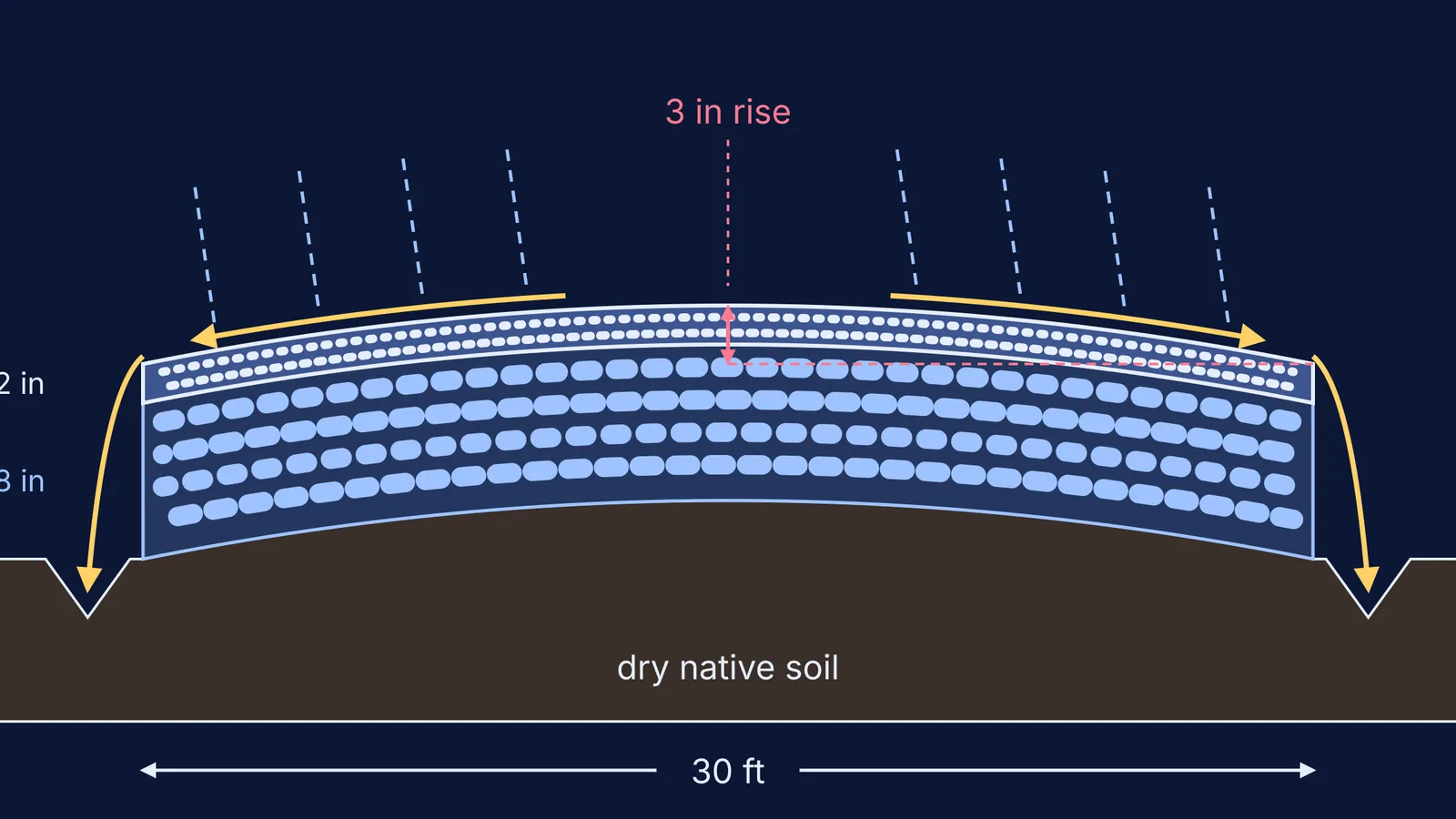
Build up about ten inches of clean stone; a road of small broken stone “to the depth of ten inches, will be smooth, solid and durable.”
Keep it nearly flat: “a rise of three inches from the centre to the side is sufficient for a road thirty feet wide.”
The usual description is about 8 inches of stones no bigger than 3 inches, under about 2 inches of smaller stone, and workers are said to have checked size by whether a stone fitted in the mouth (Wikipedia: Macadam). Why so small? McAdam reasoned that a wheel touches a smooth road over “about an inch”, so any stone bigger than an inch in any dimension “is mischievous”: the wheel knocks it loose instead of rolling over it.
That locking comes from friction and interlocking edges: sharp-edged pieces resist sliding past one another more than rounded pebbles do. Our explainer on angle of repose and the tan θ = μ result shows the physics. For an earlier road builder who also fought water, read about John Metcalf, the blind road builder.
How steep is a road camber, really?
Here is a worked example using McAdam’s own numbers from his book.
Half the width: 30 feet ÷ 2 = 15 feet = 180 inches.
Rise from edge to centre: 3 inches.
Slope: 3 ÷ 180 = 1 in 60, about 1.7%.
Angle: tan⁻¹(1/60) ≈ 0.95°, less than one degree.
That is enough for rain to run off a packed surface, yet gentle enough that a carriage “may stand upright”, one of McAdam’s stated aims. Apply the same 1-in-60 slope to a 7-metre-wide road and the centre sits about 5.8 cm above the edges (3.5 m ÷ 60).
If slopes and inclined planes still trip you up in numericals, the Fermi Problem Library has worked problems with a step-by-step solver that explains the reasoning rather than printing an answer.
Why is it called tarmac?
Plain macadam had two weaknesses: it rutted and it threw up dust. In 1901, the story goes, Edgar Purnell Hooley noticed a smooth stretch of road in Denby, Derbyshire, where tar had spilled (Wikipedia: Tarmacadam). He patented tarmac in 1902, mixing tar with stone before rolling it, and in 1903 formed Tar Macadam Syndicate Ltd and registered tarmac as a trademark. Tar plus macadam made tarmacadam, shortened to tarmac.
Black roads bring a new problem in an Indian summer: see why tar roads get soft and sticky in summer. McAdam’s name also lives on in Indian road rules: the Indian Roads Congress publishes standards for water bound macadam (IRC 19), bituminous macadam (IRC 27) and wet mix macadam (IRC 109) (Public.Resource.Org list of IRC standards).
What can you try at home to test McAdam’s ideas?
Three quick checks, one per rule:
Angles lock. Pour rounded aquarium gravel and crushed stone (gitti) into separate heaps. Measure each slope with a protractor; the crushed stone should stand steeper.
Camber drains. Prop one end of a 30 cm tray up by 5 mm, a 1-in-60 slope. Sprinkle water and watch whether it runs off or pools.
Dry soil carries load. Press a coin into dry soil, then into the same soil soaked. Compare how far it sinks.
For ideas that are hard to picture, the Fermi Simulation Lab has interactive simulations for ideas that are easier to see than to read.
Next time you cross a road after rain, look at its edges: the water is still following a rule McAdam put in writing two centuries ago.