

On this page
When you look at a towering syllabus or a seemingly impossible physics problem, it is easy to feel like you are sinking into a bog. In the 18th century, English engineers faced actual bogs that swallowed their building materials whole. It took a man who could not see the terrain to figure out how to successfully cross it.
John Metcalf (1717–1810), often called "Blind Jack of Knaresborough", lost his sight to smallpox at the age of six). Yet, he grew up to become one of the fathers of modern civil engineering, building approximately 290 km (180 miles) of turnpike roads across the difficult terrain of Northern England between 1765 and 1792.
Who was John Metcalf, the blind road builder?
Metcalf did not let the loss of his sight limit his physical world. As a young man, he refused to be confined, becoming an expert swimmer, a daring horse rider, and a talented fiddler. Because he relied entirely on touch, hearing, and an exceptional mental map of the landscape, he understood the local terrain in a way sighted engineers often missed. His spatial awareness was so highly developed that he frequently worked as a guide for sighted visitors navigating the confusing roads of Yorkshire.
When he began winning road-building contracts later in life, he surveyed the routes himself. Armed only with a long staff, he would walk the proposed paths alone. By feeling the texture, moisture, and depth of the soil with his staff, he gathered precise data about the ground's stability. This tactile feedback allowed him to calculate the necessary materials, labor, and costs entirely in his head, bypassing the need for traditional drawn blueprints.
How did John Metcalf build roads on bogs?
During the early years of the Industrial Revolution, heavy horse-drawn wagons routinely destroyed poorly made dirt paths. The biggest challenge for any road builder in Northern England was crossing deep peat bogs and marshes. Traditional engineers tried to dig down to a solid foundation, which meant dumping endless amounts of expensive stone into the mud until it inevitably sank.
Metcalf understood that heavy loads needed their weight to be distributed evenly—a physical principle you can explore today in Fermi Simulation Lab when studying pressure, area, and buoyancy. Instead of fighting the deep bog, he decided to float his roads on top of it.
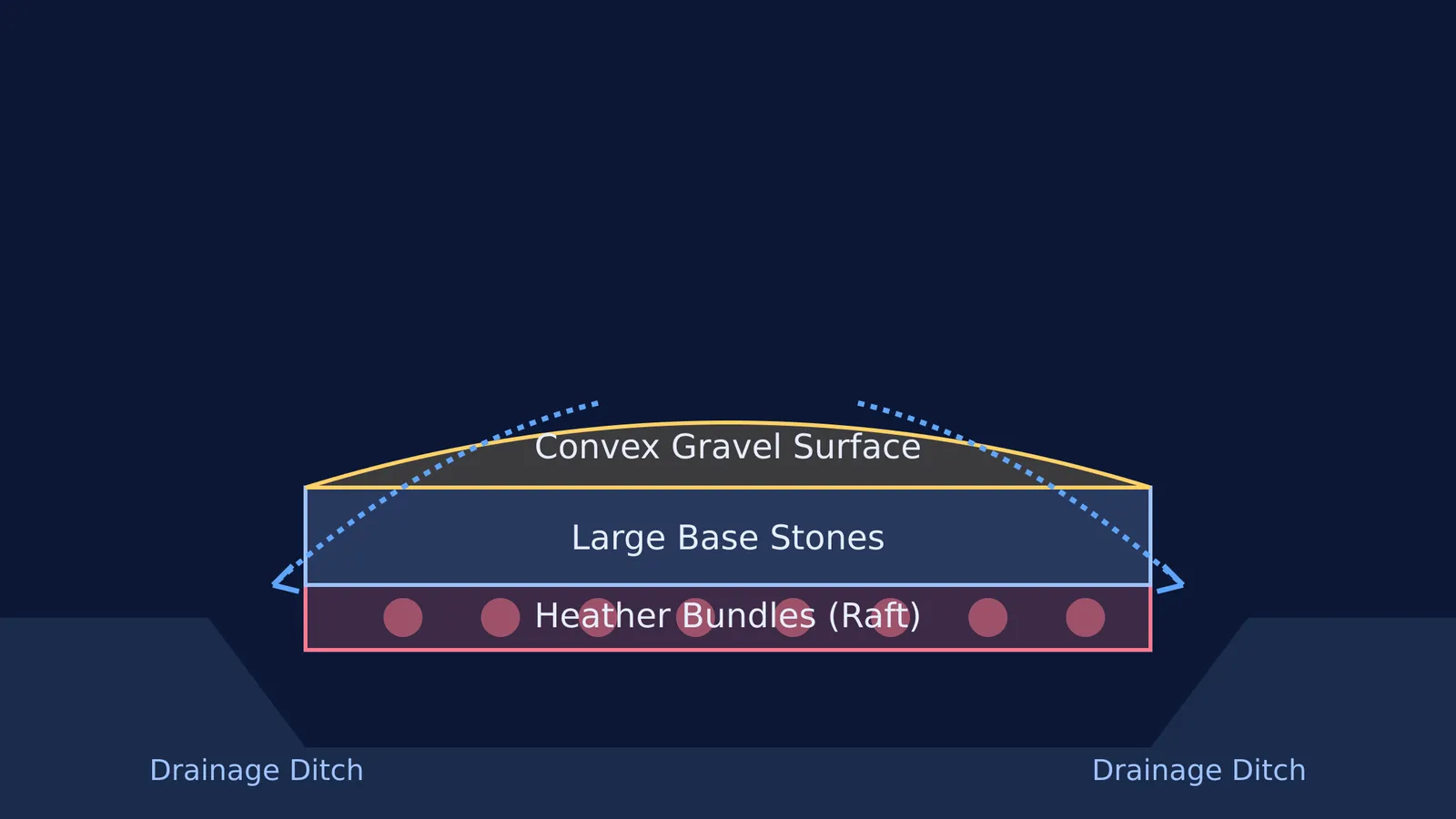
His solution was to build a buoyant foundation. He laid huge bundles of heather (ling) and gorse (furze) directly onto the marshy ground. On top of this flexible, woven mat, he placed a layer of large base stones, followed by a top layer of smaller gravel. The heather acted like a modern geotextile, spreading the road's massive weight over a large surface area so it would not sink into the soft peat.
He also solved the chronic problem of water damage. Metcalf insisted on building his roads with a convex, or cambered, surface, meaning the center of the road was built noticeably higher than the edges. Rainwater immediately ran off the curved surface into deep drainage ditches on either side, keeping the stone foundation dry, stable, and intact year-round.
What can Metcalf teach us about tackling hard problems?
Metcalf’s approach to engineering is a masterclass in problem-solving that applies just as well to preparing for a tough examination.
If you are facing a difficult subject that feels like a bottomless bog, you need a deliberate strategy:
Feel the terrain first: Before you dump hours of effort into memorizing formulas you do not understand, probe the ground. What do you actually know? Where are your weak spots? Take a diagnostic test to map your current understanding.
Build a raft for the soft spots: Do not try to build heavy, complex knowledge on a weak foundation. When you hit a topic you do not understand, distribute the load by mastering the fundamental, basic concepts first.
Ensure drainage: Do not let confusion pool and ruin your foundation. Address small mistakes immediately and review your errors so they do not become deep-seated habits.
If you find yourself stuck in a challenging topic and are unsure where your foundation is weak, Fermi's AI tutor can help you build a plan for your study session. It works out what you already know and teaches through the material step-by-step, so you sit down to a clear next step instead of staring at a blank page.
You do not need to see the entire path to the finish line from the very beginning—you just need a solid, well-distributed foundation for the next step.


