

On this page
Have you ever noticed your shoes sticking to the road on a hot summer afternoon? The black binder holding the crushed stones together—tar or bitumen—has begun to flow. This sticky situation is a classic real-world example of how amorphous solids behave under heat.
Why do tar roads become soft and sticky in summer?
Bitumen is a thick, black mixture of heavy carbon compounds left over from refining petroleum (for a refresher on how we describe these, see Naming carbon compounds in Class 10: prefixes, suffixes, examples). It acts as the glue in asphalt pavements.
Because it is dark, asphalt is a highly efficient absorber of solar radiation, causing road surface temperatures to climb much higher than the surrounding air. During heatwaves, the surface of a road can become hot enough to soften the bitumen.
At these temperatures, bitumen loses its stiffness. It shifts from a hard, brittle state to a viscous, fluid one. Under the weight of heavy traffic, this softened binder is pushed around, leading to permanent ruts in the road and a sticky surface layer that can trap your shoes.
Because bitumen is viscoelastic, it is highly sensitive to the speed of traffic. Fast-moving cars make it act elastically, bouncing back to shape. But slow-moving trucks give it time to flow like a viscous liquid, which is why traffic jams on hot days cause the worst road damage.
Why does bitumen not have a melting point?
In chemistry and physics, we classify solids by how their particles are arranged.
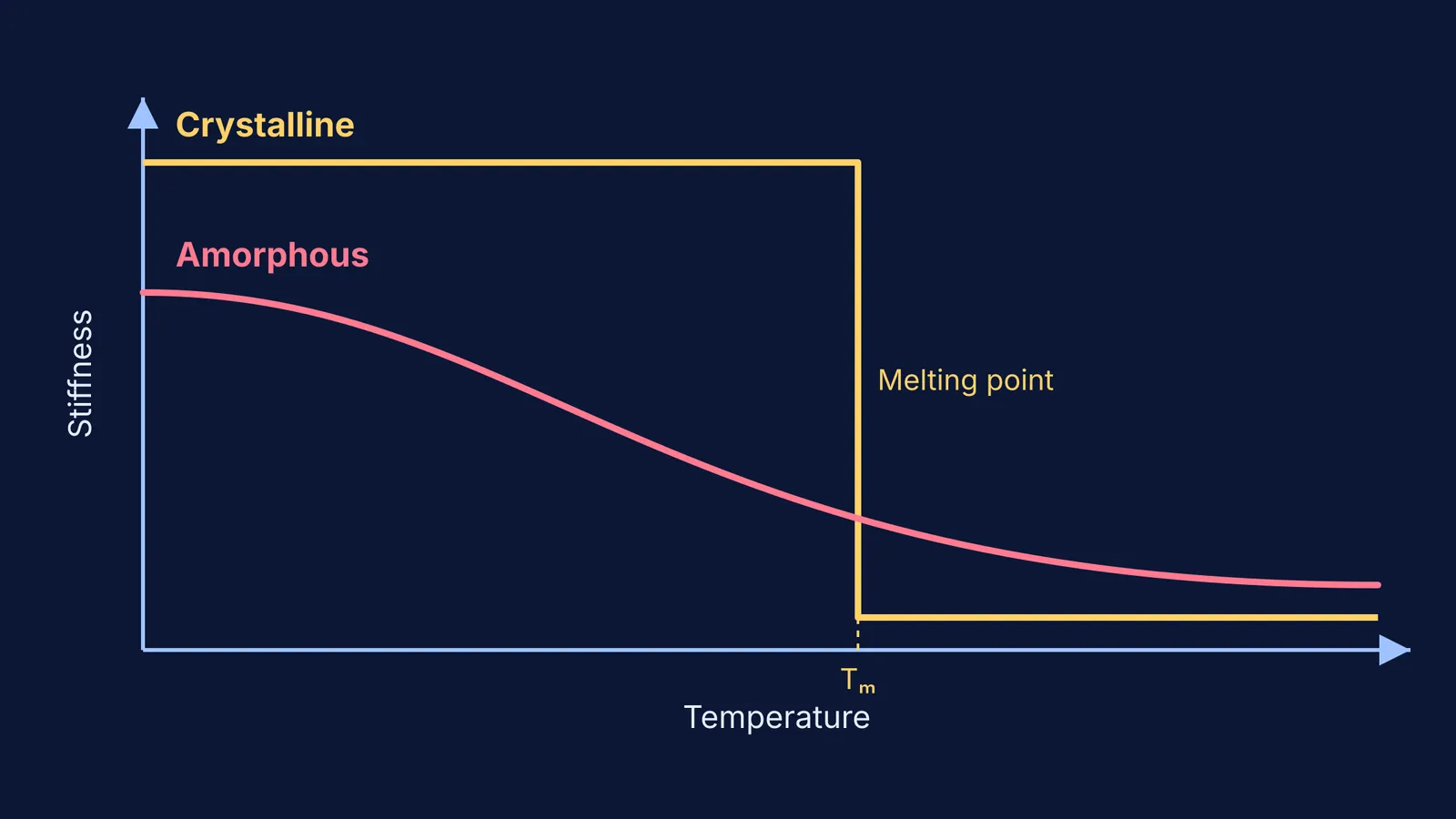
In crystalline solids (like ice, salt, or metals), molecules are locked into a neat, repeating lattice. Every intermolecular bond is identical. When the material absorbs enough heat to break these bonds, the entire structure collapses at once. This is why crystalline solids have a sharp, specific melting point.
Bitumen, however, is a viscoelastic, amorphous solid (https://doi.org/10.1016/j.polymer.2018.09.042). Its large, complex hydrocarbon molecules are tangled together randomly, without any long-range order. Because the intermolecular forces vary from place to place within this tangle, different bonds break at different temperatures. Instead of melting abruptly at a single temperature, bitumen softens gradually over a wide temperature range. Another common amorphous solid is glass; for a practical look at how glass behaves, see Tracing a ray through a glass slab: the Class 10 practical.
What is the softening point of bitumen?
Since bitumen does not melt sharply, road engineers cannot look up its "melting point." Instead, they measure its "softening point" using a standardised physical test.
The most common method is the Ring-and-Ball apparatus test, defined by standards such as ASTM D36 (https://doi.org/10.1520/d0036_d0036m-14). A sample of bitumen is poured into a small brass ring, and a standard steel ball is placed on top of it. The assembly is then lowered into a liquid bath, which is heated at a steady rate. As the bitumen warms up, it softens and begins to sag under the weight of the ball. The softening point is recorded as the exact temperature at which the bitumen stretches enough to let the ball touch a bottom plate.
This test simply measures when the bitumen reaches a specific viscosity, giving engineers a reliable benchmark for how a grade handles hot weather.
Standard road-grade bitumen has a softening point that summer road temperatures can sometimes cross. To prevent this, modern highways often use polymer-modified bitumen, which adds synthetic polymers to raise the softening point, keeping the road stable during heatwaves.
How can you tell an amorphous solid from a crystalline one?
When studying the solid state, use this quick checklist to classify a material:
Phase change: Crystalline solids melt sharply at a specific melting point. Amorphous solids soften gradually over a range of temperatures.
Cleavage: A crystalline solid cut with a sharp edge splits into smooth, plain pieces. Amorphous solids break into irregular, uneven surfaces.
Directional properties: Amorphous solids are isotropic; their physical properties are identical in all directions. Crystalline solids are typically anisotropic.
Rigidity: Amorphous solids are often called pseudo-solids or supercooled liquids because they can flow very slowly over long periods.
Visualising amorphous structures and comparing their phase changes is much easier when you can see the molecules move. The Fermi Simulation Lab has interactive simulations for the ideas that are easier to see than to read, letting you heat up different solids to watch their molecular behaviour. If you are preparing for exams and need to clear up your chemistry concepts, Fermi's AI tutor can work out what you already know and build a plan for the session.


