

On this page
The modern traffic intersection operates on a strict rhythm: green, yellow, red. But in the early days of the automobile, that warning period did not exist. Roads in the 1920s were a dangerous, chaotic mix of horse-drawn carriages, streetcars, pedestrians, and newly affordable cars. Traffic flowed until a police officer manually switched a semaphore signal from "Go" directly to "Stop".
This abrupt change ignored the physics of motion, and the result was frequent collisions. It took an American inventor named Garrett Morgan to realise that safety required a transition phase.
Why did the two-position signal fail?
A vehicle in motion carries kinetic energy that cannot disappear instantly. When a driver sees a "Stop" command, they need reaction time to apply the brakes, and the vehicle needs braking distance to come to a halt. Early cars had weak mechanical brakes, and a horse pulling a carriage could not stop on a dime.
When a two-position traffic signal suddenly changed, drivers who were too close to the intersection had no choice but to keep going. At the exact same moment, cross-traffic received a "Go" signal and pulled forward.
Traffic engineering relies on predicting paths to prevent crashes, much like testing if two projectiles will collide midair using relative motion. Without a buffer, the two streams of traffic were put on a collision course. After witnessing a severe accident between a car and a horse-drawn carriage at a busy Cleveland intersection, Morgan set out to build a safer system.
Who was Garrett Morgan?
Garrett Augustus Morgan was born in Kentucky in 1877 to parents who had been enslaved. Despite having only an elementary school education, he possessed a brilliant mechanical mind and a strong entrepreneurial spirit. He moved to Cleveland, Ohio, where he repaired sewing machines, eventually opening his own repair shop and a successful tailoring business.
Morgan was a prolific inventor whose work often focused on public safety. Several years before his work on traffic control, he invented a protective "smoke hood" that filtered out toxic fumes. This early version of the gas mask made national headlines in 1916 when Morgan and his brother used it to rescue workers trapped in a smoke-filled tunnel under Lake Erie. His ability to observe a deadly hazard and engineer a practical, life-saving device was the exact same skill he later applied to the chaotic roads of the 1920s.
How did Morgan's traffic signal work?
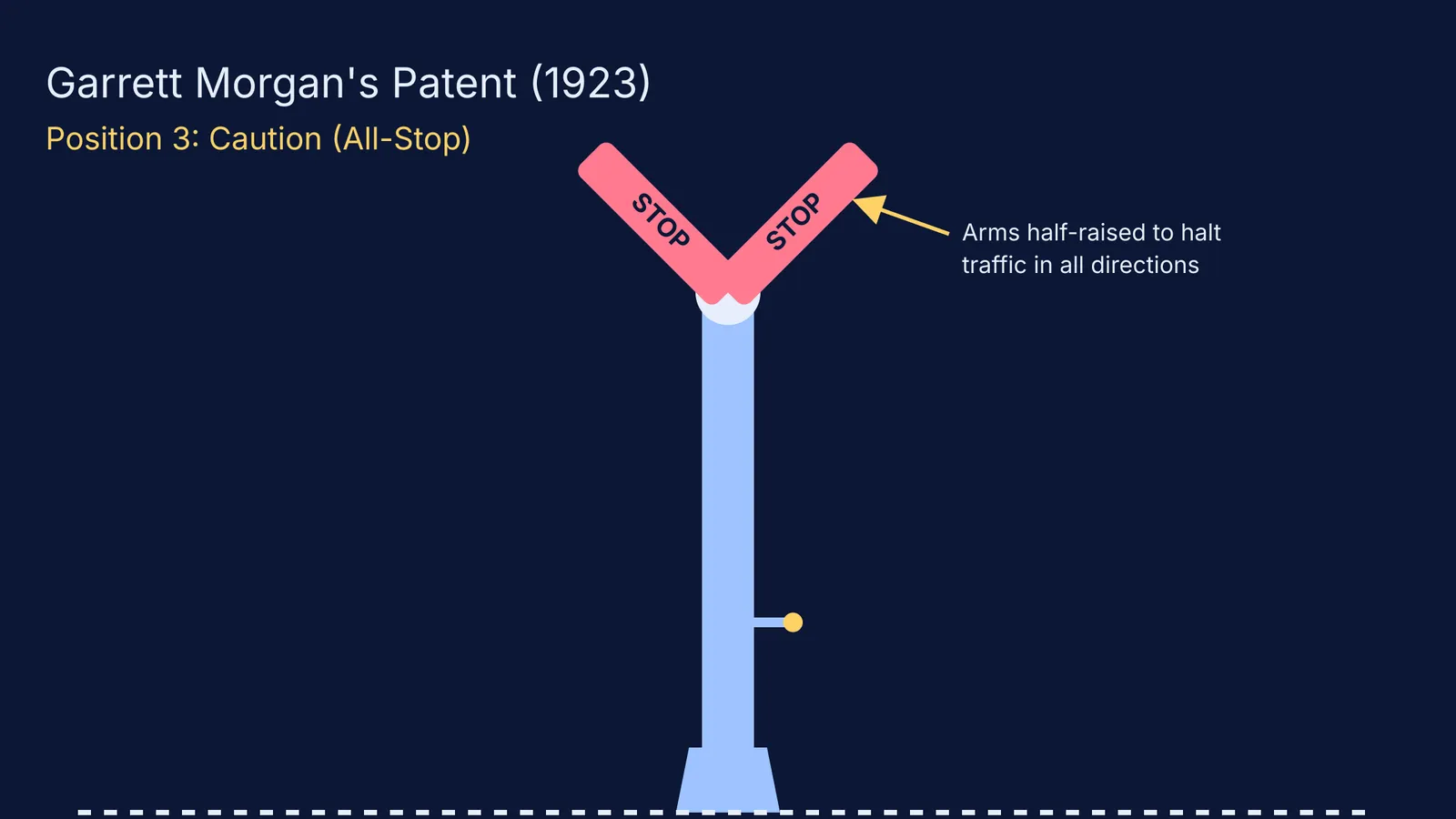
Morgan designed a T-shaped pole with mechanical arms that an operator could crank by hand. It featured the standard "Stop" and "Go" signs, but introduced a crucial third configuration.
When transitioning between the two main flows of traffic, the operator raised all the arms halfway. This created an all-directional "caution" position that commanded everyone to halt. Vehicles already in the middle of the intersection had a brief window to clear out safely, while waiting traffic was warned that a change was coming.
This simple mechanical pause acknowledged that stopping takes time. When learning about kinematics and stopping distances, calculating the distance in the nth second of braking reveals just how much ground a car covers before it finally rests. Morgan's third position built that necessary distance into the rhythm of the road.
If you are struggling to picture how velocity, time, and distance intersect in kinematics problems, the Fermi Simulation Lab lets you run the motion and test different braking forces to see what happens before the maths gets complicated.
What happened to Garrett Morgan's patent?
Morgan filed for his invention in 1922. Garrett Morgan was granted U.S. Patent 1,475,024 for his "Traffic Signal" on November 20, 1923.
The design was highly successful and saw use across North America. However, as electricity became more widespread and automated light systems grew more viable, manual semaphores began to fade out. Recognising the shift, Morgan made a lucrative business decision. He eventually sold the patent rights to General Electric for $40,000.
General Electric used his "caution" concept as they developed the automated, electric red-yellow-green traffic lights that became the global standard. Today, every time an amber light warns you to slow down, you are relying on the safety interval that Morgan patented a century ago.


