

On this page
On the docks of Mumbai or Kochi, a deckhand can hold back a swaying passenger ferry using just a few rope turns around an iron bollard. Pulling a multi-tonne vessel directly on flat ground would be impossible, but wrapping rope around a rough cylinder fundamentally transforms how friction behaves.
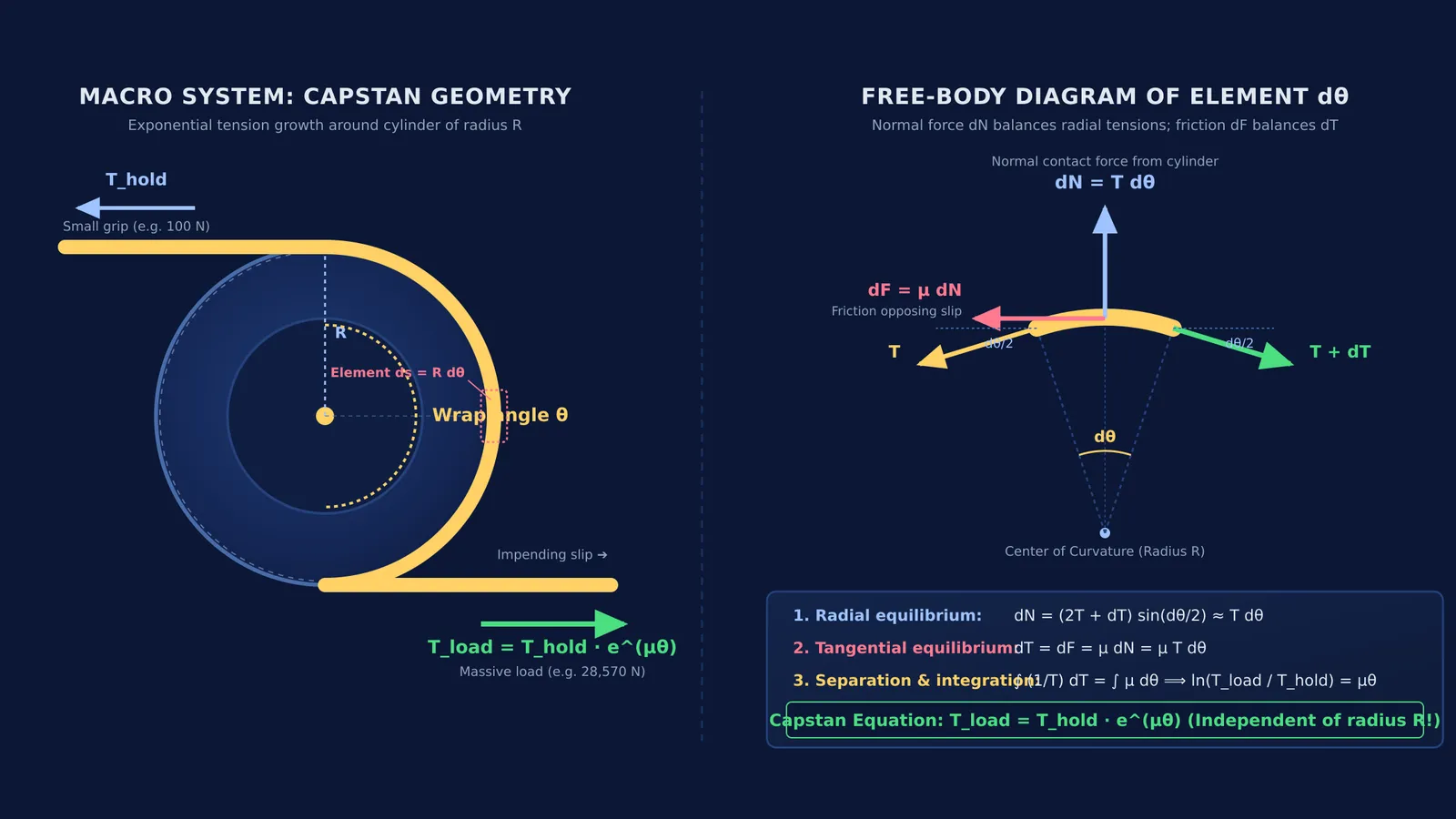
Rather than resisting motion with a fixed force, a cylinder creates a self-amplifying system. As physicist George L. Hazelton explained in The Physics Teacher, the capstan acts as an exponential force amplifier. With a typical static friction coefficient μ = 0.3 between rope and steel, half a turn (wrap angle θ = π radians) multiplies holding capacity by 2.57. One full turn (θ = 2π) amplifies grip by 6.59, and two full turns provide a 43.4-fold boost. At three turns (θ = 6π), holding capacity multiplies by 285.7: a modest 100 N pull holds 28,570 N. At four turns, that 100 N grip restrains 188,100 N—over 19 tonnes of load.
How does Euler's capstan equation derive from a small element?
Leonhard Euler first solved this relation in his 1769 paper Remarques sur l'effet du frottement dans l'équilibre, and German engineer Johann Albert Eytelwein popularized it in 1808. To see why tension multiplies, isolate an infinitesimal rope element subtending angle dθ on a cylinder of radius R.
Tension enters at T and leaves at T + dT at impending slip. Radial equilibrium gives dN = (2T + dT) sin(dθ/2). Using sin(dθ/2) ≈ dθ/2 and dropping the differential product dT · dθ yields:
dN = T dθ
Tangentially, static friction balances the tension change: dT = dF = μ dN = μ T dθ. Dividing by T separates variables:
dT / T = μ dθ
Integrating from T_hold at θ = 0 to T_load at wrap angle θ yields:
∫ (1/T) dT = ∫ μ dθ ⟹ ln(T_load / T_hold) = μ θ ⟹ T_load = T_hold × e^(μθ)
Eugene Levin verified in the American Journal of Physics that this exponential law holds for both static thresholds and kinetic sliding. Just as in growth and decay differential equations, growth is proportional to current value: because normal force depends on tension, each radian multiplies the accumulated load.
When visualizing how normal forces distribute along curves, the Fermi Simulation Lab provides interactive simulations for the ideas that are easier to see than to read.
Why does the cylinder radius cancel out?
As Leonhard Euler demonstrated in Remarques sur l'effet du frottement dans l'équilibre, cylinder radius R cancels out entirely. Wrapping a line around a thin pen produces the exact same multiplier as wrapping it around a massive dock bollard.
The arc length of an element is ds = R dθ, while curvature makes normal force per unit length equal T/R. Their product yields dN = (T/R)(R dθ) = T dθ: radius R in arc length cancels 1/R from curvature. On a flat plane, contact area does not alter friction, as explored in angle of repose and friction. Around a cylinder, wrap angle multiplies friction exponentially.
What does a worked JEE physics problem look like?
Applying the capstan tension relation demonstrated by George L. Hazelton in The Physics Teacher, consider a standard competitive mechanics question: A 70 kg climber (weight 700 N, taking g = 10 m/s²) hangs from a rope wrapped 1.5 full turns around a rough horizontal tree branch with friction coefficient μ = 0.25. What force holds them, and what force hoists them?
Find contact angle: θ = 1.5 × 2π = 3π radians ≈ 9.425 rad.
Calculate the exponent: μθ = 0.25 × 9.425 ≈ 2.356, yielding e^(μθ) = e^(2.356) ≈ 10.55.
Calculate holding tension: Friction assists the belayer against downward slip, giving T_hold = 700 / 10.55 ≈ 66.4 N (under 7 kg of effort).
Calculate hoisting tension: Friction opposes upward motion, giving T_pull = 700 × 10.55 ≈ 7,385 N (equivalent to lifting nearly 740 kg).
This asymmetry explains why capstans secure loads with ease. Alongside problems like finding the minimum force to drag a block on a rough floor, resolving friction directions is critical. The Fermi Problem Library has worked problems with a step-by-step solver that explains the reasoning rather than printing an answer.
Where do students lose marks on belt friction questions?
Four recurring errors appear in exam solutions:
Using turns instead of radians: Always convert n turns to θ = 2πn before exponentiating.
Inverting load and hold sides: Friction always opposes slip; the side pulling against motion carries the larger tension.
Factoring in cylinder radius: Massless, flexible ropes make radius irrelevant; treat given diameters as distractors.
Neglecting stiffness in cables: Thick steel cables have bending resistance, causing minor deviations at low wrap angles.
For students working through concept gaps across Newtonian mechanics, the Fermi Concept Library covers every concept in physics, chemistry, biology, mathematics and computing, each with its own lesson and its place in the map.


