

On this page
Start a gearless scooter, leave your hand off the throttle, and the engine ticks over while the rear wheel stays still. Twist the throttle and the scooter pulls away smoothly, with no clutch lever to squeeze. The part that decides when the engine starts to drive the wheel is a centrifugal clutch, and it runs entirely on one Class 11 idea: a body moving in a circle needs a centripetal force mω²r, and a spring can only supply so much.
How does a centrifugal clutch work in a gearless scooter?
The clutch has two halves.
The hub is turned by the engine through the belt drive. It carries two or three curved friction shoes that can slide out a millimetre or two.
Springs hold the shoes in against the hub, away from the outer part.
The drum is a steel bowl around the shoes, connected to the rear wheel.
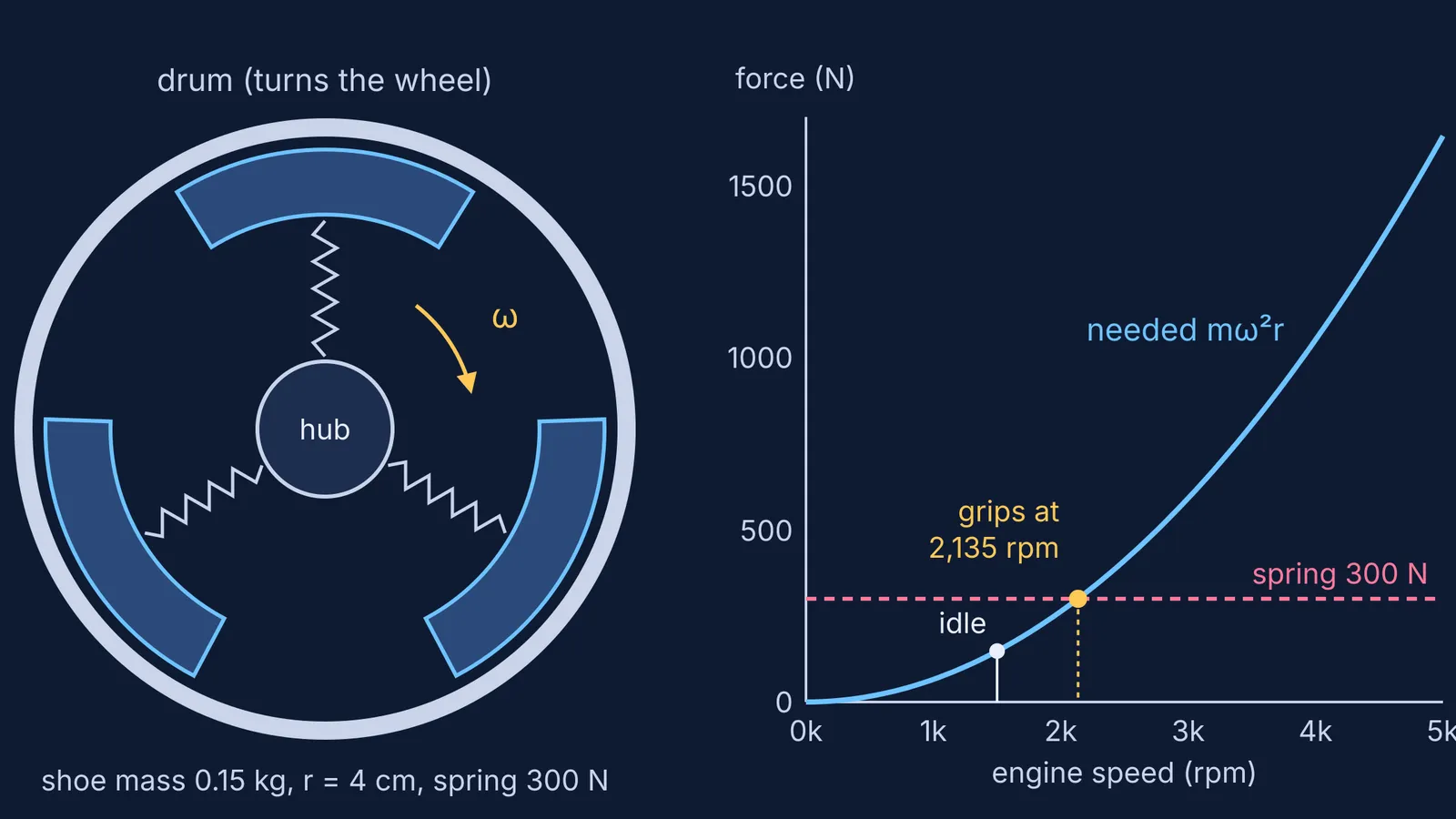
At low engine speed the shoes spin with the hub without touching the drum, so no torque reaches the wheel. At higher speed they move out, press on the drum, and friction turns it. The engine speed alone decides when the clutch grips.
The hand-worked friction clutch and torque converter are covered in why vehicles need gears, and how the clutch works. Here circular motion, not the rider, decides when to connect.
Why do the shoes move out if nothing pushes them?
Work in the ground frame. A shoe of mass m whose centre of mass is at radius r, turning at angular speed ω, is not moving in a straight line. To keep it on its circle, something must pull it towards the centre with a net force mω²r.
At low ω, the spring pulls inwards and the hub's slot holds the shoe in place. The required mω²r is less than the spring force, so the shoe sits firmly in.
As ω rises, mω²r grows as ω². At some speed it equals the spring's pull.
Above that speed the spring alone cannot supply the force the shoe needs. The shoe does what any body does when the inward force is too small: it drifts to a larger radius, until the drum stops it.
Once the shoe is against the drum, the drum pushes inwards on it with a normal force N, and the spring and drum together supply the centripetal force: F_spring + N = mω²r. By Newton's third law the shoe pushes outwards on the drum with the same N. That outward push on the drum is real, and it is what friction acts on.
In the hub's rotating frame you would add an outward centrifugal force mω²r instead. Both give the same numbers; just never mix the two frames in one free-body diagram. The difference is laid out in centripetal vs centrifugal force.
At what speed does a centrifugal clutch engage?
Here is a worked example with illustrative values. Real scooters use different masses, springs and engagement speeds, so treat these as a model, not a specification.
Three shoes, each of mass m = 0.15 kg.
Centre of mass of each shoe at r = 4.0 cm = 0.040 m.
Spring preload on each shoe F = 300 N.
Engine idle speed 1,500 rpm.
Set the condition. The shoe starts to move out when mω²r = F.
Solve for ω. ω = √(F ÷ mr) = √(300 ÷ (0.15 × 0.040)) = √50,000 = 224 rad/s.
Convert to rpm. rpm = ω × 60 ÷ 2π = 224 × 60 ÷ 6.283 ≈ 2,135 rpm.
Check idle. At 1,500 rpm, ω = 157 rad/s, so mω²r = 0.15 × 157² × 0.040 ≈ 148 N. The spring offers 300 N, about twice what the shoe needs, so the shoe stays in. The engine idles and the wheel does not turn.
Check units. kg × (rad/s)² × m = kg m/s² = N, as it should be.
Notice that the friction coefficient is missing. Engagement depends only on m, r and the spring preload.
We treat r and the spring force as fixed; the shoe moves out only about a millimetre, so this is close enough for an estimate.
How much torque does the clutch pass once it grips?
Above engagement, each shoe presses on the drum with N = mω²r − F. Friction on the drum is μN, acting at the drum radius R, so the torque from all three shoes is τ = 3μ(mω²r − F)R.
Take μ = 0.30 and a drum radius R = 5.5 cm = 0.055 m.
At 3,000 rpm: mω²r = 592 N, so N = 292 N per shoe, and τ = 3 × 0.30 × 292 × 0.055 ≈ 14.5 N m.
At 4,000 rpm: mω²r = 1,053 N, so N = 753 N, and τ ≈ 37.3 N m.
At 5,000 rpm: mω²r = 1,645 N, so N = 1,345 N, and τ ≈ 66.6 N m.
Because the needed force grows as ω², the clutch takes up the load gently just above 2,135 rpm and then firmly a little higher. Between 3,000 and 5,000 rpm the engine speed rises by a factor of 1.67, but the torque the clutch can pass rises by a factor of about 4.6. That is the smooth, slip-then-grip start riders feel. While the shoes slip, friction work turns into heat, which is why holding a scooter on a slope with the throttle wears them.
If you want to see how the required force grows with ω and r before you put numbers in, the Simulation Lab has interactive simulations of circular motion. The same mω²r idea, applied to a test tube rather than a shoe, is used in how a centrifuge separates blood.
Why does a weak spring make the scooter creep at idle?
Swap the 300 N springs for weaker 120 N springs and keep everything else the same.
ω = √(120 ÷ (0.15 × 0.040)) = √20,000 = 141 rad/s.
That is about 1,350 rpm, below the 1,500 rpm idle.
Now the shoes are already touching the drum at idle. The scooter creeps forward at a traffic light, and the shoes wear even when you are not riding. Too strong a spring makes the clutch grip only at high revs, so engagement is set comfortably above idle.
What is the difference between the clutch and the CVT?
A gearless scooter has two separate devices on the transmission side.
The CVT (continuously variable transmission) is a belt running between two pulleys whose effective diameters change with speed. It changes the gear ratio smoothly.
The centrifugal clutch sits after it, on the rear pulley, and only decides whether the drive is connected at all.
The CVT's front pulley also has rollers that move out with speed, which is why the two are easy to confuse.
Quick checklist
A spinning shoe needs a net inward force mω²r to stay on its circle.
The clutch grips when mω²r exceeds the spring preload: ω = √(F/mr).
Engagement speed does not depend on μ; transmitted torque does: τ = nμ(mω²r − F)R.
Force grows as ω², so the grip builds quickly above engagement.
In the ground frame there is no outward force on the shoe; centrifugal force exists only in the rotating frame.
Engagement must sit above idle, or the scooter creeps.


