

On this page
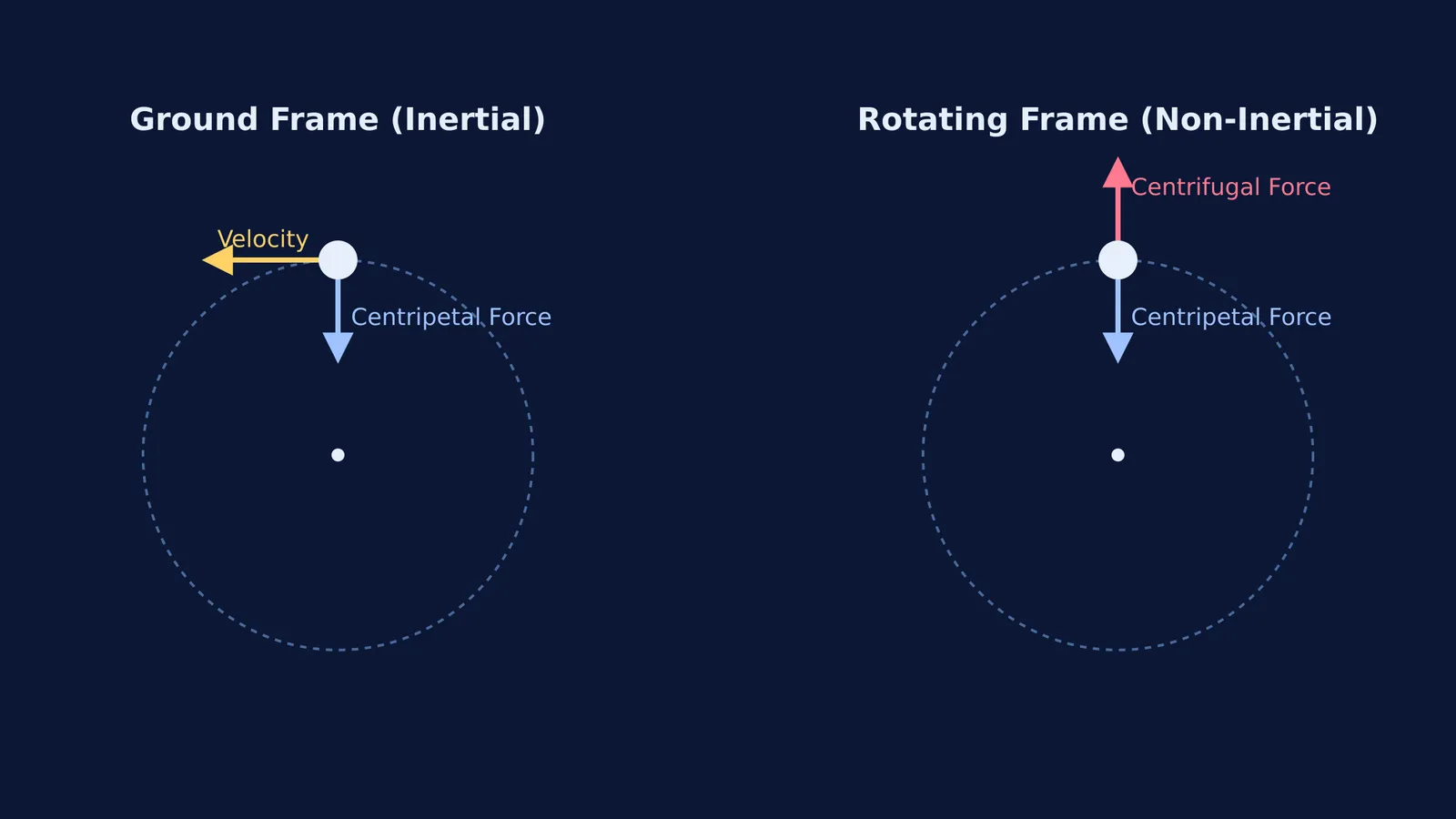
When you watch a car take a sharp turn from the sidewalk, you know that friction is pushing it toward the center of the curve. But if you are sitting inside that car, you feel as though you are being thrown against the door, away from the center. This everyday experience perfectly captures the difference between centripetal and centrifugal force. The distinction comes down entirely to the frame of reference from which you observe the motion.
What is the difference between centripetal and centrifugal force?
Centripetal force is a real net force that acts on a body moving in a circular path, and it is directed toward the center of curvature. According to the OpenStax University Physics text, any net force causing uniform circular motion—whether it is tension, gravity, or friction—is called a centripetal force. For example, if a 900.0-kg car drives around a 500.0-m radius curve at 25.00 m/s, it requires exactly 1,125 N of centripetal force (provided by road friction) to stay on the path. If the road suddenly becomes perfectly icy and friction is lost, the car does not fly straight outward; it continues in a straight line tangential to the curve, proving there was no outward force pushing it.
Centrifugal force is a "fictitious" or inertial force that appears to act outward on a body when observed from a rotating frame of reference. If you draw a free-body diagram from the perspective of the turning car, your own inertia feels like a force pushing you outward.
If you are struggling to decide which frame to use for a tricky mechanics question, the Fermi Problem Library provides a step-by-step solver that explains the reasoning rather than just printing an answer.
Is centrifugal force a real force?
No, centrifugal force is not a real force with a physical origin. In a stationary frame of reference, there is no physical interaction—like a string, a magnetic field, or a gravitational pull—acting outward when a car turns. The physics curriculum emphasizes that centrifugal force is a fiction resulting purely from an object's inertia attempting to keep it moving in a straight line while its container turns.
However, because the Earth itself is a rotating frame, we experience a tiny centrifugal effect every day. According to Wikipedia's Gravity of Earth page, the rotation of the Earth creates an outward centrifugal acceleration at the equator. This effect counteracts Earth's gravity to a small degree, reducing the apparent pull of gravity by up to 0.3% at the equator compared to the poles. The material of the Earth itself responds to this effect, creating an equatorial bulge that makes the planet an oblate spheroid.
When you learn physics, shifting between these reference frames can feel abstract. The Fermi Concept Library contains every concept in physics, chemistry, biology, mathematics and computing, each with its own lesson and its place in the map to help you visualise inertial and non-inertial frames.
How do you calculate force in a centrifuge?
Even though centrifugal force is technically fictitious in the ground frame, the biological and chemical sciences rely heavily on it to separate samples in a centrifuge. Because the samples sit inside the spinning rotor (a non-inertial frame), they behave exactly as if a massive outward gravitational pull is dragging denser particles to the bottom of the tube.
In the laboratory, this apparent force is measured as Relative Centrifugal Force (RCF), often called "g-force". RCF standardises the force regardless of the centrifuge's physical size, whereas Revolutions Per Minute (RPM) is specific to the machine's radius.
To find the RCF, you can use the formula from Wikipedia's Centrifuge page: RCF = 1.118 × 10⁻⁶ × r × (RPM)², where the radius *r* is measured in millimetres from the rotor's center to the bottom of the tube. Using this formula, a centrifuge with a 100 mm radius spinning at 5,000 RPM produces a relative centrifugal force of exactly 2,795 × g.
What is the checklist for circular motion problems?
When tackling circular motion exam questions like a car over a hump or solving conical pendulum problems, use this strict three-step framework:
Pick your frame of reference: Decide whether you are solving from the ground (the inertial frame) or from the object's perspective (the non-inertial frame). Do not mix them.
Identify the real forces: Draw the tension, gravity, normal force, and friction. In the ground frame, the vector sum of these real forces pointing toward the center is the net centripetal force (mv²/r).
Add the pseudo-force only if rotating: If you chose the rotating frame, add an outward centrifugal force of magnitude mv²/r. In this non-inertial frame, the object is considered stationary, so all inward real forces and outward pseudo-forces must sum to zero.
Mastering this distinction will stop you from "double counting" forces—a classic mistake where students draw both an inward tension and an outward centrifugal force while trying to solve a problem from the ground frame.


