

On this page
A siphon empties a container through a tube that climbs over the rim and then falls to a lower outlet, like the pipe used to drain a terrace water tank. Once the tube is full, water keeps flowing uphill over the bend with no pump.
How does a siphon work?
One end of a full tube sits under the water surface; the other hangs lower, outside. Gravity pulls water down the long outlet leg and out. That lowers the pressure at the bend, and the air pressing on the open surface pushes more water up the short leg to replace it.
A 2015 paper in Scientific Reports concluded that siphons operate through gravity and molecular cohesion: the attraction between water molecules helps hold the column together.
The rule that matters most: the outlet must be lower than the water surface it draws from. If the two levels are equal, the flow stops.
What is the pressure inside a siphon tube?
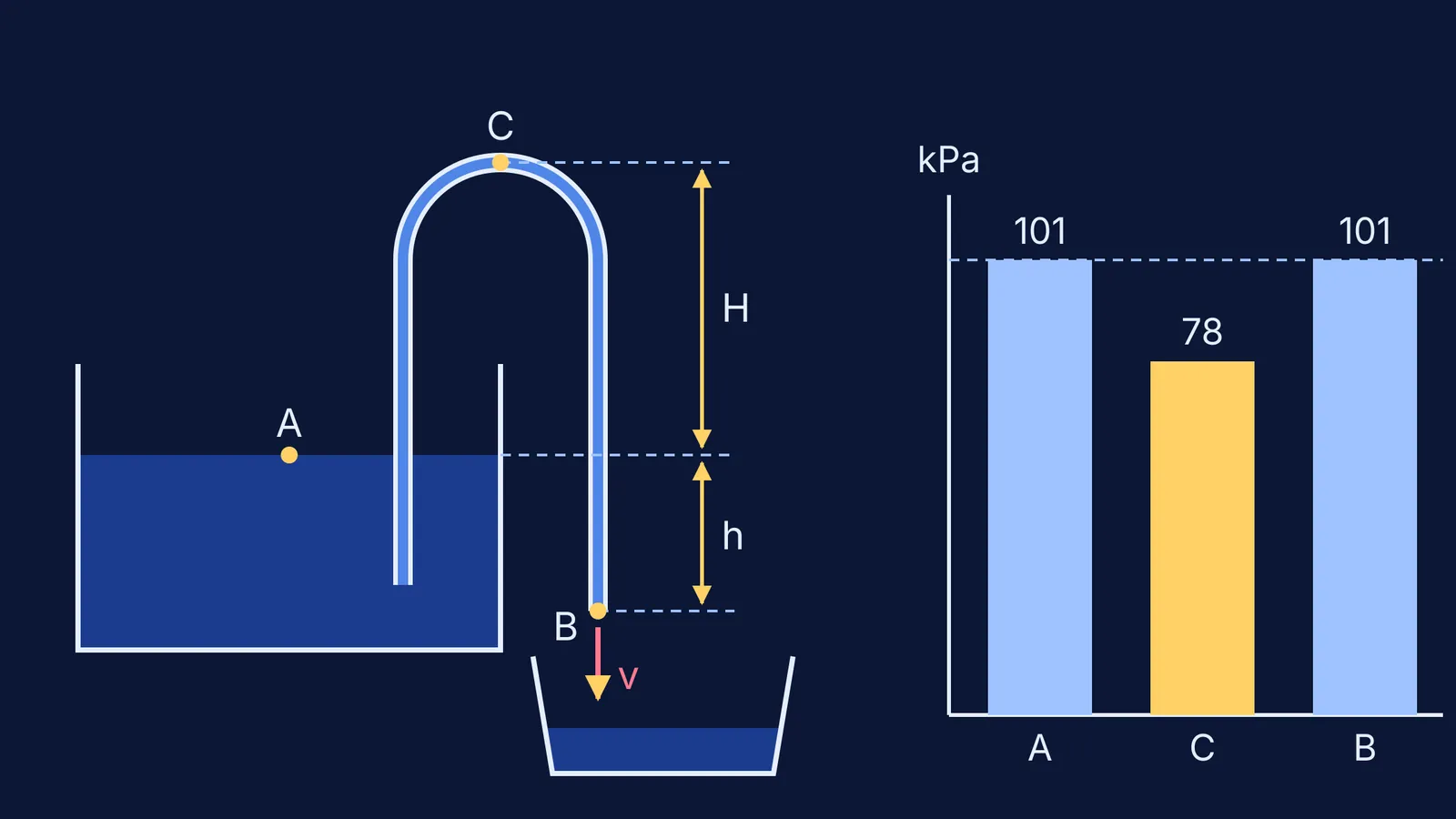
Use Bernoulli's equation, p + ½ρv² + ρgy = constant, which holds along a streamline for an incompressible, frictionless fluid. Label three points, as in the diagram above:
A: the open water surface in the upper tank. Pressure is atmospheric, p₀, and the surface falls so slowly that v ≈ 0. Take y = 0 here.
C: the crown, the highest point of the tube, a height H above A.
B: the outlet, a depth h below A and open to the air, so its pressure is also p₀.
The tube has the same width all along and water barely compresses, so the water moves at the same speed v everywhere inside it. Bernoulli between A and C gives:
p_C = p₀ − ρgH − ½ρv²
The crown pressure is below atmospheric for two reasons: the crown is higher up, and the water there is moving.
How fast does water come out of a siphon?
Apply Bernoulli between A and B. The pressure is p₀ at both, so p₀ + 0 + 0 = p₀ + ½ρv² − ρgh, which gives v = √(2gh).
It is the same speed as water spurting from a hole in a tank, Torricelli's law of efflux. The crown height H is missing: raising the bend does not change the ideal outlet speed; only the drop h does.
Put v² = 2gh into the crown equation:
p_C = p₀ − ρg(H + h)
How do you calculate the crown pressure in a siphon?
Atmospheric pressure at sea level is 1.01 × 10⁵ Pa, per OpenStax College Physics. Take water density 1000 kg/m³, g = 9.8 m/s², a crown 1.5 m above the water surface (H) and an outlet 0.8 m below it (h), as when draining a terrace tank.
Outlet speed: v = √(2 × 9.8 × 0.8) = √15.7 ≈ 4.0 m/s.
Crown pressure: p_C = 101,000 − 1000 × 9.8 × (1.5 + 0.8) = 101,000 − 22,540 ≈ 78,500 Pa, about 78 kPa.
Check: 78 kPa is far above water's vapour pressure, so the column holds.
Friction makes the real speed lower; 4.0 m/s is the ideal upper limit.
What limits the height of a siphon?
The crown pressure cannot fall below the vapour pressure of water. Below that, the water boils at room temperature, bubbles form and the column breaks. Water's vapour pressure at 20 °C is about 2.3 kPa, according to the Scientific Reports paper by Boatwright, Hughes and Barry.
Set p_C equal to that vapour pressure, with very slow flow (h close to 0):
H_max ≈ (p₀ − p_vap) / ρg = (101,000 − 2,330) / (1000 × 9.8) ≈ 10.1 m
That matches the textbook figure: the authors note that the maximum height of a siphon is generally assumed to depend on barometric pressure, about 10 m at sea level. It is the same reasoning as a water barometer, the idea behind how Torricelli built the first barometer. With flow, the condition is really that H + h stays below about 10 m, so a longer drop lowers the safe crown height.
The 10 m figure is not absolute. The same team ran a siphon at sea level with a 15 m crown, using water degassed beforehand so that bubbles could not form. Its flow was slow: about 400 ml in 850 seconds. For ordinary water in a board or JEE question, use about 10 m unless the problem says otherwise.
What mistakes do students make with siphons?
Putting the crown height H into the outlet-speed formula.
Measuring h from the tank bottom or the inlet instead of the water surface.
Reporting a negative crown pressure instead of concluding that the siphon fails.
For more traps, read our list of pressure, buoyancy and Bernoulli mistakes to avoid. To practise, the Fermi Problem Library has worked problems with a step-by-step solver that explains the reasoning rather than printing an answer, so you can check each Bernoulli step.


