

On this page
What is the hydrostatic paradox?
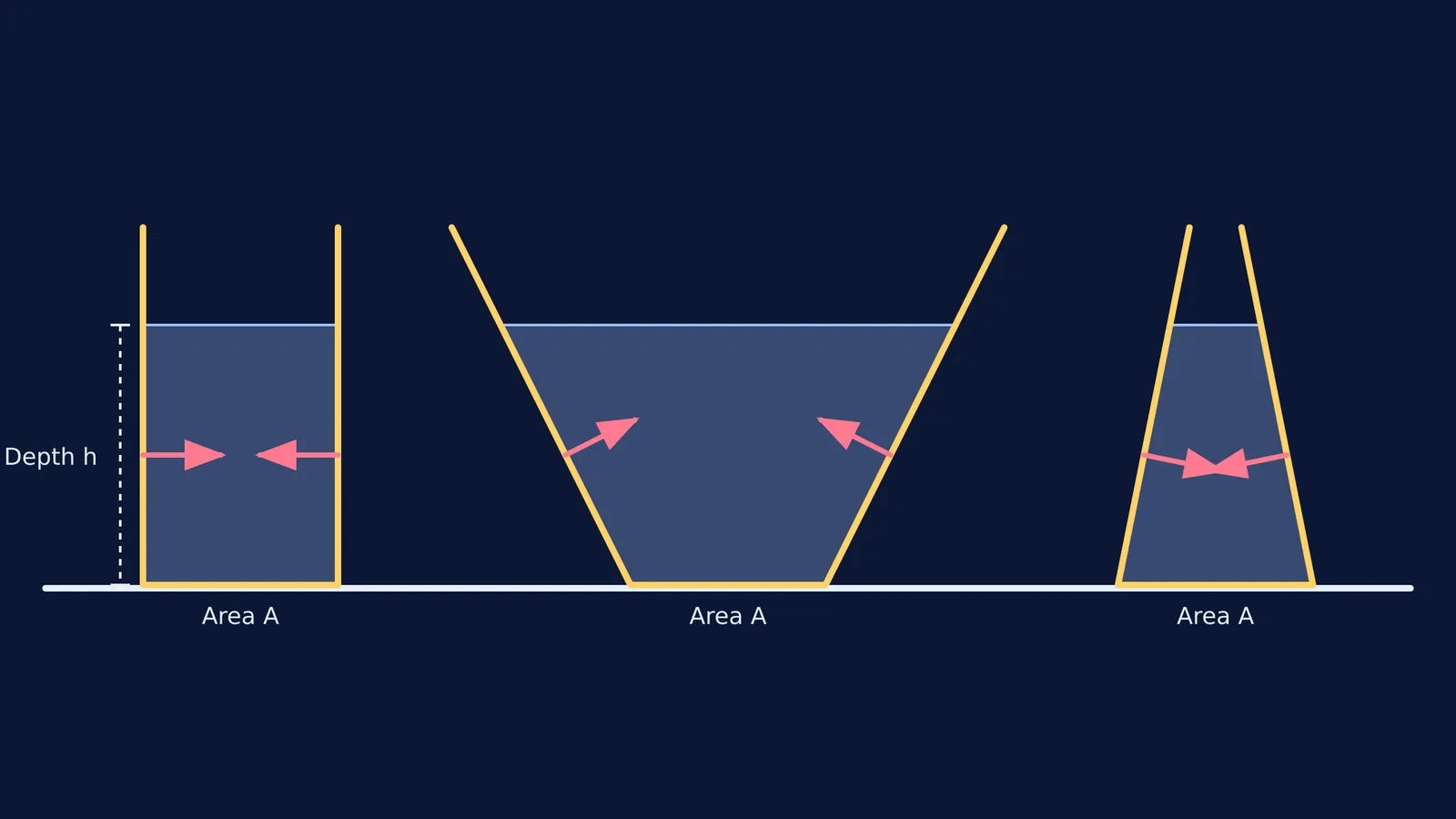
Imagine three glass vessels resting on a table. The first is a straight cylinder, the second flares outward like a bowl, and the third tapers inward like a conical flask. If you fill all three with water to the exact same depth, the pressure at the bottom of each vessel is identical.
Because the base area of each vessel is the same, and the pressure is the same, the downward force on each base is identical. Yet, if you pick them up, the flaring bowl is clearly heavier—it holds much more water—while the tapered flask is much lighter.
How can three vessels containing wildly different amounts of water exert the exact same force on their bases? The Flemish mathematician Simon Stevin first published his explanation of the hydrostatic paradox in 1586 (1). The answer lies in the forces exerted by the walls of the containers.
Why does pressure only depend on depth?
The pressure at the bottom of a fluid is its depth multiplied by its density and the acceleration due to gravity (2). The shape of the container does not enter the equation.
If you drop a small cube of water near the bottom of any of these vessels, the only thing pressing down on it is the column of water directly above it. The water to its left or right is supported by other columns of water. The pressure at a depth h is simply P = ρgh.
To find the total force on the base, you multiply this pressure by the base's area (F = P × A). Since P and A are the same for all three vessels, the base force matches.
Where does the extra weight go?
If the force on the base equals the weight of the water in the cylinder, how do the other two vessels balance out?
You have to look at the forces exerted by the sloping walls. A fluid under pressure pushes outward against its container perpendicularly to the surface. By Newton's third law, the container walls push back on the fluid.
The cylinder (straight walls): The walls are purely vertical. They push back perfectly horizontally. Because they have no vertical tilt, they neither support the water nor push it down. The base supports 100% of the liquid's weight.
The flaring vessel (outward sloping): The walls slope outward, meaning the water pushes down and out against them. The walls, in turn, push inward and upward on the water. This upward force from the glass supports the "extra" water that sits above the slanted walls. The base only has to support the central column.
The tapered vessel (inward sloping): The walls slope inward, so the water pushes up and out against them. The walls push inward and downward on the liquid. This downward force from the glass adds to the weight of the actual water. The base feels the weight of the water *plus* the downward push of the walls.
How do you trace forces in exams?
This distinction between base force and total weight is a classic trap in JEE Main, JEE Advanced and NEET-UG physics. Examiners will ask you to compare the thrust on the bottom of a flask to the reading on a weighing machine.
If you are confusing the weight of the liquid with the thrust on the base, the Fermi Concept Library map for hydrostatics isolates these ideas. When a problem gets tangled, Fermi's AI tutor can draw the free-body diagram of the liquid with you, checking that you have accounted for the normal forces from the walls.
Once you see how the container pushes back, the paradox vanishes. Whether you are finding an unknown density in a manometer with two immiscible liquids or calculating the lift using Pascal's law in hydraulic machines, remembering that a fluid pushes perpendicular to its boundary will keep your equations balanced.


