

On this page
Have you ever stared at a sputtering pressure cooker and wondered how such a tiny metal cap keeps a roaring fire in check? That little cap—the whistle—is a masterclass in middle-school physics. It uses the relationship between pressure, force, and area to safely cook food in a fraction of the time.
Why does a pressure cooker whistle?
As water boils inside a sealed pressure cooker, it turns into steam. Because the steam is trapped in a fixed volume, it pushes outward against the walls of the cooker, creating internal pressure. If you want to understand what happens to a gas that isn't contained, you can look at the Free expansion of an ideal gas: why work and ΔU are both zero.
The whistle on the lid is officially called a "dead weight regulator," and it sits over a tiny hole called a vent. A standard pressure cooker operates at a gauge pressure of 15 psi (about 1 bar) above atmospheric pressure 1.
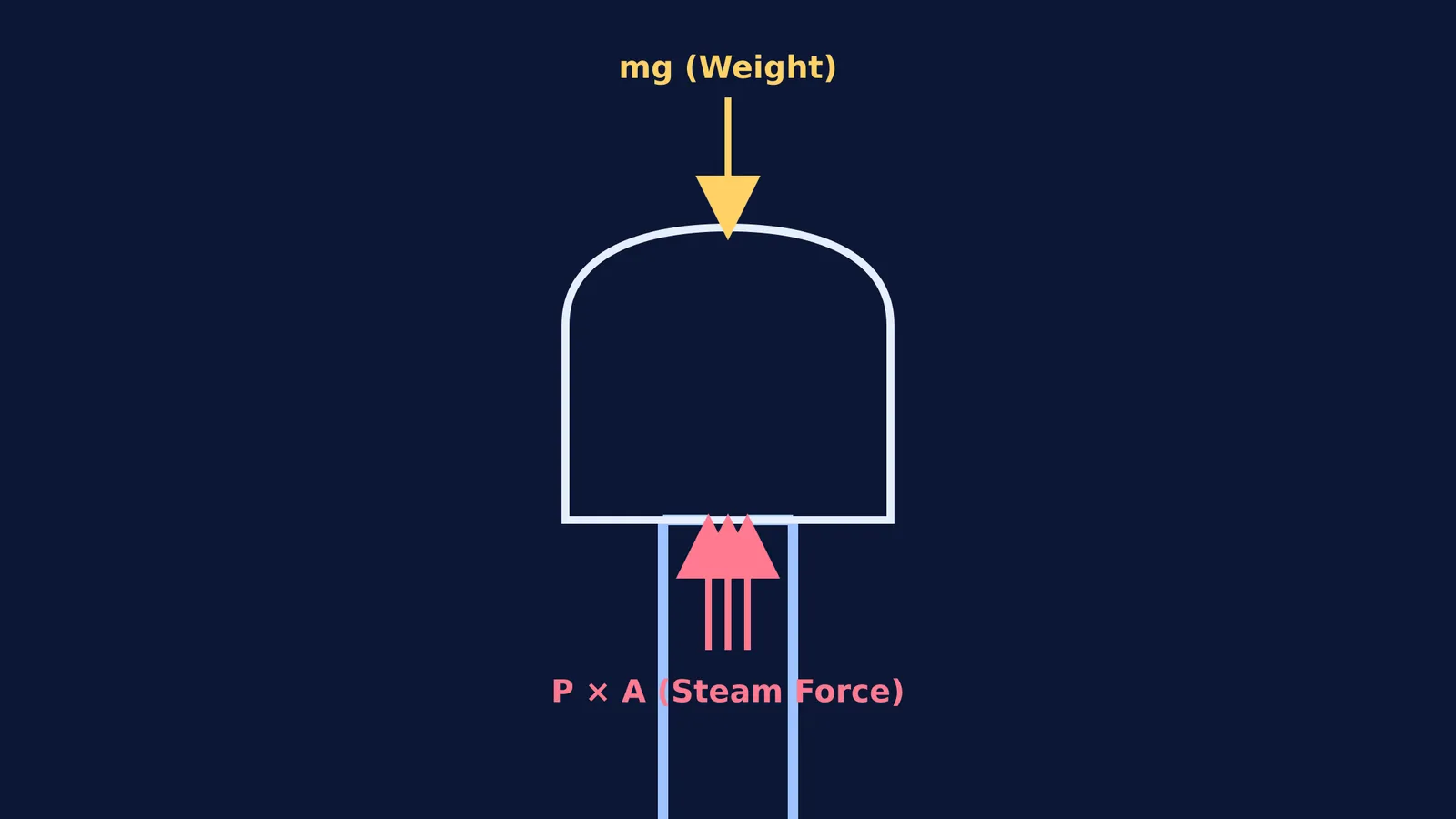
To hold the steam back, the whistle uses its own mass. Gravity pulls the whistle down against the vent, while the internal steam pushes it up. The cooker whistles when the upward force of the steam finally beats the downward weight of the metal cap. The cap lifts, a jet of steam escapes with a hiss, the pressure drops slightly, and the cap falls back down. This cycle of lifting and falling is what causes the rhythmic whistling or jiggling.
Gauge pressure versus absolute pressure
When we say a pressure cooker runs at 1 bar, we are talking about gauge pressure 1. This is the pressure *above* the normal atmospheric pressure of the room you are standing in.
The atmosphere around us already exerts about 1 bar (14.7 psi) of pressure on everything, including the outside of the cooker. Inside the cooker, the steam is pushing outward with 2 bars of absolute pressure (1 bar from the atmosphere + 1 bar of extra steam pressure). The whistle only has to hold back the difference between the inside and the outside, which is exactly 1 bar.
This is why pressure cookers behave differently at high altitudes. High in the mountains, the atmospheric pressure pushing down on the whistle is lower. Since the whistle still only adds 1 bar of gauge pressure, the absolute pressure inside the pot will be lower than it would be at sea level, meaning your food will take longer to cook.
How much must the whistle weigh?
We can calculate the whistle's exact weight using the formula Pressure = Force / Area.
The steam's upward force (F) is the internal gauge pressure (P) multiplied by the area of the vent hole (A). For the whistle to lift, this upward force must precisely equal the whistle's weight (m × g).
Let's assume the cooker runs at 1 bar of gauge pressure (10⁵ pascals) and the vent hole has a diameter of 2.5 mm 1:
The radius is 1.25 mm (0.00125 m).
The area of the hole (A = πr²) is about 4.9 × 10⁻⁶ square metres.
The upward force is P × A = 10⁵ × 4.9 × 10⁻⁶ = 0.49 newtons.
To provide a downward force of 0.49 newtons, the whistle's mass (m = F/g) must be 0.49 / 9.8 = 0.05 kg, or exactly 50 grams.
Because the vent hole is so small, a 50-gram piece of metal is heavy enough to hold back a tremendous amount of pressure. This is identical to the principles at play in Pascal's law in hydraulic machines: lifting a car with a small push, where the area of a surface determines the resulting force. If you struggle to visualise how forces balance out across different areas, the Fermi Simulation Lab lets you adjust areas and weights on a virtual rig to see the equilibrium shift in real time.
Why do we cook under pressure?
The entire point of trapping steam is to raise the boiling point of water.
In an open pot at sea level, water boils at 100 °C. No matter how high you turn up the stove, the liquid will not get any hotter; the extra energy just turns more water into steam.
However, boiling happens when a liquid's vapour pressure matches the pressure pushing down on it. By adding 1 bar of extra pressure inside the sealed pot, the water must reach a much higher temperature before it can boil. At 15 psi, the boiling point of water rises to approximately 121 °C (250 °F) 1.
Cooking food at 121 °C rather than 100 °C drastically speeds up the chemical reactions that break down tough meat fibres and starches. The rule of thumb in chemistry is that reaction rates double for every 10 °C increase 1. By jumping from 100 °C to 121 °C, the cooking process becomes roughly four times faster. What takes hours in an open pot takes only minutes under pressure.
If you are learning the thermodynamics of phase changes, Fermi's AI tutor can work out what you already know and build a plan for the session, teaching you how pressure affects boiling and melting points.


