On this page
The NEET (UG) 2026 syllabus puts this chapter in Unit 2 of Biology, whose title is Structural Organisation in Animals and Plants. We wrote all 13 questions from NCERT's Class 11 Biology Chapter 7, 2026-27 reprint; none comes from a past paper or forecasts one.
Why are all the figures in this set about the frog?
In the current reprint, the chapter opens with a short passage on tissues, organs and organ systems and then turns to the frog, which fills all four figures (NCERT kebo107): external features (7.1), internal organs (7.2), and the male and female reproductive systems (7.3, 7.4). There are no tissue drawings and no cockroach section.
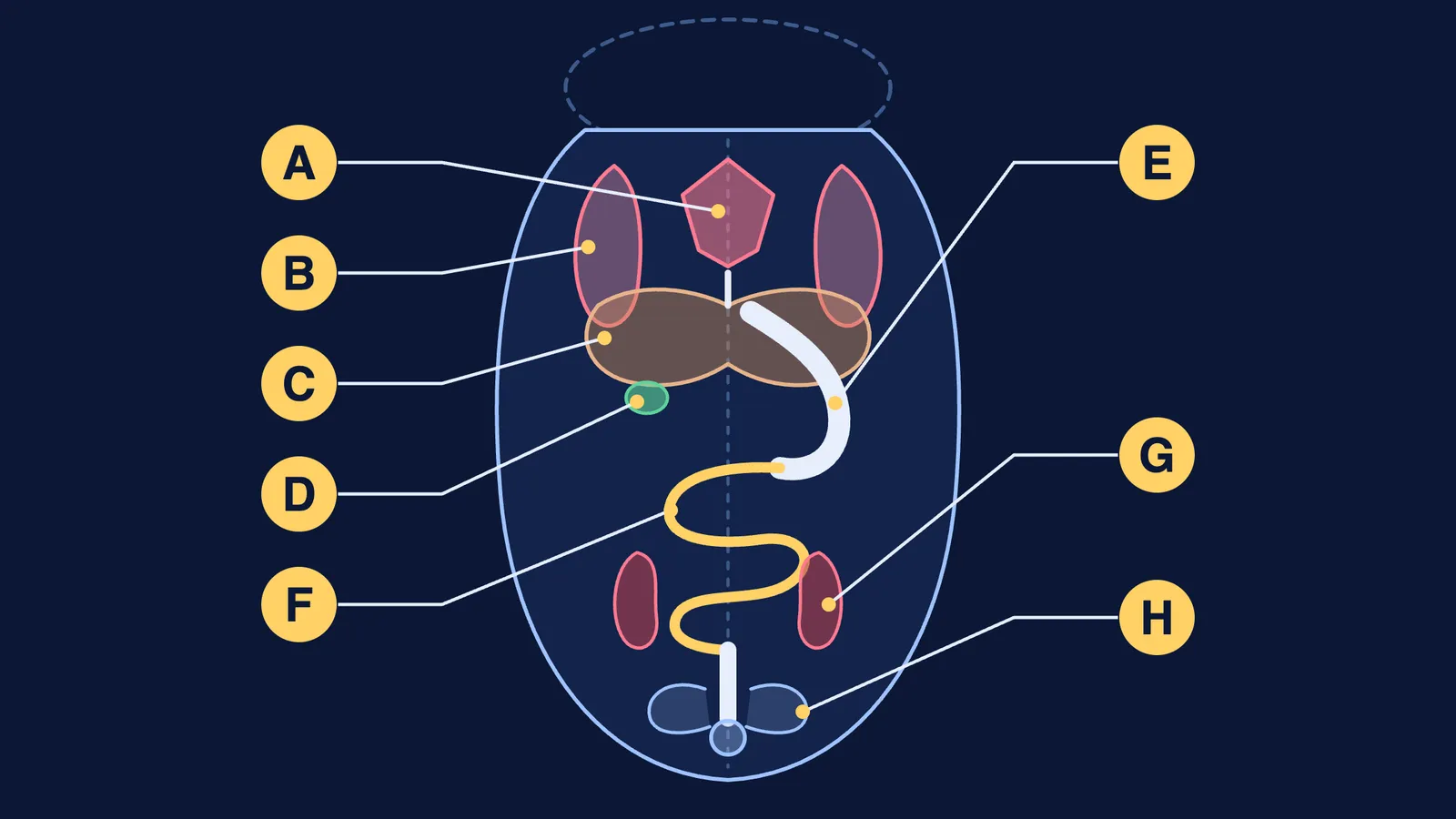
Q1 to Q6 use our hero schematic of the body cavity, organs marked A to H. Q7 to Q13 work from the other figures, told in words.
What should you check first in a figure marked with letters?
Start with position, not shape. An organ high up, beside the vertebral column or near the cloaca narrows the options fast.
Next, pin one job to each organ before reading the options. A gland and the small sac beside it are often tested on making versus holding the same juice.
Two-statement key: (1) I and II both hold (2) neither holds (3) I holds, II does not (4) II holds, I does not.
Q1 to Q6: which frog organs are marked A to H?
Q1. HCl and gastric juices start digesting food in which lettered organ? (1) C (2) E (3) F (4) H
Q2. Match each letter to its description. Letters: B, H, A, C Descriptions: (i) Pink, elongated sac in the upper trunk (ii) Thin-walled sac ventral to the rectum, opening into the cloaca (iii) Three chambers wrapped in the pericardium (iv) Secretes bile (1) B-iii, H-ii, A-i, C-iv (2) B-i, H-ii, A-iii, C-iv (3) B-i, H-iv, A-iii, C-ii (4) B-iv, H-ii, A-i, C-iii
Q3. Statement I: Partly digested food leaves E and enters the duodenum, the first part of F. Statement II: Villi and microvilli on the inner wall of F absorb digested food.
Q4. Statement I: The frog breathes with B only while it is in water. Statement II: During hibernation, gases are exchanged through the skin.
Q5. Which lettered organ is compact, dark red and bean-shaped, on either side of the vertebral column? (1) A (2) C (3) G (4) B
Q6. The secretion stored in D reaches the duodenum by the common bile duct. Its job there is to: (1) digest proteins (2) digest carbohydrates (3) emulsify fat (4) absorb water
Answer key for the lettered diagram
A: heart. B: lung. C: liver. D: gall bladder. E: stomach. F: intestine. G: kidney. H: urinary bladder.
Q1: (2). NCERT places HCl and gastric juice action in the stomach.
Q2: (2). The three-chambered heart sits in the pericardium; the lungs are pink sacs in the thorax; the liver secretes bile; the bladder lies ventral to the rectum.
Q3: (1). Chyme goes from stomach to duodenum; villi and microvilli absorb.
Q4: (4). In water the skin breathes; lungs work on land.
Q5: (3). NCERT describes the frog kidney this way.
Q6: (3). Bile emulsifies fat; pancreatic juice digests carbohydrates and proteins.
Can you picture the other frog figures from words alone?
Build the figure in your head first; one misplaced part or misrouted duct sinks an option.
Q7. In the figure of external features, the body is divided into: (1) head, neck and trunk (2) head and trunk only (3) head, trunk and tail (4) cephalothorax and abdomen
Q8. Statement I: A membranous tympanum sits on either side of the eyes. Statement II: The fore limbs only swim; leaping and burrowing are left to the hind limbs.
Q9. Pair each part with its role. List-I: J. Vocal sacs K. Tympanum L. Nostrils M. Webbed digits List-II: (i) Help in swimming (ii) Produce sound, in males only (iii) Pick up sound signals (iv) Let air into the buccal cavity (1) J-iii, K-ii, L-iv, M-i (2) J-ii, K-iv, L-iii, M-i (3) J-ii, K-iii, L-iv, M-i (4) J-i, K-iii, L-iv, M-ii
Q10. Stroke the frog of Figure 7.1 and its skin feels smooth and slippery. The cause is: (1) mucus (2) scales (3) a nictitating membrane (4) a dry, horny layer
Q11. Male system (Figure 7.3). Statement I: The yellowish, ovoid testes are attached to the upper part of the kidneys. Statement II: The urinogenital duct from each kidney opens into the urinary bladder.
Q12. Female system (Figure 7.4). Which is correct? (1) Ova pass from the ovaries into the kidneys (2) The ovaries lie near the kidneys but have no functional connection with them (3) The oviducts join the ureters before the cloaca (4) There is a single oviduct
Q13. Trace food through the gut of Figure 7.2. Which order is right? (1) buccal cavity, pharynx, oesophagus, stomach (2) buccal cavity, oesophagus, pharynx, stomach (3) pharynx, buccal cavity, stomach, oesophagus (4) oesophagus, pharynx, buccal cavity, stomach
Q7 to Q13: answers and why
Q7: (2). NCERT says a neck and tail are absent.
Q8: (3). NCERT credits both pairs of limbs with swimming, walking, leaping and burrowing.
Q9: (3). Vocal sacs are male; the tympanum receives sound; air enters the buccal cavity through the nostrils.
Q10: (1). Mucus keeps the skin moist, smooth and slippery.
Q11: (3). The urinogenital duct opens into the cloaca.
Q12: (2). Each oviduct opens separately into the cloaca.
Q13: (1). The buccal cavity leads to the oesophagus through the pharynx; the oesophagus opens into the stomach.
How do you turn wrong answers into revision?
Cover the key, write the eight organ names on a blank outline, then compare positions with Figure 7.2 in the NCERT chapter.
For each miss, decide whether you confused where an organ sits or what it does, then reread the figure or the paragraph beside it.
Explain Figures 7.3 and 7.4 aloud side by side, tracking where each duct ends.
For text-only practice, try our frog and animal tissues statement and match-the-list set. To revise by system, read our frog chapter walkthrough for Class 11. For a memory routine, see drawing NEET Biology diagrams from memory.
Which frog figure is still fuzzy for you? Fermi's AI tutor works out what you already know and builds a plan for the session.