

On this page
The 2026-27 reprint of NCERT Class 11 Biology Chapter 7 has two sections: 7.1 Organ and Organ System, and 7.2 Frogs. In the National Medical Commission's NEET (UG) 2026 syllabus, Unit 2, on structural organisation in animals and plants, names animal tissues and the frog's systems (digestive, circulatory, respiratory, nervous, reproductive), as a brief account only. The reprint keeps only a short passage on tissues, so this set centres on the frog and its tissue item stays inside that passage.
What does the 2026-27 NCERT chapter still say about tissues?
A tissue is a group of similar cells, with intercellular substances, that carries out a specific function. Complex animals have just four basic types: epithelial, connective, muscular and neural, and the heart is the chapter's example of an organ with all four. Its summary adds that epithelia are sheet-like, with one free surface, and that their cells are joined at junctions.
How do you attack two-statement questions?
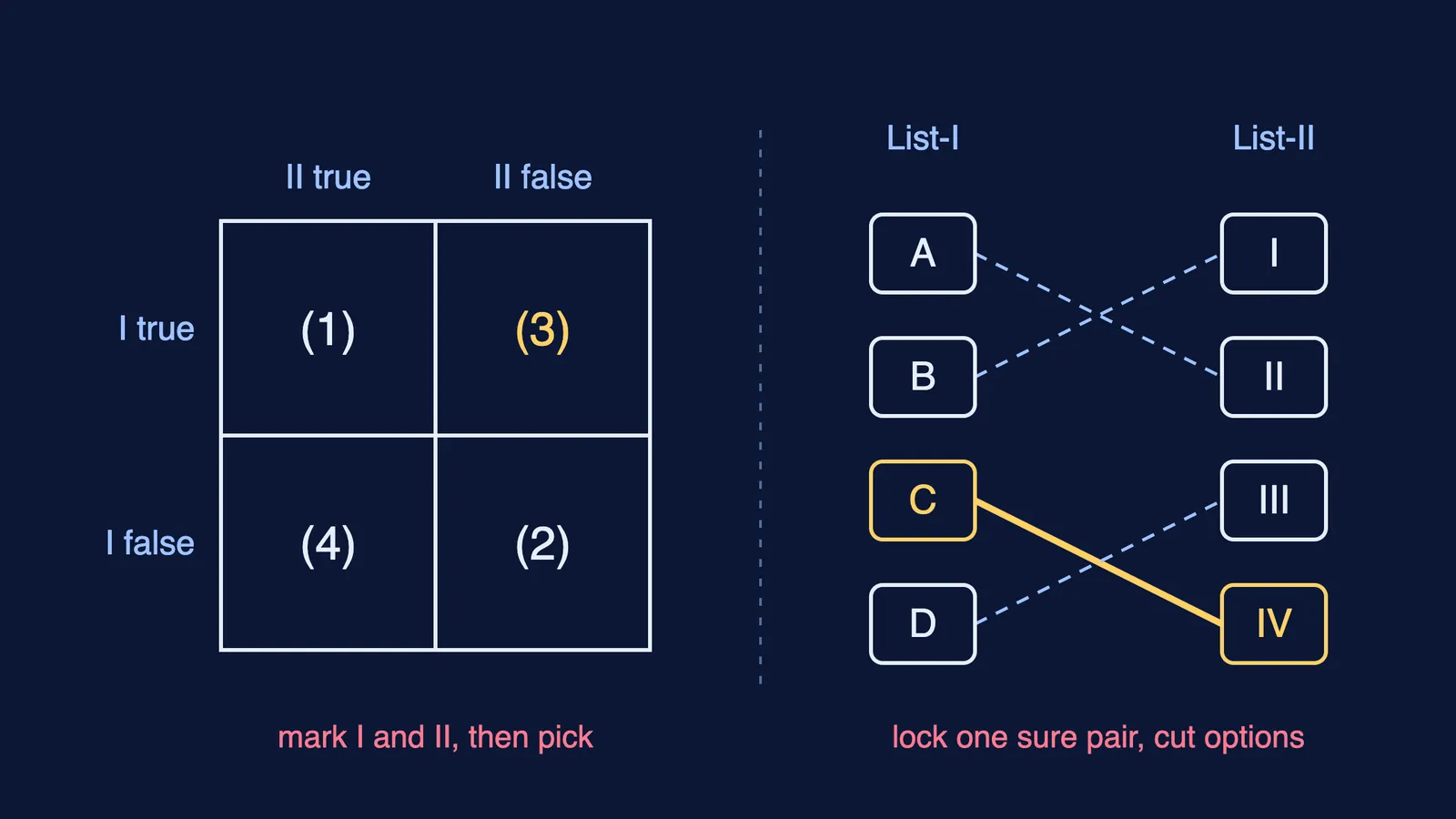
Mark each statement true or false before reading the options, testing words that set a limit or direction, such as "all", "left" or "dorsal".
For questions 1 to 5: (1) Both I and II are correct (2) Both I and II are incorrect (3) I is correct, II is incorrect (4) I is incorrect, II is correct.
I: The frog heart has two atria and one ventricle. II: The sinus venosus joins the left atrium.
I: In a male frog, the ureters act as a urinogenital duct. II: In a female frog, the ureters and oviducts open into the cloaca separately.
I: The frog excretes uric acid, so it is uricotelic. II: The frog's urinary bladder lies dorsal to the rectum.
I: Every organ contains all four basic tissue types. II: Epithelial cells are linked at junctions, in structure and in function.
I: The frog's autonomic nervous system has sympathetic and parasympathetic parts. II: The frog's spinal cord runs outside the vertebral column.
Answers. 1: (3). The sinus venosus joins the right atrium. 2: (1). NCERT states both. 3: (2). Frogs excrete urea (ureotelic), and the bladder lies ventral to the rectum. 4: (4). An organ has one or more tissue types; the heart happens to have all four. 5: (3). The spinal cord is enclosed in the vertebral column.
How do you solve match-the-list questions quickly?
Lock one pair you are sure of and cross out every option that contradicts it; a second sure pair usually leaves one option.
List-I: A. Touch B. Taste C. Smell D. Hearing. List-II: I. Nasal epithelium II. Tympanum with internal ears III. Sensory papillae IV. Taste buds. Options: (1) A-III, B-IV, C-I, D-II (2) A-IV, B-III, C-I, D-II (3) A-III, B-IV, C-II, D-I (4) A-I, B-IV, C-III, D-II
List-I: A. Hepatic portal system B. Renal portal system C. Conus arteriosus D. Vena cava. List-II: I. Veins bringing blood to the sinus venosus II. Kidney and lower-body venous link III. Liver and intestine venous link IV. Ventral sac the ventricle opens into. Options: (1) A-II, B-III, C-IV, D-I (2) A-III, B-II, C-IV, D-I (3) A-III, B-II, C-I, D-IV (4) A-IV, B-II, C-III, D-I
List-I: A. Mesorchium B. Vasa efferentia C. Bidder's canal D. Cloaca. List-II: I. Ten to twelve ducts from the testes II. Peritoneal fold holding the testes to the kidneys III. Canal the vasa efferentia open into IV. Chamber passing faeces, urine and sperms out. Options: (1) A-I, B-II, C-III, D-IV (2) A-II, B-III, C-I, D-IV (3) A-II, B-I, C-III, D-IV (4) A-II, B-I, C-IV, D-III
Answers. 6: (1). These are the four sense-organ pairings NCERT gives for the frog. 7: (2). The hepatic portal system links liver and intestine; vena cava feeds the sinus venosus. 8: (3). Vasa efferentia open into Bidder's canal, which joins the urinogenital duct.
Which single-correct frog questions test the details?
Recall the fact being tested before you read the options.
Compared with blood, frog lymph lacks: (1) plasma (2) water (3) a few proteins and RBCs (4) nutrients
In water, a frog's eyes are protected by: (1) the tympanum (2) a nictitating membrane (3) the pericardium (4) the mesorchium
Which is not among the frog endocrine glands NCERT lists? (1) Pineal body (2) Thymus (3) Parathyroid (4) Gall bladder
The frog's main digestive glands are: (1) liver and pancreas (2) gall bladder and thyroid (3) pancreas and adrenals (4) liver and thymus
The frog's ear is an organ of: (1) hearing only (2) balance only (3) both hearing and balance (4) neither, since there is no external ear
Aestivation is: (1) winter sleep in burrows (2) summer sleep in deep burrows (3) a colour change to hide from enemies (4) the change from tadpole to adult
Answers. 9: (3). NCERT says lymph lacks a few proteins and RBCs. 10: (2). The nictitating membrane covers the eyes in water. 11: (4). The gall bladder is not on that list; it stores bile. 12: (1). The gall bladder only stores bile the liver makes. 13: (3). NCERT says the ear serves hearing and balancing (equilibrium). 14: (2). Winter sleep is hibernation.
Where should you go next on this chapter?
For another format, try the assertion-reason questions on structural organisation in animals. To revise system by system, read the Class 11 frog chapter explainer. Why fish, frogs and humans have different heart chambers sets the three-chambered frog heart beside the others.
Not sure which frog system to revise first? Fermi's AI tutor works out what you already know and builds a plan for the session.


