On this page
Count the chambers in a fish, a frog and a human heart and you get 2, 3 and 4. Each heart matches the number of loops the blood makes and how well oxygen-rich and oxygen-poor blood are kept apart. See that link and the single vs double circulation question becomes easy marks.
How many chambers do fish, frog and human hearts have?
The NCERT Class 11 chapter Body Fluids and Circulation gives the full list in one paragraph:
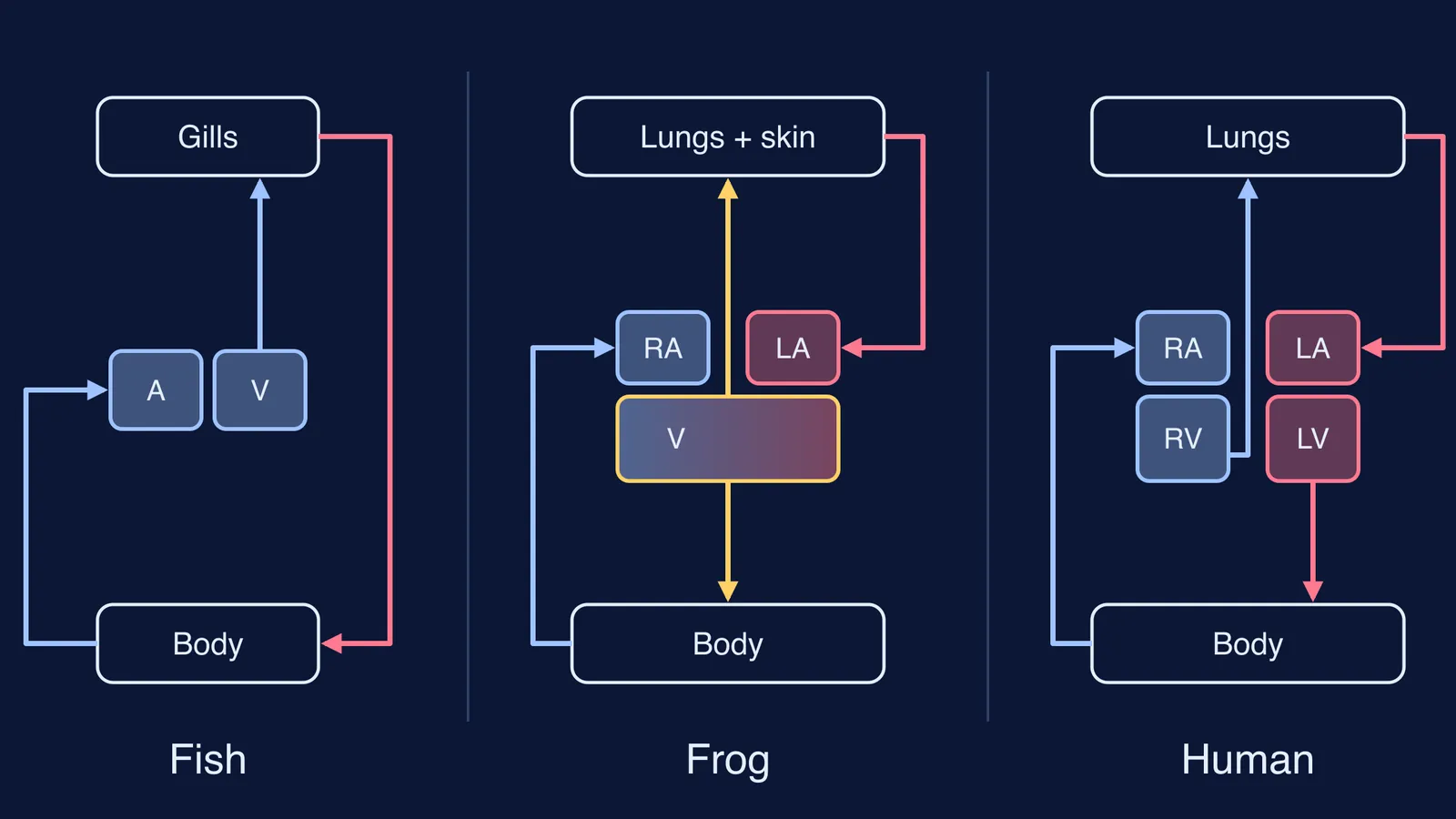
Fishes have a 2-chambered heart with one atrium and one ventricle.
Amphibians and reptiles (except crocodiles) have a 3-chambered heart with two atria and a single ventricle.
Crocodiles, birds and mammals have a 4-chambered heart with two atria and two ventricles.
The same page names each pattern: single circulation in fishes, incomplete double circulation in amphibians and reptiles, double circulation in birds and mammals.
Why does a fish need only two chambers?
In a fish, the heart pumps deoxygenated blood to the gills, where it picks up oxygen, and the blood then goes to the body and returns to the heart (NCERT Class 11). The heart only ever handles one kind of blood, so one atrium to collect it and one ventricle to push it are enough.
The Class 10 chapter Life Processes puts it in one line: in a fish, blood goes through the heart only once during one cycle of passage through the body. That is single circulation.
There is a cost. The OpenStax university textbook Biology 2e notes that this one-way loop creates a gradient from oxygenated to deoxygenated blood around the fish's body, which limits how much oxygen reaches some organs and tissues.
Why do frogs have three chambers?
A frog has two atria but one ventricle. According to NCERT Class 11, the left atrium receives oxygenated blood from the gills, lungs or skin, the right atrium receives deoxygenated blood from the body, and the two mix in the single ventricle, which pumps out mixed blood. NCERT calls this incomplete double circulation.
The skin matters here. OpenStax Biology 2e explains that amphibians also exchange gases through the skin, called pulmocutaneous circulation, and that a ridge inside the ventricle diverts oxygen-rich blood towards the body to reduce the mixing.
Why is mixing acceptable? NCERT's Class 10 chapter says animals that do not use energy to keep their body warm, such as amphibians and many reptiles, have body temperatures set by the environment and can tolerate some mixing.
Why do humans need a four-chambered heart?
In humans the right side of the heart sends deoxygenated blood to the lungs, and the left side sends oxygenated blood to the body. The Class 10 chapter says this separation gives a highly efficient supply of oxygen to the body, which is useful in birds and mammals because they constantly use energy to maintain their body temperature. Blood passes through the heart twice in each cycle, which is double circulation.
For the full route, read our guide to double circulation in humans. For the other vertebrate classes, see heart chambers across vertebrate classes.
How do you write single vs double circulation in a board answer?
Draw a four-column table with the headings Feature, Fish, Frog, Human. Then copy these rows, built from NCERT's Class 11 chapter and Class 10 chapter:
Chambers: 2 (1 atrium, 1 ventricle) / 3 (2 atria, 1 ventricle) / 4 (2 atria, 2 ventricles).
Blood in the heart: deoxygenated only / mixed in the ventricle / kept separate.
Passes through the heart per cycle: once / twice / twice.
Type of circulation: single / incomplete double / double.
Where blood takes up oxygen: gills / gills, lungs or skin / lungs.
For a 3-mark question such as "Differentiate between single and double circulation", add two sentences under the table:
"In single circulation, as in fish, blood passes through the heart once in each complete cycle."
"In double circulation, as in humans, blood passes through the heart twice, once for the lungs and once for the body, so oxygenated and deoxygenated blood do not mix."
If the question asks why, add the reason in one line: separation gives a highly efficient oxygen supply, useful for birds and mammals, which use energy to keep their body temperature up. More ways to lay out comparison answers are in our guide to CBSE biology difference questions.
Before the exam, check yourself with this list:
Can you say which side of the human heart handles oxygen-poor blood? (The right.)
Can you explain why the fish heart never sees oxygen-rich blood?
If the two loops still feel abstract, the Fermi Concept Library gives each biology concept its own lesson and shows where it sits in the map, so you can see how circulation connects to respiration. You can also ask Fermi's AI tutor to draw the figure and check your understanding as you trace the path of blood in each animal.