

On this page
Heart chambers across vertebrate classes are a staple of Class 11 biology, and the question looks simple until a crocodile turns up in the options. Here is the textbook answer, the reason behind each number, and a short drill to make it stick.
How many heart chambers does each vertebrate class have?
The NCERT Class 11 Biology chapter Body Fluids and Circulation states it in one line: all vertebrates have a muscular chambered heart, but the number of chambers differs by class.
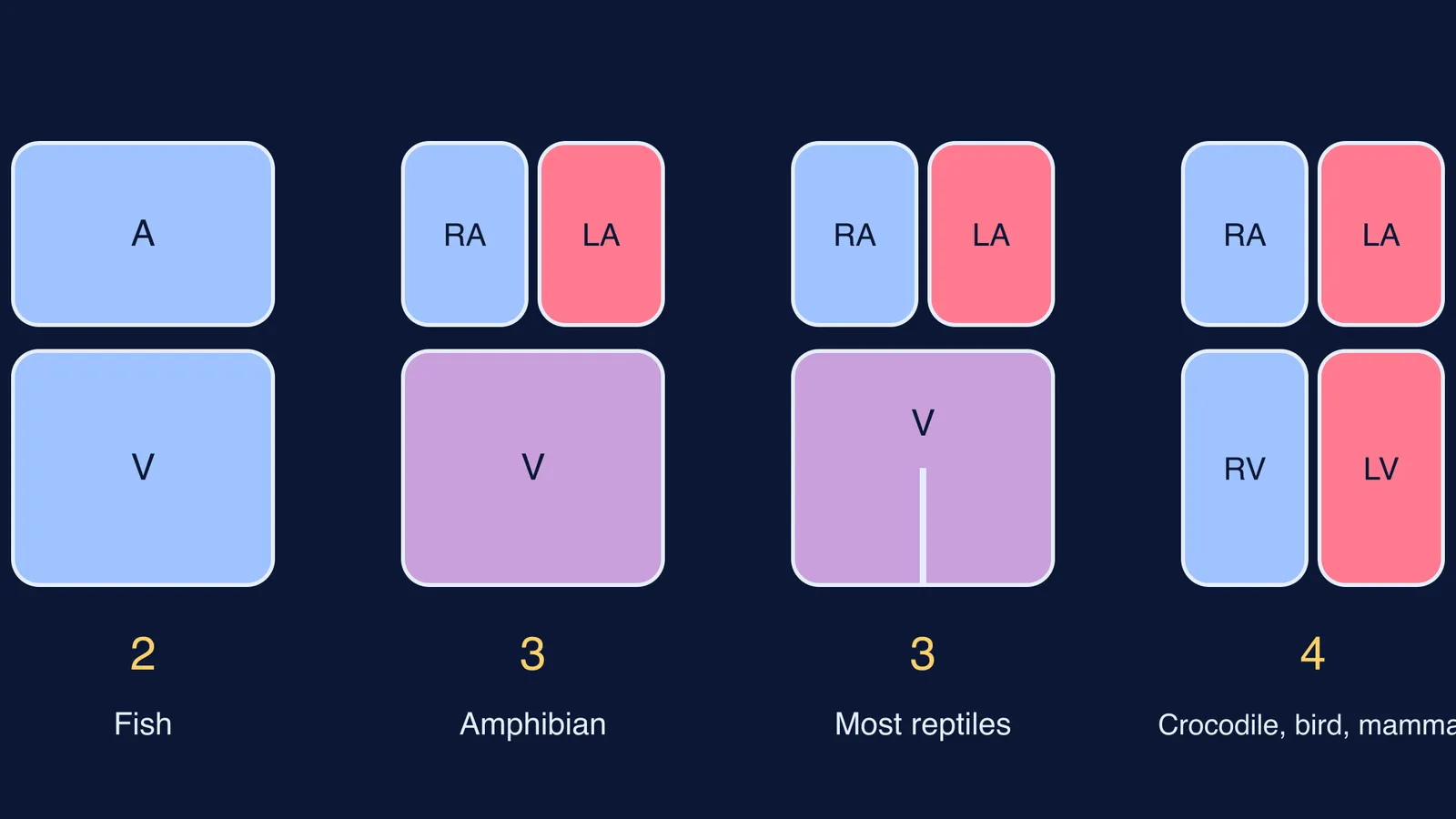
Fish: 2 chambers, one atrium and one ventricle.
Amphibians: 3 chambers, two atria and one ventricle.
Reptiles, except crocodiles: 3 chambers, two atria and one ventricle.
Crocodiles, birds and mammals: 4 chambers, two atria and two ventricles.
For the human heart, the same NCERT chapter calls the two smaller upper chambers atria and the two larger lower chambers ventricles. The atria receive blood coming into the heart, and the ventricles pump it out.
Why does the number of chambers matter?
The chamber count tells you whether oxygen-rich and oxygen-poor blood are kept apart. NCERT links each heart type to a circulation pattern.
Single circulation (fish): the heart pumps out deoxygenated blood, the gills oxygenate it, it goes to the body, and deoxygenated blood returns to the heart.
Incomplete double circulation (amphibians and most reptiles): the left atrium receives oxygenated blood from the gills, lungs or skin, and the right atrium receives deoxygenated blood from the body. The two mix in the single ventricle, which pumps out mixed blood.
Double circulation (birds and mammals): each side of the heart handles one kind of blood, and the ventricles pump it out without mixing, so there are two separate pathways.
A good way to remember it: count the ventricles, not the atria. One ventricle means blood can mix; two ventricles means the heart keeps the streams apart.
Do all reptiles really have a three-chambered heart?
For your exam, use the textbook answer: three chambers. The real anatomy is more varied.
A 2009 study in Nature by Koshiba-Takeuchi and colleagues compared developing hearts in the green anole lizard and the red-eared slider turtle. As the Tokyo Institute of Technology summary of the study explains, the anole has only one ventricle, while the turtle has two ventricles divided by an indistinct septum. The researchers linked the difference to where a gene called Tbx5 is switched on as the heart forms. In mice and humans, a mutated or missing Tbx5 gene disturbs the formation of the wall between the ventricles.
So most reptiles sit between the amphibian heart and the fully divided one, and the textbook counts their partly divided ventricle as one chamber.
Why is the crocodile the exception among reptiles?
Crocodiles, alligators and their relatives finish the job that other reptiles leave half done. According to a 2010 paper in the Journal of Experimental Biology by Eme and colleagues, crocodilians have complete anatomical separation between the right and left ventricles, similar to birds and mammals.
The twist is in the plumbing outside the heart. In crocodilians, a left aortic arch leaves the right ventricle alongside the pulmonary artery, and the two aortic arches are connected by an opening called the foramen of Panizza, as the same paper describes. When resistance in the lungs rises, blood from the right ventricle can be pushed into that left aorta and sent to the body instead of the lungs. This is called a right-to-left shunt.
Why crocodiles keep this ability is still debated. In the Eme study, juvenile alligators whose shunt was surgically removed grew almost as well as normal ones, which the authors read as a sign the trait may persist simply because it has not been selected against.
A two-minute recall drill
Do this from memory on a blank page, then check it.
Draw four small hearts in a row: fish, frog, lizard, crocodile.
Split each into atria on top and ventricles below: 1 plus 1, 2 plus 1, 2 plus 1 with a half wall, 2 plus 2.
Shade oxygen-poor blood blue, oxygen-rich blood red, and mixed blood purple.
Under each, write the circulation type: single, incomplete double, incomplete double, double.
Answer the check question below out loud, giving a reason for each option you rule out.
Worked check. In which of these does oxygenated and deoxygenated blood mix inside the ventricle: frog, pigeon, crocodile or rabbit? The answer is the frog, because amphibians have one ventricle. The pigeon and rabbit have four chambers. The crocodile is the distractor: a reptile, but with fully separated ventricles.
If the diagram still feels abstract, the Fermi Concept Library gives every concept in biology its own lesson and its place in the map. For practice, the Fermi Problem Library has worked problems with a step-by-step solver that explains the reasoning rather than printing an answer.
Redo the drill tomorrow without looking, and the crocodile will stop catching you out.


