On this page
Structural Organisation in Animals is short, so every line of the frog account can become a statement. Each statement below was checked against the NCERT Class 11 Biology chapter on Structural Organisation in Animals (2026-27 reprint). The NMC syllabus for NEET (UG)-2026 lists animal tissues and the frog's morphology and anatomy under Unit 2; the 2026-27 reprint covers tissues only briefly, in its opening pages and summary, so the tissue item stays inside those lines. For the wider unit plan, start with our Human Physiology for NEET preparation guide.
How do you answer assertion-reason questions?
Judge each statement on its own first. Only when both are true, ask: is R the direct reason NCERT gives for A? Two true facts about one frog are not automatically cause and effect.
Keys for every question:
Assertion-reason: (A) Both A and R are true and R is the correct explanation of A. (B) Both A and R are true but R is NOT the correct explanation of A. (C) A is true but R is false. (D) A is false but R is true.
Statement pairs: (A) Both statements are correct. (B) Both statements are incorrect. (C) Statement I is correct, Statement II is incorrect. (D) Statement I is incorrect, Statement II is correct.
Structural organisation in animals assertion-reason questions with answers
All facts below are from the NCERT Structural Organisation in Animals chapter.
Q1 (easy). Assertion (A): The skin of a frog feels smooth and slippery. Reason (R): Mucus is present on the frog's skin.
Answer: (A). Both are true, and NCERT states that the skin is smooth and slippery because of the mucus. Trap: suspecting a trick in an easy item and dropping to (B).
Q2 (easy). Assertion (A): Frogs are poikilotherms. Reason (R): Frogs keep their body temperature constant by aestivating in summer and hibernating in winter.
Answer: (C). A is true: a frog's body temperature varies with its surroundings. R is false: frogs have no constant body temperature, and aestivation and hibernation are periods spent sheltering in deep burrows from extreme heat and cold. Trap: treating any seasonal behaviour as temperature control.
Q3 (medium). Assertion (A): The alimentary canal of a frog is long. Reason (R): Frogs are carnivores.
Answer: (D). R is true, but A is false: NCERT says the canal is short, because a carnivore's intestine is reduced in length. Trap: seeing the correct link in your head and forgetting that it makes A false, not true.
Q4 (medium). Assertion (A): The red blood cells of a frog contain haemoglobin. Reason (R): The red blood cells of a frog are nucleated.
Answer: (B). Both are true, but having a nucleus is not why the cells carry haemoglobin. Trap: two correct facts about the same cell, joined by habit into cause and effect.
Q5 (hard). Assertion (A): The eyes of a frog are compound eyes. Reason (R): Among the frog's sense organs, only the eyes and internal ears are well-organised structures; the rest are cellular aggregations around nerve endings.
Answer: (D). R matches NCERT. A is false: frog eyes are simple eyes, possessing only one unit. Trap: reading "well-organised" in R and upgrading the eye to a compound eye.
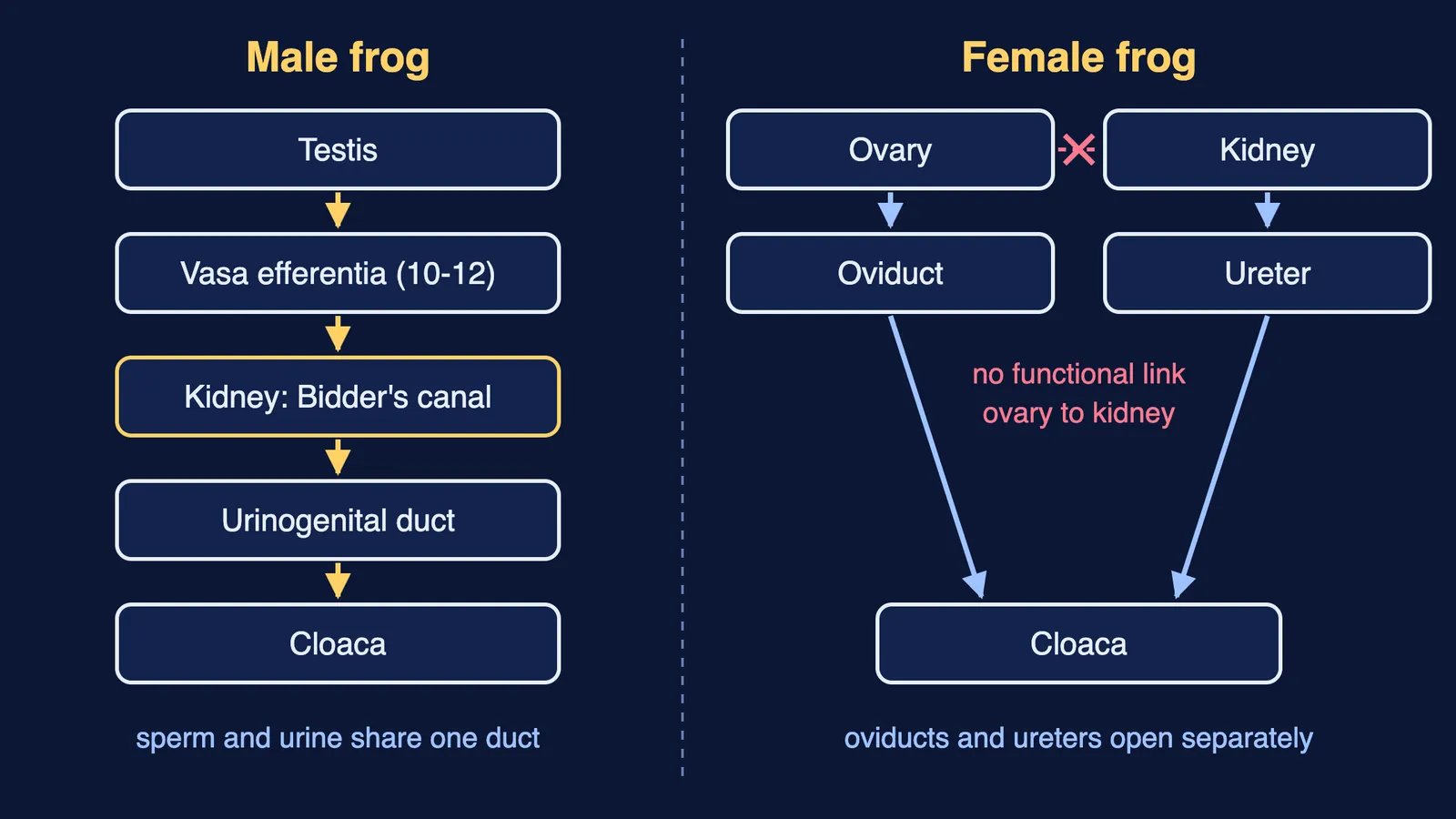
Q6 (hard). Assertion (A): In a female frog, the ureters do not carry ova. Reason (R): The ovaries have no functional connection with the kidneys, and the oviducts open separately into the cloaca.
Answer: (A). Both are true, and R is the reason: ova leave through the oviducts and never enter the kidneys. Contrast the male, where vasa efferentia enter the kidneys and the ureters act as urinogenital ducts. Trap: carrying the male route over to the female.
Statement I and Statement II questions on animal tissues and the frog
Same source: the NCERT chapter.
Q7 (easy). Statement I: The human heart contains all four basic types of tissue: epithelial, connective, muscular and neural. Statement II: Epithelia are sheet-like tissues with one free surface that faces a body fluid or the outside environment.
Answer: (A). Both lines follow NCERT: all complex animals have only four basic tissue types, the heart has all four, and epithelia have one free surface. Trap: thinking an organ is built from a single tissue.
Q8 (medium). Statement I: A frog never drinks water but absorbs it through its skin. Statement II: On land, a frog respires only through its lungs.
Answer: (C). Statement I is NCERT's own description. Statement II is wrong: on land the buccal cavity, skin and lungs all act as respiratory organs. Trap: linking "pulmonary" to "on land" and forgetting the skin keeps working.
Q9 (medium). Statement I: Male frogs have vocal sacs and a copulatory pad on the first digit of the hind limbs. Statement II: The hind limbs of a frog end in five digits, while the forelimbs end in four.
Answer: (D). The copulatory pad is on the first digit of the forelimbs, so Statement I is wrong. Statement II is correct. Trap: placing the pad on the larger, muscular limb.
Q10 (hard). Statement I: In a male frog, the 10-12 vasa efferentia carry sperm straight to the cloaca, bypassing the kidneys. Statement II: The optic lobes are part of the frog's forebrain.
Answer: (B). The vasa efferentia enter the kidneys and open into Bidder's canal, which leads to the urinogenital duct and then the cloaca. The optic lobes characterise the midbrain; the forebrain has the olfactory lobes, cerebral hemispheres and diencephalon. Trap: half-remembering a route and accepting a confident line.
How should you use this practice set?
Do all ten in one sitting, without notes.
For every miss, note which step failed: a false statement you believed, or a wrong cause-and-effect call.
Re-read the NCERT paragraph behind each miss, then draw the male and female urinogenital routes and the three brain regions from memory.
Retry the set after three days in a new order.
If one idea keeps slipping, such as which brain region holds the optic lobes, the Fermi Concept Library gives every concept in biology its own lesson, so you can rebuild it first. For the chapter as notes, read our structural organisation in animals guide for NEET, and for the method behind this format across subjects, see how to crack assertion-reason questions.